
Revolution Surfaces (Surfaces of Revolution) Dynamic Construction
Loading the math board and drawing, please wait…
In collections
geometriadinamica.es
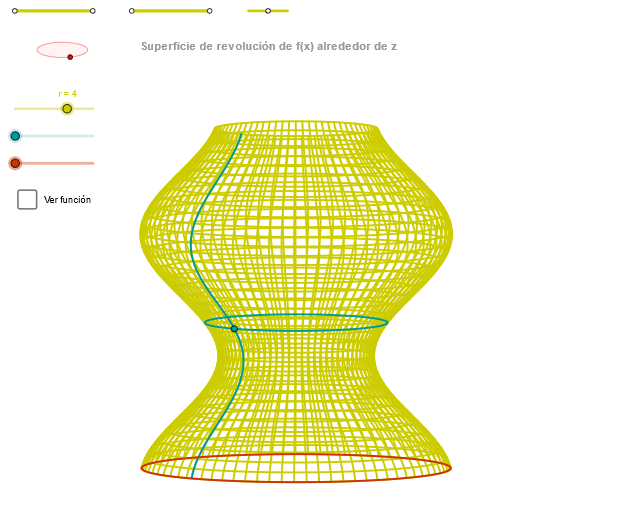
① This GeoGebra example dynamically demonstrates how a plane curve (such as an ellipse) rotates around an axis to generate a surface of revolution, visualizing the 3D shape of the rotated body. ② Core mathematical concepts include surfaces of revolution, parametric equations, space curves and surfaces, symmetry, and rotational properties of conic sections like ellipses. ③ Construction highlights: from the summary, commands such as Segment, Point, OrthogonalLine, Circle, Intersect, Ellipse, Angle, CurveCartesian, and Sequence are used, along with multiple auxiliary points (P1-P4, Q1-Q4), vectors (v1, v2, etc.), a rotation angle variable (zAngRot), and ellipse objects (zElipse1, zElipse2), with sequences generating the rotational traces. ④ Suitable for high school to university-level analytic geometry, solid geometry, or calculus courses, helping students understand the generation principle and parametric representation of surfaces of revolution, and serving as a visual teaching resource.
GeoGebra Commands & Parameters
Segment(Q3, Q4) → p2Point(p2) → P3Segment(P3, Q4) → p4Point(p4) → P4Segment(Q1, Q2) → p1Point(p1) → P1Segment(P1, Q2) → p3Point(p3) → P2OrthogonalLine(C, yAxis) → zz1Circle(C, 0.62) → zz0Intersect(zz0, zz1, 1) → ZZ1Intersect(zz0, zz1, 2) → ZZ2Ellipse(ZZ1, ZZ2, 0.65) → zElipse1Intersect(zElipse1, zz1) → ZZ5, ZZ6Point(zElipse1) → XYAngle(ZZ6, C, XY) → zAngRotOrthogonalLine(C, xAxis) → zz2Intersect(zz0, zz2, 2) → ZZ3Intersect(zz0, zz2, 1) → ZZ4Ellipse(ZZ3, ZZ4, 0.65) → zElipse2Intersect(zElipse2, zz2) → ZZ7, ZZ8Point(zElipse2) → ZAngle(ZZ8, C, Z) → zAngIncSegment(Q5, Q6) → p5Point(p5) → P5Segment(ZZ5, ZZ6) → zz4Segment(ZZ7, ZZ8) → zz3Intersect(zElipse2, zElipse1, 1) → zPunto1Intersect(zElipse2, zElipse1, 4) → zPunto2Segment(zPunto1, zPunto2) → zSeg2CurveCartesian((r / 4 * (((f(v) * cos(α)) * sin(zAngRot)) + ((f(v) * sin(α)) * cos(zAngRot)))), (r / 4 * (((((-f(v)) * cos(α)) * cos(zAngRot)) * sin(zAngInc)) + (((f(v) * sin(α)) * sin(zAngRot)) * sin(zAngInc)) + ((v - 4) * cos(zAngInc)))), v, v1, v2) → curva2Sequence(CurveCartesian[(r / 4 * (((f(v) * cos(u)) * sin(zAngRot)) + ((f(v) * sin(u)) * cos(zAngRot)))), (r / 4 * (((((-f(v)) * cos(u)) * cos(zAngRot)) * sin(zAngInc)) + (((f(v) * sin(u)) * sin(zAngRot)) * sin(zAngInc)) + ((v - 4) * cos(zAngInc)))), u, u1, u2], v, v1, v2, (3 * paso)) → list2CurveCartesian((r / 4 * (((f(4) * cos(u)) * sin(zAngRot)) + ((f(4) * sin(u)) * cos(zAngRot)))), (r / 4 * (((((-f(4)) * cos(u)) * cos(zAngRot)) * sin(zAngInc)) + (((f(4) * sin(u)) * sin(zAngRot)) * sin(zAngInc)))), u, u1, u2) → curva1CurveCartesian((r / 4 * (((f(β) * cos(u)) * sin(zAngRot)) + ((f(β) * sin(u)) * cos(zAngRot)))), (r / 4 * (((((-f(β)) * cos(u)) * cos(zAngRot)) * sin(zAngInc)) + (((f(β) * sin(u)) * sin(zAngRot)) * sin(zAngInc)) + ((β - 4) * cos(zAngInc)))), u, u1, u2) → a1CurveCartesian(f(t), t, t, -10, 10) → aSequence(CurveCartesian[(r / 4 * (((f(v) * cos(u)) * sin(zAngRot)) + ((f(v) * sin(u)) * cos(zAngRot)))), (r / 4 * (((((-f(v)) * cos(u)) * cos(zAngRot)) * sin(zAngInc)) + (((f(v) * sin(u)) * sin(zAngRot)) * sin(zAngInc)) + ((v - 4) * cos(zAngInc)))), v, v1, v2], u, u1, u2, paso) → list1
AI Drawing Prompt Reference
Draw a 3D surface of revolution showing how a plane ellipse rotates around an axis to form a solid. The figure includes two ellipses, rotation axes, intersection points, and rotation angle parameters, with parametric curves generating the surface outline. It illustrates the principle of surface generation and spatial curve relationships, suitable for geometry education.
The prompt above was compiled from the original drawing commands and is for reference only.