
Catenary: Parametric Curve and Geometric Construction
Loading the math board and drawing, please wait…
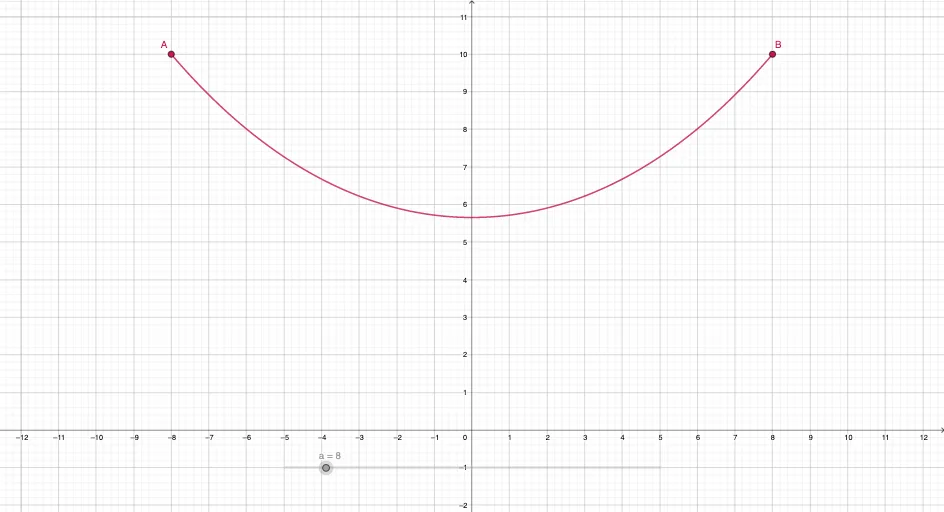
① This example demonstrates the generation of the catenary, a classic parametric curve representing the shape of a hanging chain or cable under uniform gravity. ② Core mathematical concepts include parametric equations, hyperbolic cosine (related to logarithmic and exponential functions), similar triangles, special points (such as the vertex), and optimization problems (e.g., minimizing arc length or potential energy). ③ Construction highlights: Based on the summary, objects A, B, a, and c are used; a and c likely serve as parameters or constants. The catenary is defined via GeoGebra's parametric curve command (e.g., Curve), with sliders or input boxes to adjust parameters. Similar triangles may be constructed to illustrate geometric relationships, and special points (like the lowest point) are marked, possibly with auxiliary circles or pie charts to show angles or proportions. ④ Suitable for high school to undergraduate mathematics education, especially for analytic geometry, calculus (derivatives and optimization), and physics (suspension bridges, cables), as well as for mathematical modeling and interactive visualization.
GeoGebra Commands & Parameters
(-8, 10)(8, 10)Numeric a(8)c(x) = If[-8 ≤ x ≤ 8, (a / 2 * (ℯ^(x / a) + ℯ^(((-x)) / a))) - (a / 2 * (ℯ^(8 / a) + ℯ^(-8 / a))) + 10]
AI Drawing Prompt Reference
Draw a catenary curve with parameter a=8, using the equation c(x) = (a/2 * (ℯ^(x/a) + ℯ^((-x)/a))) - (a/2 * (ℯ^(8/a) + ℯ^((-8)/a))) + 10 from x=-8 to x=8. Also, construct two vertical line segments at x=-8 and x=8 with height 10. Observe how the curve changes by adjusting the value of parameter a.
The prompt above was compiled from the original drawing commands and is for reference only.