
Castle del Monte - Central Building and Towers
Loading the math board and drawing, please wait…
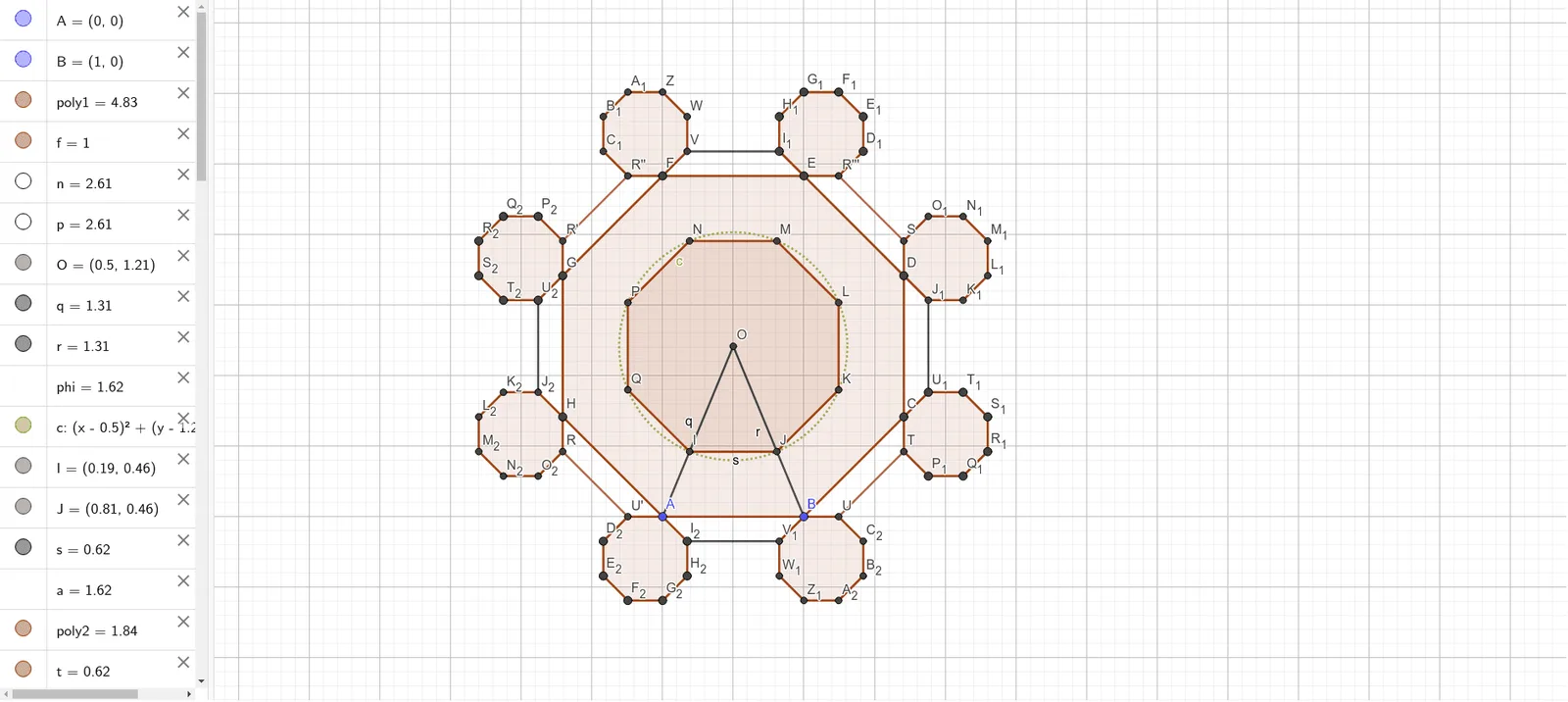
This example demonstrates the geometric construction of the central building and towers of Castle del Monte. Key mathematical concepts include polygons, equilateral triangles, and geometric constructions. Using GeoGebra commands such as Polygon, Distance, and Segment, precise geometric shapes can be constructed. Suitable for middle school and above students to learn geometric constructions and solid geometry.
GeoGebra Commands & Parameters
Polygon(A, B, 8) → poly1, f, D, E, F, G, H, g, h, i, j, k, l, m, CDistance(C, D) → CDSegment(F, B) → nSegment(E, A) → pIntersect(n, p) → OSegment(O, A) → qSegment(O, B) → rCircle(O, q / phi) → cIntersect(c, q) → I,Intersect(c, r) → J,Segment(I, J) → sPolygon(I, J, 8) → poly2, t, L, M, N, P, Q, b, d, e, f_1, g_1, h_1, i_1, KLine(O, f) → k_1OrthogonalLine(O, j) → l_1Line(I, J) → j_1Line(H, G) → m_1Intersect(j_1, m_1) → RMirror(R, k_1) → R'Line(N, M) → n_1Mirror(m_1, l_1) → p_1Intersect(n_1, p_1) → SIntersect(p_1, j_1) → TDistance(R, T) → RTDistance(T, S) → TSLine(R', k) → q_1Line(S, i) → r_1Line(T, g) → s_1Line(R, m) → t_1LineBisector(G, F) → a_1Mirror(R', a_1) → R''Mirror(R'', l_1) → R'''Mirror(R''', k_1) → UMirror(U, l_1) → U'Polygon(R'', R''', U, U') → q1, r'', r''', u, u'Segment(R', R'') → b_1Segment(R''', S) → c_1Segment(T, U) → d_1Segment(U', R) → e_1Polygon(R'', F, 8) → poly3, f_2, W, Z, A_1, B_1, C_1, g_2, h_2, i_2, j_2, k_2, l_2, m_2, VPolygon(E, R''', 8) → poly4, n_2, E_1, F_1, G_1, H_1, I_1, p_2, q_2, r_2, s_2, t_2, a_2, b_2, D_1Polygon(S, D, 8) → poly5, c_2, K_1, L_1, M_1, N_1, O_1, d_2, e_2, f_3, g_3, h_3, i_3, j_3, J_1Polygon(C, T, 8) → poly6, k_3, Q_1, R_1, S_1, T_1, U_1, l_3, m_3, n_3, p_3, q_3, r_3, s_3, P_1Polygon(U, B, 8) → poly7, t_3, W_1, Z_1, A_2, B_2, C_2, a_3, b_3, c_3, d_3, e_3, f_4, g_4, V_1Polygon(A, U', 8) → poly8, h_4, E_2, F_2, G_2, H_2, I_2, i_4, j_4, k_4, l_4, m_4, n_4, p_4, D_2Polygon(R, H, 8) → poly9, q_4, K_2, L_2, M_2, N_2, O_2, r_4, s_4, t_4, a_4, b_4, c_4, d_4, J_2Polygon(G, R', 8) → poly10, e_4, Q_2, R_2, S_2, T_2, U_2, f_5, g_5, h_5, i_5, j_5, k_5, l_5, P_2Segment(U_2, J_2) → m_5Segment(V, I_1) → n_5Segment(J_1, U_1) → p_5Segment(V_1, I_2) → q_5