
Brazilian Air Routes
Loading the math board and drawing, please wait…
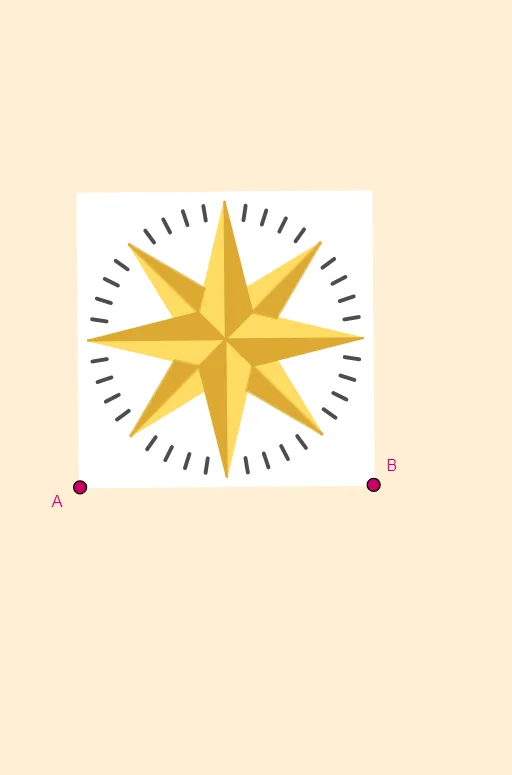
This example demonstrates the geometric representation of Brazilian air routes. Key mathematical concepts include geometric transformations, vectors, and polygons. Using GeoGebra commands such as LineBisector, Vector, and Polygon, complex geometric shapes can be constructed. Suitable for high school geometry courses.
GeoGebra Commands & Parameters
LineBisector(A, B) → mVector(A, B) → uOrthogonalVector(u) → vLineBisector(A, C) → dIntersect(m, d) → EMidpoint(C, A) → JOrthogonalLine(M, d) → iLine(A, B) → sOrthogonalLine(A, s) → bOrthogonalLine(I, b) → hMirror(h, d) → h'Intersect(m, h') → NMirror(F, m) → F'OrthogonalLine(C, v, xOyPlane) → fIntersect(f, m) → UMirror(i, m) → i'Intersect(h, m) → SOrthogonalLine(B, u, xOyPlane) → gIntersect(g, f) → DMirror(M, m) → M'Intersect(g, h') → A_1Polygon(A, B, D, C) → q11, a_3, b_2, d_2, c_3Mirror(F', E) → F''Mirror(F', E) → F''_1LaTeX(q11, true, true) → text1Line(C, E) → jMirror(j, m) → j'Circle(E, N) → cCircle(E, K) → eCircle(E, H) → kIntersect(e, j') → L, OIntersect(e, j) → P, RAngularBisector(j', m) → l, nMirror(n, m) → n'Mirror(l, d) → l'Intersect(k, n') → T, VIntersect(k, n) → W, ZIntersect(k, l') → B_1, C_1Intersect(k, l) → D_1, E_1Line(W, L) → pMirror(p, m) → p'Intersect(p, p') → F_1Polygon(F_1, E, L) → t1, l_1, f_1, e_1Mirror(F_1, E) → G_1Mirror(E, E) → E'Mirror(L, E) → L'Polygon(G_1, E', L') → t1', q, g_1, e'Mirror(F_1, m) → H_1Mirror(E, m) → E'_1Mirror(L, m) → L'_1Polygon(H_1, E'_1, L'_1) → t1'_1, l'_1, h_1, e'_1Mirror(H_1, E) → I_1Mirror(E'_1, E) → J_1Mirror(L'_1, E) → K_1Polygon(I_1, J_1, K_1) → t2, k_1, i_1, j_1Rotate(F_1, -90°, E) → L_1Rotate(E, -90°, E) → E'_2Rotate(L, -90°, E) → L'_2Polygon(L_1, E'_2, L'_2) → t1'_2, l'_2, r, e'_2Rotate(F_1, 90°, E) → M_1Rotate(E, 90°, E) → E'_3Rotate(L, 90°, E) → L'_3Polygon(M_1, E'_3, L'_3) → t1'_3, l'_3, m_1, e'_3Mirror(M_1, E) → N_1Mirror(E'_3, E) → O_1Mirror(L'_3, E) → P_1Rotate(I_1, 90°, E) → Q_1Rotate(J_1, 90°, E) → R_1Rotate(K_1, 90°, E) → S_1Polygon(Q_1, R_1, S_1) → t2', s_1, q_1, r_1Mirror(Q_1, E) → T_1Mirror(R_1, E) → U_1Mirror(S_1, E) → V_1Polygon(T_1, U_1, V_1) → t2'', v_1, t_1, u_1Intersect(c, j') → W_1, Z_1Intersect(c, j) → A_2, B_2Polygon(W, W_1, S_1) → t4, t, w, w_1Mirror(W, U_1) → W'Mirror(W_1, U_1) → C_2Mirror(S_1, U_1) → F_2Polygon(W', C_2, F_2) → t4', f_2, w', c_2Rotate(W, -90°, U_1) → W'_1Rotate(W_1, -90°, U_1) → G_2Rotate(S_1, -90°, U_1) → H_2Polygon(W'_1, G_2, H_2) → t4'_1, h_2, w'_1, g_2Mirror(W'_1, E) → I_2Mirror(G_2, E) → J_2Mirror(H_2, E) → K_2Polygon(I_2, J_2, K_2) → t5, k_2, i_2, j_2Polygon(S_1, B_1, W_1) → t6, a, a_1, b_1Mirror(S_1, E) → L_2Mirror(B_1, E) → M_2Mirror(W_1, E) → N_2Polygon(L_2, M_2, N_2) → t6', n_2, l_2, m_2Rotate(S_1, 90°, E) → O_2Rotate(B_1, 90°, E) → P_2Rotate(W_1, 90°, E) → Q_2Polygon(O_2, P_2, Q_2) → t6'_1, q_2, o_2, p_2Mirror(O_2, E) → R_2Mirror(P_2, E) → S_2Mirror(Q_2, E) → T_2Polygon(R_2, S_2, T_2) → t7, t_2, r_2, s_2Rotate(M, 9°, U_1) → M'_1Rotate(M'_1, 9°, U_1) → U_2Rotate(U_2, 9°, U_1) → V_2Rotate(V_2, 9°, E) → W_2Rotate(Z_2, 9°, U_1) → A_3Rotate(Z_2, 18°, U_1) → B_3Rotate(A_3, 18°, E) → C_3Rotate(B_3, 18°, U_1) → D_3Segment(M'_1, A_3) → n_1Segment(U_2, B_3) → p_1Segment(V_2, C_3) → c_1Segment(W_2, D_3) → d_1Mirror(M'_1, d) → E_3Mirror(A_3, d) → F_3Segment(E_3, F_3) → a_2Mirror(U_2, d) → G_3Mirror(B_3, d) → H_3Segment(G_3, H_3) → e_2Mirror(V_2, d) → I_3Mirror(C_3, d) → J_3Segment(I_3, J_3) → f_3Mirror(W_2, d) → K_3Mirror(D_3, d) → L_3Segment(K_3, L_3) → g_3Mirror(M'_1, m) → M_3Mirror(A_3, m) → N_3Segment(M_3, N_3) → h_3Mirror(U_2, m) → O_3Mirror(B_3, m) → P_3Segment(O_3, P_3) → i_3Mirror(V_2, m) → Q_3Mirror(C_3, m) → R_3Segment(Q_3, R_3) → j_3Mirror(W_2, m) → S_3Mirror(D_3, m) → T_3Segment(S_3, T_3) → k_3Mirror(E_3, m) → U_3Mirror(F_3, m) → V_3Segment(U_3, V_3) → l_3Mirror(G_3, m) → W_3Mirror(H_3, m) → Z_3Segment(W_3, Z_3) → m_3Mirror(I_3, m) → A_4Mirror(J_3, m) → B_4Segment(A_4, B_4) → n_3Mirror(K_3, m) → C_4Mirror(L_3, m) → D_4Segment(C_4, D_4) → p_3Mirror(M'_1, j') → E_4Mirror(A_3, j') → F_4Segment(E_4, F_4) → q_3Mirror(U_2, j') → G_4Mirror(B_3, j') → H_4Segment(G_4, H_4) → r_3Mirror(V_2, j') → I_4Mirror(C_3, j') → J_4Segment(I_4, J_4) → s_3Mirror(W_2, j') → K_4Mirror(D_3, j') → L_4Segment(K_4, L_4) → t_3Mirror(E_4, m) → M_4Mirror(F_4, m) → N_4Segment(M_4, N_4) → b_3Mirror(G_4, m) → O_4Mirror(H_4, m) → P_4Segment(O_4, P_4) → d_3Mirror(I_4, m) → Q_4Mirror(J_4, m) → R_4Segment(Q_4, R_4) → e_3Mirror(K_4, m) → S_4Mirror(L_4, m) → T_4Segment(S_4, T_4) → f_4Mirror(E_4, d) → U_4Mirror(F_4, d) → V_4Segment(U_4, V_4) → g_4Mirror(G_4, d) → W_4Mirror(H_4, d) → Z_4Segment(W_4, Z_4) → h_4Mirror(I_4, d) → A_5Mirror(J_4, d) → B_5Segment(A_5, B_5) → i_4Mirror(K_4, d) → C_5Mirror(L_4, d) → D_5Segment(C_5, D_5) → j_4Mirror(M_4, d) → E_5Mirror(N_4, d) → F_5Segment(E_5, F_5) → k_4Mirror(O_4, d) → G_5Mirror(P_4, d) → H_5Segment(G_5, H_5) → l_4Mirror(Q_4, d) → I_5Mirror(R_4, d) → J_5Segment(I_5, J_5) → m_4Mirror(S_4, d) → K_5Mirror(T_4, d) → L_5Segment(K_5, L_5) → n_4
AI Drawing Prompt Reference
Draw a geometric representation of Brazilian air routes, showcasing geometric transformations, vectors, and polygons. Start by constructing the perpendicular bisector of segment AB and vector AB, then create a orthogonal vector. Use midpoint, orthogonal lines, and mirror operations to form complex shapes, including polygons and circles. The final image features multiple polygons and circles, highlighting the details and aesthetics of geometric construction.
The prompt above was compiled from the original drawing commands and is for reference only.