
2D Vectors and Geometric Constructions
Loading the math board and drawing, please wait…
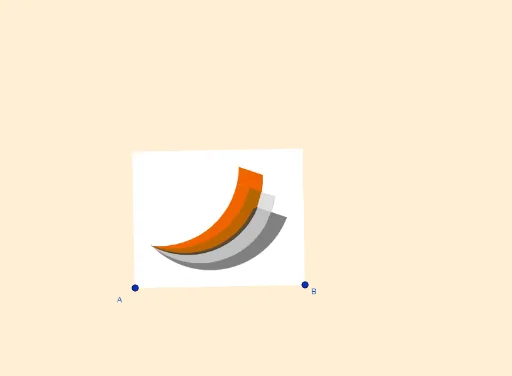
This example demonstrates the process of constructing complex geometric figures using 2D vectors and basic elements like circles, squares, and equilateral triangles. Key math concepts include vector operations, linear regression, polygon construction, and geometric transformations. Construction highlights involve commands like LineBisector, Vector, OrthogonalVector, Line, OrthogonalLine, Mirror, Intersect, Polygon, CircumcircleArc, and Midpoint, as listed in the construction summary. Suitable for high school and above learners to understand the integration of vectors, geometric transformations, and computational geometry.
GeoGebra Commands & Parameters
LineBisector(A, B) → mVector(A, B) → uOrthogonalVector(u) → vLineBisector(A_1, A) → lLine(A, B) → sOrthogonalLine(Q, s) → qMirror(q, m) → q'OrthogonalLine(D, s) → iIntersect(i, l) → PMirror(i, m) → i'Intersect(i', l) → HOrthogonalLine(A, s) → bOrthogonalLine(J, b) → pIntersect(q', p) → L_1Line(H, L_1) → aLine(I, a) → f_1OrthogonalLine(F, b) → fIntersect(i, f) → RLineBisector(R, P) → nIntersect(n, i) → TMirror(f, l) → f'Intersect(m, f') → SLine(K_1, f_1) → g_1Mirror(f, l) → f'_1Intersect(q', f'_1) → KOrthogonalLine(N, f') → hIntersect(h, g_1) → VOrthogonalLine(A_1, b) → rIntersect(i, f') → EOrthogonalLine(K_1, f'_1) → n_1Intersect(m, l) → LOrthogonalLine(B, u, xOyPlane) → gIntersect(g, r) → CMirror(F, l) → F'Polygon(A_1, C, B, A) → c4, a_1, c_3, b_2, a_2Intersect(i', f') → WMirror(p, l) → p'Intersect(i', f) → G_1Intersect(m, f) → GLine(H, L_1) → jLine(I, j) → kIntersect(h, k) → MCircumcircleArc(T, G, H) → cCircumcircleArc(T, U, I) → dCircumcircleArc(T, L, K_1) → tIntersect(t, f_1) → Z,CircumcircleArc(T, O, V) → eIntersect(e, f_1) → B_1,Midpoint(Z, B_1) → C_1Midpoint(L, O) → D_1CircumcircleArc(T, D_1, C_1) → c_1Intersect(d, a) → E_1,Intersect(e, a) → F_1,Vector(H, E_1) → wPolygon(K_1, V, B_1, C_1, T) → poly1, k_1, v_1, b_1, h_1, t_1CircumcircleArc(T, I_1, J_1) → p_1CircumcircleArc(T, O, F_1) → q_1Polygon(K_1, V, B_1, Z) → q1, i_1, v_2, j_1, z_1Intersect(t, a) → H_1,Polygon(C_1, Z, H_1) → t1, l_1, m_1, z_2Polygon(B_1, I, E_1, F_1) → q2, r_1, i_2, s_1, f_2Intersect(d, p') → M_1,Polygon(H, E_1, M_1) → t2, g_2, h_2, j_2