
Yatko Conjecture F: Interactive Exploration of Quadrilaterals and Geometric Prob
Loading the math board and drawing, please wait…
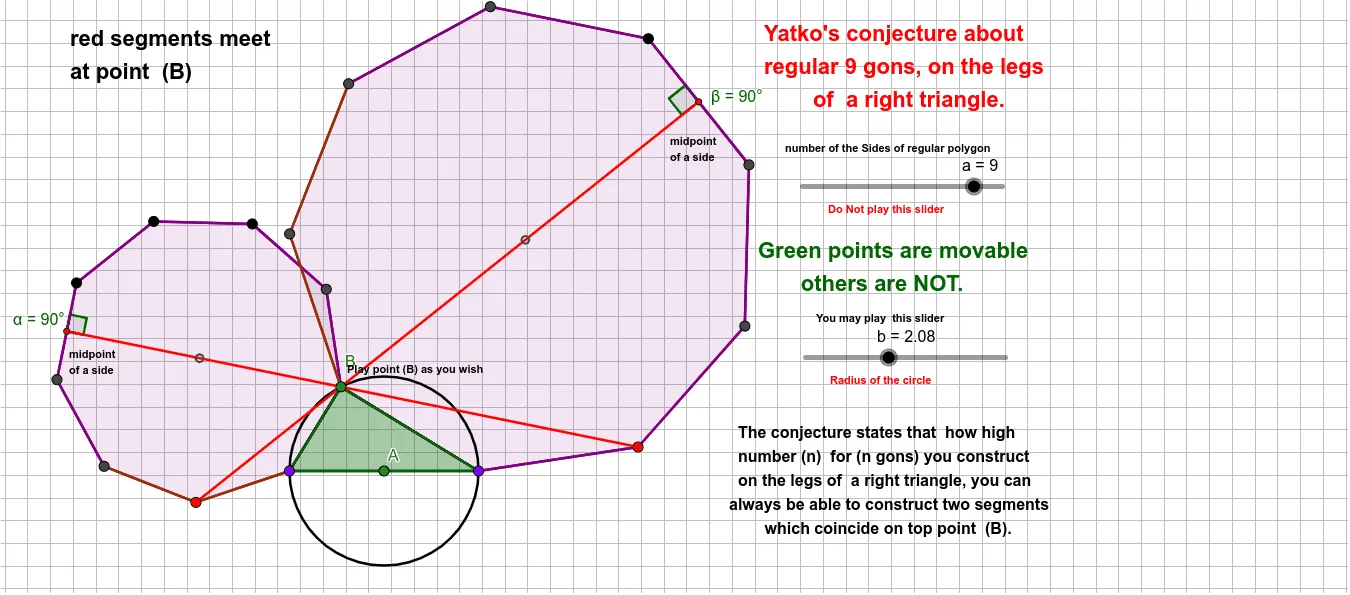
This GeoGebra example demonstrates a geometric construction named 'Yatko Conjecture F', involving quadrilaterals, circles, polygons, and various geometric transformations intertwined with probability distributions. Core mathematical concepts include general quadrilaterals, the Pythagorean theorem, geometric distribution, hypergeometric distribution, conditional probability, expected value, inequalities, and geometric transformations. Construction highlights: based on the summary, the example uses GeoGebra commands such as Circle, Point, Segment, Polygon, PointIn, Centroid, Midpoint, and Angle, creating multiple points (A, B, C, D, E, F, G, H, I, J, Q, R), segments (a, b, c, f, g, h, etc.), polygons (poly1, poly2), and auxiliary objects (l_1, m_1, etc.), with relationships built via midpoints, centroids, and angles. Suitable for high school to university-level mathematics, this resource supports interdisciplinary teaching of geometry and probability/statistics, encouraging students to test conjectures, analyze shape properties, and explore connections with random distributions.
GeoGebra Commands & Parameters
Circle(A, b) → cPoint(c) → BPoint(c) → CPoint(c) → DSegment(C, D) → fSegment(B, C) → gSegment(B, D) → hPolygon(C, B, a) → poly1, i, m_1, E, F, G, H, I, J, Q, R, j, k, l, m, n, p, q, l_1Polygon(B, D, a) → poly2, r, p_1, K, L, M, N, O, P, S, T, s, t, d, e, f_1, g_1, h_1, n_1Segment(R, N) → q_1Polygon(C, B, D) → t1, d_1, c_1, b_1PointIn(t1) → Pointt1Centroid(poly1) → F_1Centroid(poly2) → G_1PointIn(poly1) → Pointpoly1_{1}PointIn(poly2) → Pointpoly2_{1}PointIn(poly1) → Pointpoly1PointIn(poly2) → Pointpoly2Midpoint(N, M) → USegment(Q, U) → i_1Midpoint(H, I) → VSegment(K, V) → j_1Angle(B, V, H) → αAngle(N, U, B) → β
AI Drawing Prompt Reference
Draw a quadrilateral ABCD, connect the diagonals BD, then draw two triangles BCA and BDA, and find their circumcircles, marking points E, F, G, H, I, J, Q, R on the circles. Next, determine the centroids F1 of quadrilateral BCD and G1 of quadrilateral BDA, then connect point R and point N, and point Q and point U, where point U is the midpoint of N and M, and point V is the midpoint of H and I.
The prompt above was compiled from the original drawing commands and is for reference only.