
3D Construction for a Torus–Sphere Relation Theorem
Loading the math board and drawing, please wait…
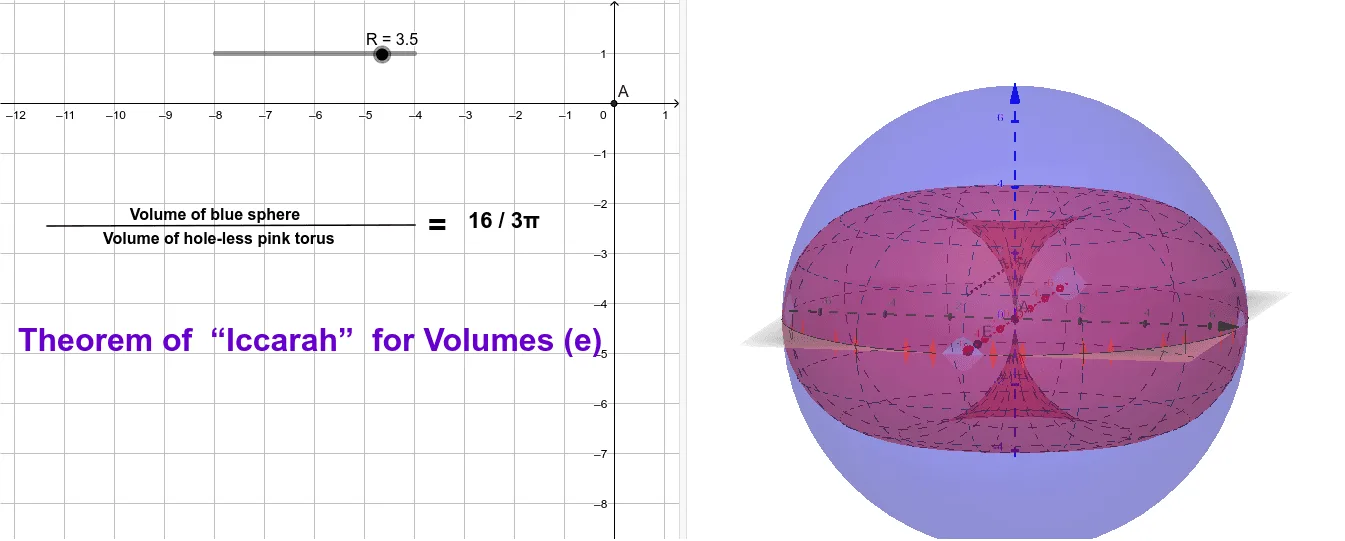
This example demonstrates, through an interactive 3D construction, the geometric relationship embodied in a torus–sphere relation theorem. It highlights core ideas from solid geometry (sphere and related surfaces), geometric transformations using angular parameters, and geometric measurement concepts that connect to expressions involving logarithmic functions and volume/metric-type quantities. The construction is built in GeoGebra by using Intersect and Point to create key intersection points, Surface and Sphere to generate the main curved geometries, and Segment to form constraint edges between significant points. Parameters such as radius-like R together with angles (θ, φ and variants like theta1, phi1) govern the spatial configuration, while labeled points (A, E, F, G, B, C, D, H) and text objects (text1–text4) present the theorem’s symbols and the resulting relationship. Suitable for advanced high-school students, contest-oriented geometry learners, and early undergraduate audiences who want to visualize how 3D geometric relationships translate into computable, observable functional/metric dependencies.
GeoGebra Commands & Parameters
Intersect(zAxis, yAxis) → APoint(xAxis) → ESurface((sin(theta) * (R + (R * cos(phi)))), (cos(theta) * (R + (R * cos(phi)))), (R * sin(phi)), theta, 0, theta1, phi, 0, phi1) → bSphere(A, (2 * R)) → aSegment(D, H) → f
AI Drawing Prompt Reference
Create a 3D geometric construction illustrating a torus-sphere relation theorem. Start by placing the origin at the center of a sphere, and mark a point on the x-axis. Draw a sphere centered at the origin with radius twice R. Then generate a torus using parametric equations with radii R and angles theta and phi, limited to specified ranges. Identify key intersection points on the torus and connect them with line segments to form constraint edges. Finally, add text labels to denote the theorem's symbols and relationships, making the geometric transformation and metric dependencies visible.
The prompt above was compiled from the original drawing commands and is for reference only.