
Composite Construction of Tangent Function and Cylinder Geometry (Part 3)
Loading the math board and drawing, please wait…
In collections
Exploration: One Special Constant
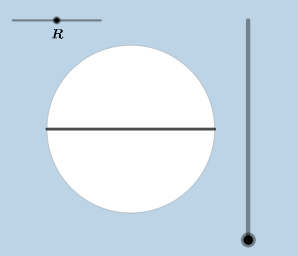
① This example demonstrates a dynamic geometric system in GeoGebra that combines the tangent function graph with rectangles, line segments, and cylinders through transformations such as rotation, reflection, and translation. ② Core mathematical concepts include the properties of the tangent function, geometric mean, cylindrical solid geometry, and intersections of lines and circles. ③ Construction highlights: Based on the construction summary, commands used include Rotate, CircleArc, Mirror, Line, Intersect, Angle, Segment, Circle, OrthogonalLine, Point, Vector, Dilate, Translate, Ray, and If, involving objects like M, a, r, N, N', c, c', C, C', C''₁, O, t, g₁, H, h, i, D, β, D', D'', s₁, t₁, R, H', R', H'', C'', n₂, p₂, q₂, U, eq1, f, B, B'₂, b, f₁, d₁, I, J, forming a complex network of geometric relations. ④ Suitable for high school or college students studying trigonometry and geometric transformations, useful for exploring interactions between tangent functions and solid geometry, and as a teaching demonstration of dynamic mathematical models.
GeoGebra Commands & Parameters
Rotate(N, If[1 < a ≤ 2, (-(a - 1)), -1], M) → N'CircleArc(M, N', N) → cMirror(c, yAxis) → c'Rotate(C, If[1 < a ≤ 2, (-(a - 1)), -1], N') → C'Rotate(C', -2, M) → C''_{1}Rotate(C''_{1}, -2, M) → OLine(O, C''_{1}) → tLine(M, t) → g_1Intersect(c', g_1) → H,Line(C', C''_{1}) → hLine(M, h) → iIntersect(c, i, 1) → DAngle(D, M, H) → βRotate(D, If[5 < a ≤ 6, ((a - 5) * β), β], M) → D'Mirror(D', M) → D''Segment(D', D'') → s_1Circle(H, s_1 / 7) → t_1Intersect(t_1, s_1, 1) → RMirror(H, R) → H'Mirror(R, H') → R'Mirror(H', R') → H''Mirror(C', yAxis) → C''Line(M, C'') → n_2OrthogonalLine(C'', n_2) → p_2Line(M, p_2) → q_2Point(q_2) → USegment(((-r), 0), (r, 0)) → fRotate(B, If[7.5 < a ≤ 8.5, ((-(a - 7.5)) * 2), -2], (0, 0)) → B'_{2}Line((0, 0), B'_{2}) → bOrthogonalLine(B'_{2}, b) → f_1Circle((0, 0), r) → d_1Vector(I, J) → vRotate((r, 0), 1, (0, 0)) → KRotate((r, 0), 3, (0, 0)) → LMirror(K, y = 0) → K'Dilate(M, If[0 < a ≤ 1, 1 - a, 0], N) → M'Vector(M, M') → wTranslate(f, w) → f'_{2}Mirror(N', yAxis) → N''Mirror(A, yAxis) → A'Circle(N', r - c) → dSegment(N', C') → gMirror(N', yAxis) → N''_{1}Segment(N''_{1}, C'') → g'Rotate(C', -1, M) → C''_{2}Angle(B, M, D) → αRotate(B, If[2 < a ≤ 3, ((a - 2) * α), α], M) → B'Mirror(B', M) → B''Segment(B'', B') → jDilate(M, If[3 < a ≤ 4, 4 - a, 0], C''_{2}) → M'_{1}Vector(M, M'_{1}) → uTranslate(B'', u) → B'''Translate(B', u) → B''_{1}Segment(B''', B''_{1}) → j'Rotate(C''_{2}, If[4 < a ≤ 5, a - 4, 1], M) → ERotate(C''_{2}, If[4 < a ≤ 5, (-(a - 4)), -1], M) → FCircleArc(M, C''_{2}, E) → eCircleArc(M, F, C''_{2}) → kCircle(E, j / 2 - e) → pLine(M, E) → lOrthogonalLine(E, l) → mRotate(M, ((-pi)) / 2, E) → M'_{2}Ray(E, M'_{2}) → nIntersect(p, n, 1) → GRotate(M, pi / 2, E) → M'_{3}Segment(E, G) → qLine(M, C''_{2}) → sMirror(E, s) → E'Mirror(G, s) → G'Segment(E', G') → q'Rotate(C''_{1}, -1, M) → PSegment(D', D'') → h_1Dilate(M, If[6 < a ≤ 7, 7 - a, 0], P) → M'_{4}Vector(M, M'_{4}) → u_1Translate(D', u_1) → D''_{1}Translate(D'', u_1) → D'''Segment(D''_{1}, D''') → i_1Rotate(P, If[7 < a ≤ 8, a - 7, 1], M) → P'Line(M, P) → j_1Mirror(P', j_1) → P''CircleArc(M, P, P') → c_1CircleArc(M, P'', P) → e_1Circle(P', h_1 / 2 - c_1) → k_1Circle(P'', h_1 / 2 - c_1) → p_1Line(M, P') → l_1OrthogonalLine(P', l_1) → m_1Rotate(M, ((-pi)) / 2, P') → M'_{5}Ray(P', M'_{5}) → n_1Intersect(k_1, n_1) → Q, WSegment(P', Q) → q_1Mirror(Q, j_1) → Q'Segment(P'', Q') → r_1Mirror(R', H'') → R''Mirror(H'', R'') → H'''Mirror(R'', H''') → R'''Dilate(H, If[8 < a ≤ 9, 9 - a, 0], R) → H'_{1}Segment(H, H'_{1}) → a_1Rotate(H, If[9 < a ≤ 10, ((a - 9) * pi), pi], R) → H'_{2}Segment(R, H'_{2}) → b_1Rotate(R, If[10 < a ≤ 11, ((a - 10) * pi), pi], H') → R'_{1}Segment(H', R'_{1}) → f_2Rotate(H', If[11 < a ≤ 12, ((a - 11) * pi), pi], R') → H''_{1}Segment(R', H''_{1}) → g_2Rotate(R', If[12 < a ≤ 13, ((a - 12) * pi), pi], H'') → R''_{1}Segment(H'', R''_{1}) → h_2Rotate(H'', If[13 < a ≤ 14, ((a - 13) * pi), pi], R'') → H'''_{1}Segment(R'', H'''_{1}) → i_2Rotate(R'', If[14 < a ≤ 15, ((a - 14) * pi), pi], H''') → R'''_{1}Segment(H''', R'''_{1}) → j_2Line(M, C'') → k_2Angle(U, M, H'') → γDilate(H'', If[15.5 < a ≤ 16.5, 16.5 - a, 0], C'') → H'''_{2}Vector(H'', H'''_{2}) → v_1Dilate(R', If[15.5 < a ≤ 16.5, 16.5 - a, 0], C'') → R''_{2}Vector(R', R''_{2}) → w_1Translate(R', w_1) → R''_{3}Translate(H''_{1}, w_1) → SSegment(R''_{3}, S) → l_2Rotate(R''_{3}, If[15.5 < a ≤ 16.5, ((-(a - 15.5)) * γ), (-γ)], R''_{2}) → TRotate(S, If[15.5 < a ≤ 16.5, ((-(a - 15.5)) * γ), (-γ)], R''_{2}) → S'Segment(T, S') → m_2Rotate(C'', If[16.5 < a ≤ 17.5, ((a - 16.5) * 0.28), 0.28], M) → C'''CircleArc(M, C'', C''') → c_2Circle(C''', (0.14 * s_1) - c_2) → d_2Line(C''', M) → r_2OrthogonalLine(C''', r_2) → s_2Rotate(M, ((-pi)) / 2, C''') → M'_{6}Ray(C''', M'_{6}) → t_2Intersect(d_2, t_2, 1) → VSegment(C''', V) → a_2If(8 < a ≤ 15, 0.75, 0.25) → o_1
AI Drawing Prompt Reference
Create a dynamic geometric system combining a tangent function graph, rectangles, line segments, and cylinders through transformations like rotation, reflection, and translation. Highlight the properties of the tangent function, geometric mean, cylindrical solid geometry, and intersections of lines and circles. Start by drawing the tangent function graph, then create related rectangles and line segments, generate cylinders through rotations and reflections, and finally display the dynamic relationships between all geometric elements.
The prompt above was compiled from the original drawing commands and is for reference only.