
Volume Ratio of a Tetrahedron to a Cube (3D Visualization)
Loading the math board and drawing, please wait…
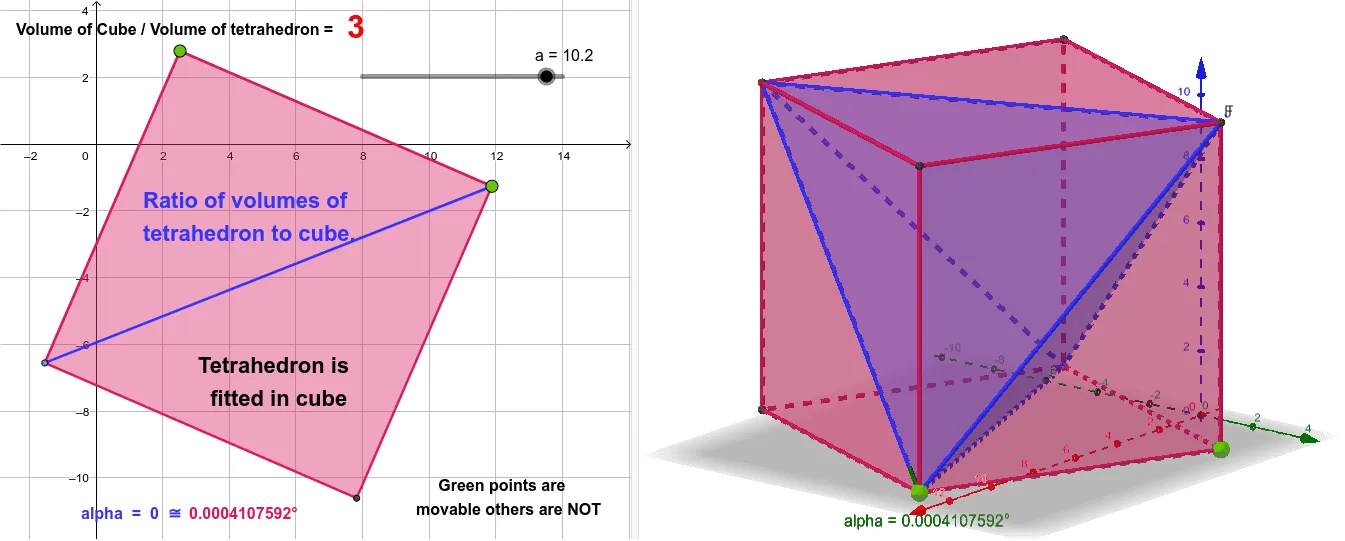
This example constructs a tetrahedron associated with a cube and visualizes the ratio of their volumes, emphasizing how a geometric setup leads to a computable (often fixed) rational relationship. The key math ideas are solid-geometry volume ratios, the geometric relationship between a tetrahedron and a cube, angle-based constraints, and the structural character of equilateral/regular tetrahedral configurations. In GeoGebra, the construction starts by creating and locating points with Point, Segment, and PointIn, then generating 3D solids using Cube and Tetrahedron. Angle objects are used to define or monitor the critical angular conditions that place the tetrahedron correctly relative to the cube. The provided construction summary highlights commands/objects such as Cube, Tetrahedron, Angle, and point/edge/face entities like faceABDC, faceBDHE, and the various edge objects (edgeAB, edgeAC, edgeBD, edgeCD, edgeBE, edgeDH, edgeEH, edgeEF, edgeAF, edgeFG, edgeCG, edgeGH), which together establish the exact 3D configuration needed for the volume-ratio reasoning. Suitable for middle school to early undergraduate solid geometry, classroom exploration, and learning-by-modeling activities.
GeoGebra Commands & Parameters
PointIn(Sphere[A, a]) → BSegment(A, B) → fPoint(Circle[A, Distance[B, A], Segment[B, A]]) → CCube(B, A, C) → b, D, faceCDHG, faceEFGH, edgeBD, edgeAB, edgeAC, edgeCD, edgeBE, edgeDH, edgeEH, edgeEF, E, edgeAF, edgeFG, edgeCG, edgeGH, F, G, H, faceABDC, faceBDHE, faceABEF, faceACGFPoint(Circle[Midpoint[B, C], (Distance[B, C] * sqrt(3) / 2), Segment[B, C]]) → ITetrahedron(B, C, I) → c, J, edgeIJ, edgeCJ, faceBCI, faceBIJ, faceBCJ, faceCIJ, edgeBI, edgeBC, edgeCI, edgeBJAngle(H, B, I) → alpha
AI Drawing Prompt Reference
Create a 3D scene with a cube defined from three related points, using the given roles of A, B, and C to position the cube and show its faces and edges. Then construct a tetrahedron whose vertices are B, C, and an additional point I placed according to the circle-based relation involving the midpoint of BC and the scaled distance between B and C. Display the tetrahedron’s edges and faces together with the cube. Finally, include an angle measure labeled alpha using the three points H, B, and I to highlight the key angular condition that positions the tetrahedron relative to the cube for comparing their volume ratio.
The prompt above was compiled from the original drawing commands and is for reference only.