
Odd or Even: Interactive Integer Parity with Conditional Logic
Loading the math board and drawing, please wait…
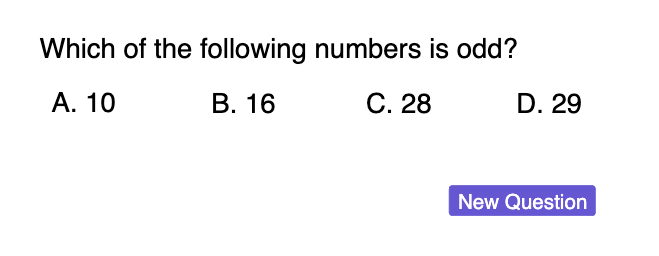
This GeoGebra example randomly generates integers and asks learners to decide whether each number is odd or even, then immediately displays the relevant set membership and feedback. It highlights the observable phenomenon of parity: every integer belongs to either the odd set or the even set. Key math concepts include integer parity, the odd/even partition of integers, and the divisibility-by-2 idea expressed through conditional logic. Construction details: Shuffle and Random are used to select values among objects a, b, c, d, e, f; If provides branching to test the parity condition; Element is used to extract the matching object (evenelement or oddelement) from evenset and oddset. Interactive elements such as button1, whichiseven, whichisodd, together with question text and options (opt1–opt4), drive the user’s choice, while correctans and feedbackvisible control whether the correct answer and feedback text (e.g., text1–text6) are shown. Best suited for elementary to early secondary education, or for classroom practice and quick formative assessment on parity and divisibility.
GeoGebra Commands & Parameters
Shuffle(Union[oddset, evenelement]) → whichiseven, {29, 5, 10, 17}Shuffle(Union[evenset, oddelement]) → whichisodd, {10, 16, 28, 29}Random(0, 1) → rIf(r ≟ 1, whichiseven, whichisodd) → questionIf(r ≟ 1, "Which of the following numbers is even?", "Which of the following numbers is odd?") → text1Element(question, 1) → opt1Element(question, 2) → opt2Element(question, 3) → opt3Element(question, 4) → opt4If(r ≟ 1, Element[evenelement, 1], Element[oddelement, 1]) → correctansIf(opt4 ≟ correctans, "You are correct.", "Try again!") → text6
AI Drawing Prompt Reference
Design an interactive integer parity checking interface. The interface includes randomly generated integers, an odd set, and an even set. Users can choose a question via a button, and the system displays the correct answer and feedback based on parity. The construction order is to first create the odd and even sets, then generate random integers, add interactive elements, and finally implement conditional logic to show feedback.
The prompt above was compiled from the original drawing commands and is for reference only.