
The 8th Set of Nets: Ellipse Construction with Conditional Probability Visualiza
Loading the math board and drawing, please wait…
In collections
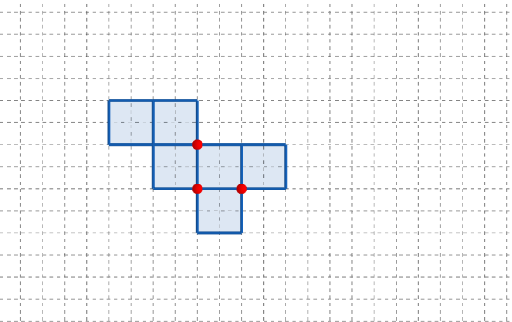
How many nets of a cuboid are there?
This GeoGebra example demonstrates an “8th set of nets” style construction that generates a structured geometric layout (curves/polygons) and connects it to a bar-chart style display to give an intuitive sense of how probability is distributed under a condition. The key math ideas are conditional probability (expressed via grouped counts or weights), organization using natural-number indexing, and ellipse-related geometry. Construction is driven by GeoGebra commands and objects: Point to define the critical vertices (e.g., A, B, C and auxiliary points), Polygon to build the net-like shapes from those vertices (including labeled points such as q1–q6 and their variants q2', q4', q5'), and Rotate to create repeated/symmetric structures through rotational transformation (using parameters like t and t'). The resulting visualization is well-suited for upper-secondary students, math club activities, and lessons that combine dynamic geometry with probability/statistics reasoning.
GeoGebra Commands & Parameters
Point(Ray[(1, 0), (3, 0)]) → APoint(Ray[A + (1, 0), A + (2, 0)]) → CPoint(Ray[A + (0, 1), A + (0, 2)]) → BPolygon({(0, 0), A, B, (0, y(B))}) → q1Polygon({A, C, (x(C), y(B)), B}) → q2Polygon({A, A - (0, l), A + (h, (-l)), C}) → q3Polygon({B, B + (0, h), B + ((-l), h), B + ((-l), 0)}) → q4Polygon({C, C + (l, 0), C + (l, w), C + (0, w)}) → q5Polygon({(0, w), (0, w + h), ((-w), w + h), ((-w), w)}) → q6Rotate(q4, (90° * t), Line[(0, w), B]) → q4'Rotate(q2, (90° * t), Line[B, A]) → q2'Rotate(Rotate[q5, (90° * t), Line[C + (0, w), C]], (90° * t), Line[B, A]) → q5'Rotate(Rotate[q6, (90° * t), Line[(0, w), (0, w + h)]], (90° * t), Line[(0, w), B]) → q6'Rotate(Rotate[q3, (90° * t), Line[C, A]], (90° * t), Line[B, A]) → q3'
AI Drawing Prompt Reference
Create an “8th set of nets” style geometry probability visualization. First place three key vertices: a start point A from a horizontal ray, then determine B and C using rays in perpendicular directions from A so that B sets a vertical scale and C sets a horizontal direction. Build a connected net of polygonal faces using these points: form q1 from a base rectangle-like outline including (0,0), A, B, and a point on the vertical through x=0 at the height y(B); construct q2 as a polygon using A, C, the point (x(C), y(B)), and B. Continue adding the adjacent faces q3, q4, q5, and q6 as further polygons based on the same reference directions and dimensions. Finally, replicate the structure by rotating q4, q2, q5, and q6 in steps of 90° times a parameter t around the appropriate lines tied to the base layout, producing q4', q2', q5', q6', and also rotate q3 to obtain q3', yielding a structured, symmetric arrangement of the net.
The prompt above was compiled from the original drawing commands and is for reference only.