
Which Square is Bigger?
Loading the math board and drawing, please wait…
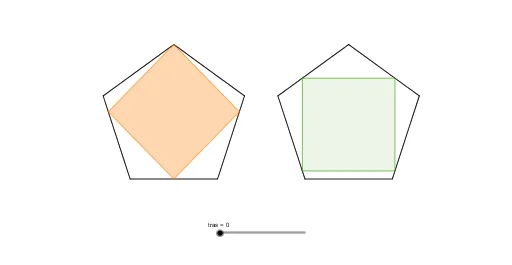
This example demonstrates the comparison of two squares within pentagons. Through geometric construction, students can understand the concept of similarity transformation. Commands used include point, polygon, midpoint, orthogonal line, intersection, segment, circle, angular bisector, vector, translation, and rotation. Suitable for middle school and above students to learn about geometric transformations and similarity.
GeoGebra Commands & Parameters
Point(xAxis) → APolygon(A, B, 5) → polígono1, f, g, h, i, j, C, D, EMidpoint(A, B) → FMidpoint(D, F) → GOrthogonalLine(G, yAxis) → kIntersect(g, k) → HIntersect(j, k) → IPolygon(F, H, D, I) → c1, f_1, h_1, d, i_1Point(xAxis) → JPoint(xAxis) → KPolygon(J, K, 5) → polígono2, l, m, n, p, q, L, M, NMidpoint(J, K) → OMidpoint(M, O) → PMidpoint(L, K) → QSegment(N, Q) → rSegment(M, O) → sIntersect(r, s) → RCircle(R, Q) → cPoint(n) → SOrthogonalLine(S, xAxis) → tOrthogonalLine(S, t) → aIntersect(p, a) → TOrthogonalLine(T, a) → bIntersect(t, m) → UIntersect(b, q) → VPolygon(V, U, S, T) → c2, v, u, s_1, t_1Midpoint(S, V) → WSegment(D, F) → eSegment(S, V) → g_1AngularBisector(C, B, A) → j_1AngularBisector(B, A, E) → k_1Intersect(k_1, j_1) → ZSegment(E, Z) → l_1Segment(Z, C) → m_1Segment(Z, B) → n_1Segment(Z, A) → p_1AngularBisector(K, J, N) → q_1AngularBisector(J, N, M) → r_1Intersect(r_1, q_1) → A_1Segment(N, A_1) → a_1Segment(A_1, M) → b_1Segment(A_1, L) → c_1Segment(A_1, K) → d_1Segment(A_1, J) → e_1Vector(V, V') → wTranslate(V, w) → V'_3Translate(U, w) → U'_2Translate(S, w) → S'_2Translate(T, w) → T'_1Rotate(V, ((2 * π) * tras / 8), V) → V'_1Rotate(U, ((2 * π) * tras / 8), V) → U'Rotate(S, ((2 * π) * tras / 8), V) → S'Rotate(T, ((2 * π) * tras / 8), V) → T'Polygon(V'_1, U', S', T') → c2', v'_1, u', s', t'Translate(V'_1, w) → B_1Translate(U', w) → U''Translate(S', w) → S''Translate(T', w) → T''Polygon(B_1, U'', S'', T'') → c2'', f_2, u'', s'', t''