
Volume of Rotation via Washer Method for Two Curves
Loading the math board and drawing, please wait…
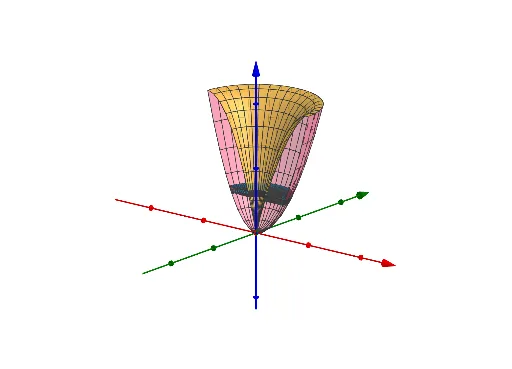
This example demonstrates the washer method to compute the volume of a solid of revolution formed by rotating the region between two curves about a specified axis, while also visualizing the resulting 3D surface in GeoGebra. Key mathematical ideas include the integral-based volume of revolution, identifying the intersection points of the two curves to set the correct interval, and using outer and inner radii (r_outer and r_inner) in the washer formula based on the difference of squares. The construction emphasizes 3D geometric modeling: a surface is generated in GeoGebra (command: Surface) using the defined curve boundaries and the rotation axis, producing the solid-with-a-hole appearance through surface objects (a, l1, b, d, f, e, c, g, h, i, j). It is well suited for upper-secondary to early university calculus, helping learners connect the algebraic integral setup with the geometric structure.
GeoGebra Commands & Parameters
Surface((r * cos(t)), (r * sin(t)), r^(2), r, 0, 2, t, 0, a) → l1Surface((r * cos(t)), (r * sin(t)), (4 * r) - r^(2), r, 0, 2, t, 0, a) → bSurface((r * cos(t)), (r * sin(t)), (4 * e) - e^(2), r, e, sqrt((4 * e) - e^(2)), t, 0, a) → cSurface((r * cos(t)), (r * sin(t)), (4 * d) - d^(2), r, d, sqrt((4 * d) - d^(2)), t, 0, a) → gSurface((r * cos(t)), (r * sin(t)), r^(2), r, sqrt((4 * e) - e^(2)), sqrt((4 * d) - d^(2)), t, 0, a) → hSurface((r * cos(t)), (r * sin(t)), (4 * r) - r^(2), r, e, d, t, 0, a) → iSurface(If[z > (4 * r) - r^(2) ∧ r^(2) > z, (r * cos(a))], If[z > (4 * r) - r^(2) ∧ r^(2) > z, (r * sin(a))], z, r, 0, 2, z, (4 * e) - e^(2), d^(2)) → j
AI Drawing Prompt Reference
Draw the solid of revolution between two curves using the washer method to calculate its volume. First, draw the outer curve r^2, then draw the inner curve (4r-r^2). Identify the intersection points e and d, and calculate their coordinates. Based on these points, draw two washers from e to d and from d to e. Finally, draw the surface of the solid, from e to d, forming a solid with a hole.
The prompt above was compiled from the original drawing commands and is for reference only.