
Lunar Horizon
Loading the math board and drawing, please wait…
In collections
geometriadinamica.es
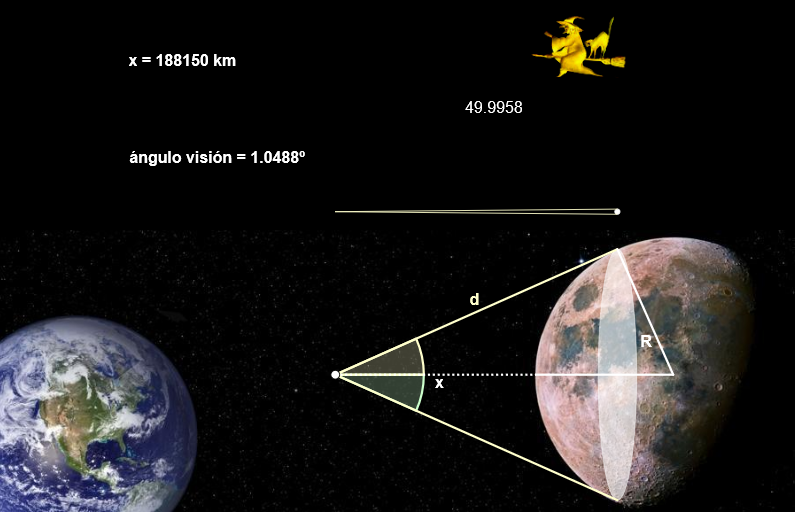
This example demonstrates the lunar horizon phenomenon. It involves core geometric and trigonometric concepts, including circles, angles, and triangles. The construction uses GeoGebra commands: Line, Circle, Intersect, Segment, Point, OrthogonalLine, Vector, Tangent, Ray, Angle, Midpoint, Mirror, Ellipse, Translate. Suitable for middle school and high school mathematics education, particularly for teaching geometry and trigonometry.
GeoGebra Commands & Parameters
Line(E, A) → fCircle(A, B) → cIntersect(c, f, 2) → CSegment(C, A) → qSegment(E, C) → iPoint(i) → JOrthogonalLine(J, q) → a_1Point(a_1) → OOrthogonalLine(O, a_1) → b_1Segment(J, C) → hVector((1, u)) → vTangent(J, c) → j, kPoint(j) → LRay(J, L) → nIntersect(c, n, 1) → NPoint(k) → KRay(J, K) → lIntersect(c, l, 1) → MSegment(M, N) → r_1Point(r_1) → HOrthogonalLine(H, b_1) → c_1Intersect(b_1, c_1) → SVector(O, S) → u0Angle(N, J, A) → βLine(A, r_1) → sIntersect(c, s, 2) → PIntersect(c, s, 1) → QSegment(P, Q) → tOrthogonalLine(P, t) → aOrthogonalLine(Q, t) → bSegment(J, M) → dSegment(J, N) → eAngle(A, J, M) → αSegment(A, M) → RMidpoint(J, C) → DMidpoint(J, M) → FMidpoint(A, M) → GMirror(H, q) → IEllipse(H, I, r_1 / 2) → pTranslate(O, v) → TLine(O, Vector[UnitVector[v] + UnitVector[u0]]) → d_1Intersect(c_1, d_1) → UCircle(S, U) → e_1Intersect(e_1, c_1, 2) → VSegment(O, V) → f_1Segment(O, U) → g_1Angle(V, O, U) → γ
AI Drawing Prompt Reference
Create a geometric diagram illustrating the lunar horizon phenomenon. Include a horizontal horizon line and a circular orbit representing the moon's path. Place an observer point outside the circle and draw two tangent lines from this point to the circle, representing the view of the moon rising above the horizon. Identify the tangent points on the circle and connect them with the observer to form sight lines. Construct angles between these sight lines and the horizontal line as the viewing angle. Create the perpendicular bisector of the sight lines intersecting with a horizontal line through the circle's center to form a vanishing point. Using the observer and tangent points as reference, construct an ellipse representing the apparent deformation of the moon in the field of view. Label the relevant angles to complete the geometric model of the lunar horizon effect.
The prompt above was compiled from the original drawing commands and is for reference only.