
Volume of a Cuboid and Volume of Water Inside It
Loading the math board and drawing, please wait…
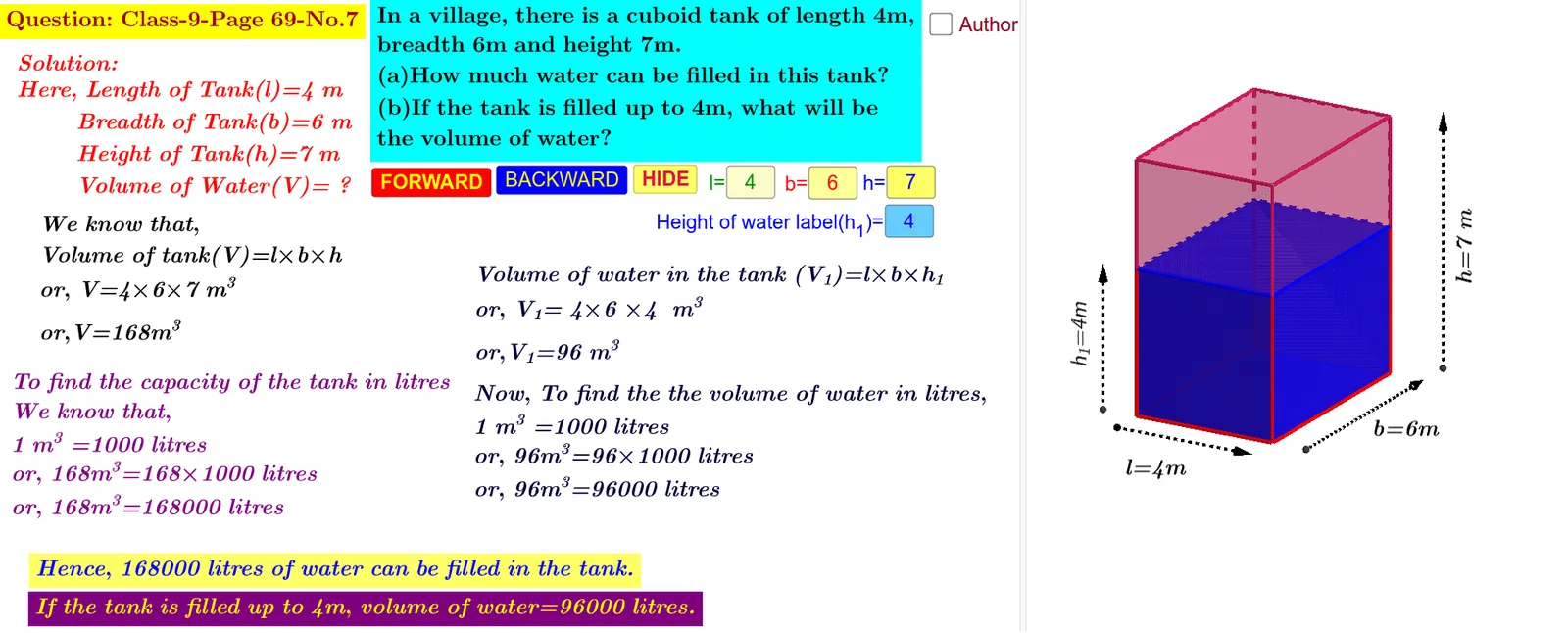
This GeoGebra example demonstrates the volume of a cuboid (rectangular prism) and the volume of water contained within it, visualized in 3D. It shows how the water volume changes as the water level rises inside the cuboid, linking the geometric volume formula (length × width × height) to a practical filling scenario. Core mathematical concepts include solid geometry, volume calculation, and proportional reasoning about partial filling. The construction uses GeoGebra commands such as Polygon to create the base rectangle, Prism to generate the cuboid, Textfield for inputting dimensions (length, width, height), Vector and VerticalText for labeling edges and water level, and defines multiple faces (e.g., faceABFE, faceBCGF) and edges (e.g., edgeAE, edgeBF) to clearly render the 3D structure. Suitable for middle school to high school students learning volume concepts, and useful for teachers demonstrating dynamic volume changes or for students exploring the relationship between water height and volume.
GeoGebra Commands & Parameters
Polygon(A, B, C, D) → q1, a, b_1, c, dPrism(q1, h) → e, E, edgeAE, edgeBF, edgeCG, edgeDH, edgeEF, edgeFG, edgeGH, edgeEH, F, G, H, faceABFE, faceBCGF, faceCDHG, faceADHE, faceEFGHPolygon(P, Q, R, S) → q2, p, q, r, sPrism(q2, h_1) → f, I, edgeIP, edgeJQ, edgeKR, edgeLS, edgeIJ, edgeJK, edgeKL, edgeIL, J, K, L, faceIJQP, faceJKRQ, faceKLSR, faceILSP, faceIJKLTextfield(l) → InputBox1Textfield(h) → InputBox3Textfield(h_1) → InputBox4Textfield(b) → InputBox2Vector(M, N) → gVector(O, T) → vVector(U, V) → iVector(Z, A_1) → jTextfield(l) → InputBox1_{1}Textfield(h) → InputBox3_{1}Textfield(b) → InputBox2_{1}VerticalText(text10) → text14VerticalText(text11) → text15
AI Drawing Prompt Reference
Draw a 3D cuboid with a rectangular base, showing water inside it. The cuboid is formed by extruding the base rectangle upward, with six faces, twelve edges, and eight vertices. Inside, a smaller cuboid represents the water, with its base parallel to the outer base and adjustable height indicating water level. Label the length, width, and height of the cuboid, and the water height. Use arrows or text to mark edge lengths, and vertical text on the side for water level. Illustrate how water volume changes with water level, emphasizing volume equals length times width times height.
The prompt above was compiled from the original drawing commands and is for reference only.