
Visualizing Multiplication of the Form (ax+b)(cx+d)
Loading the math board and drawing, please wait…
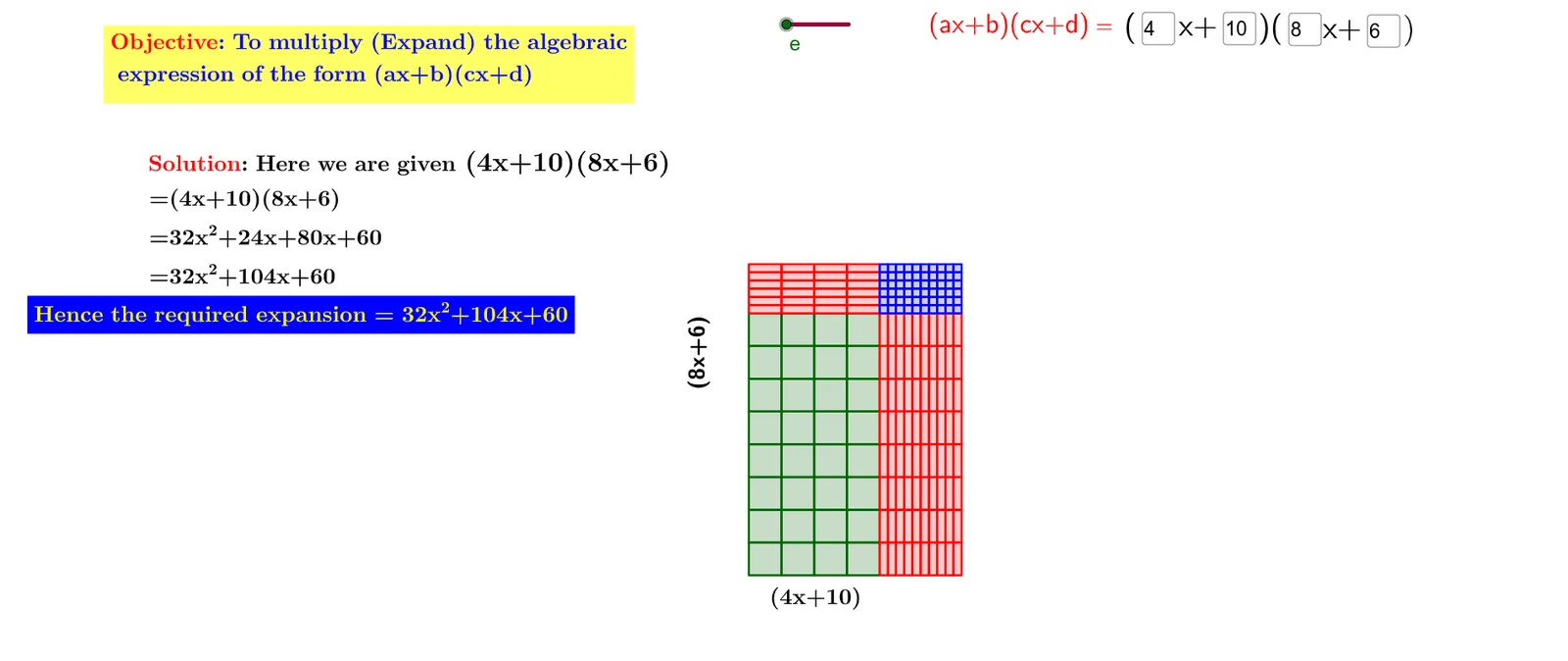
This GeoGebra example dynamically demonstrates the expansion of products like (ax+b)(cx+d) by linking algebraic multiplication to geometric area models. It visualizes how the product corresponds to the areas of rectangles and parallelograms, making the distributive law tangible. Core concepts include polynomial multiplication, the distributive property, area decomposition, and parameter-driven variation. The construction uses interactive text fields and input boxes for coefficients a, b, c, d, along with segments, sequences, translations, rotations, and conditional statements to build and update the geometric representation. Vertical text labels annotate the parts. This resource is ideal for middle and high school students learning polynomial operations or exploring algebraic-geometric connections, and serves as an effective teaching tool for classroom demonstrations.
GeoGebra Commands & Parameters
Textfield(a) → InputBox1Textfield(b) → InputBox2Textfield(c) → InputBox3Textfield(d) → InputBox4Segment(O, A) → fSequence(Sequence[Polygon[O + (f * (i, j)), A + (f * (i, j)), 4], i, 0, a - 1], j, 0, c - 1) → l1Sequence(Sequence[Polygon[{B, B + (1, 0), B + (1, f), B + (0, f)} + (i, (f * j))], i, 0, b - 1], j, 0, c - 1) → l2Sequence(Sequence[Polygon[{C, C + (f, 0), C + (f, 1), C + (0, 1)} + ((i * f), j)], i, 0, a - 1], j, 0, d - 1) → l3Sequence(Sequence[Polygon[D + (i, j), D + (1 + i, j), 4], i, 0, b - 1], j, 0, d - 1) → l4If(e ≤ 1, B + (e * (E - B)), E) → FTranslate(l2, Vector[B, F]) → l2'If(e ≤ 1, D, If[1 ≤ e ≤ 2, D + ((e - 1) * (G - D)), G]) → HRotate(Translate[l3, Vector[D, H]], If[e ≤ 1, 0, If[1 ≤ e ≤ 2, ((-(e - 1)) * π / 2), ((-π)) / 2]], H) → l5If(e ≤ 2, D, If[2 ≤ e ≤ 3, D + ((e - 2) * (I - D)), I]) → JTranslate(l4, Vector[D, J]) → l4'Textfield(a) → InputBox1_{1}Textfield(b) → InputBox2_{1}Textfield(c) → InputBox3_{1}Textfield(d) → InputBox4_{1}Textfield(a) → InputBox1_{2}Textfield(b) → InputBox2_{2}Textfield(c) → InputBox3_{2}Textfield(d) → InputBox4_{2}VerticalText(text12) → text13Textfield(a) → InputBox1_{3}Textfield(b) → InputBox2_{3}Textfield(c) → InputBox3_{3}Textfield(d) → InputBox4_{3}Textfield(a) → InputBox1_{4}Textfield(b) → InputBox2_{4}Textfield(c) → InputBox3_{4}Textfield(d) → InputBox4_{4}Textfield(a) → InputBox1_{5}Textfield(b) → InputBox2_{5}Textfield(c) → InputBox3_{5}Textfield(d) → InputBox4_{5}
AI Drawing Prompt Reference
Create a dynamic visualization for multiplying polynomials of the form (ax+b)(cx+d) using geometric area models to demonstrate the distributive property. Use sliders for coefficients a, b, c, d to generate corresponding rectangles and parallelograms, labeling each area part. Start with base rectangles, then create multiple sub-rectangles based on coefficients, and finally combine them through translation and rotation to form the complete product, visually linking multiplication to area.
The prompt above was compiled from the original drawing commands and is for reference only.