
SET Theory Example 1 (For grade 9)
Loading the math board and drawing, please wait…
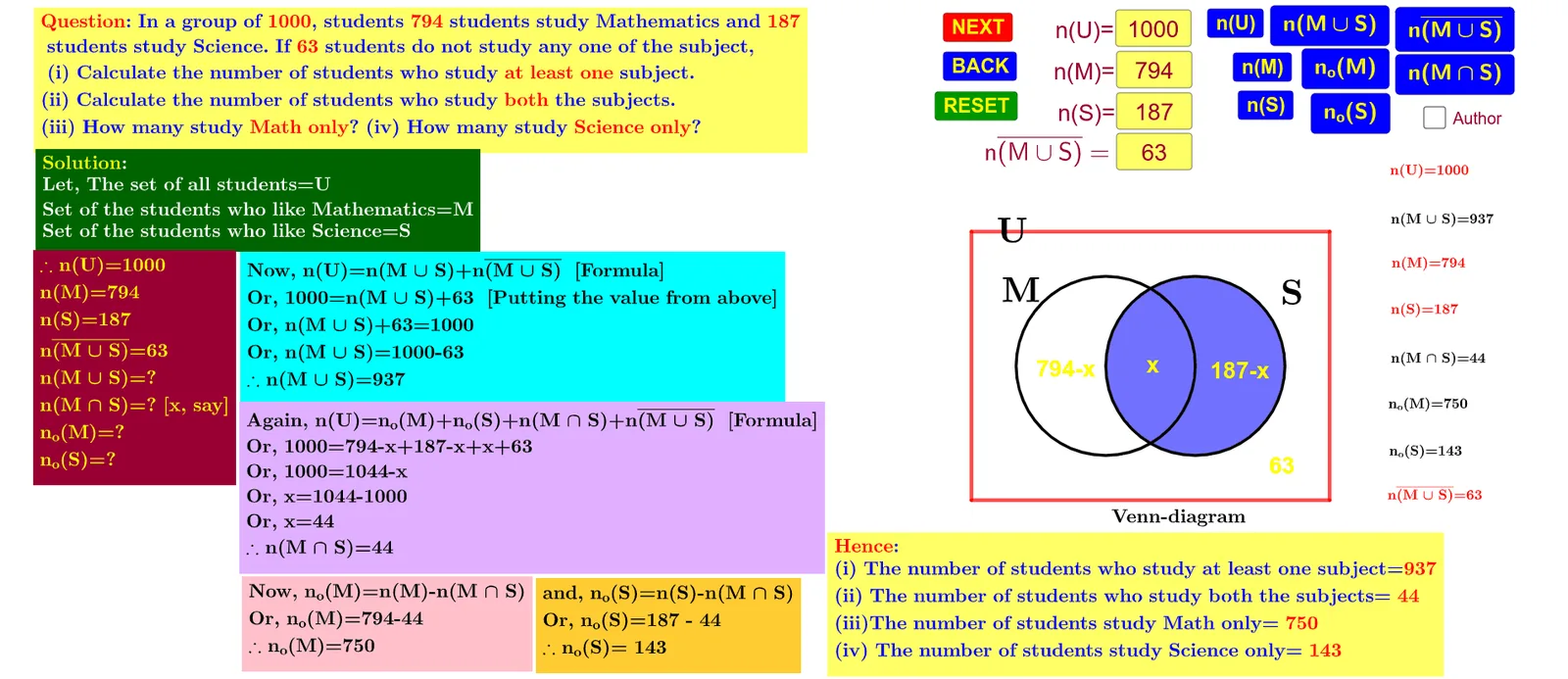
This example demonstrates the integration of basic set theory concepts with geometric figures, visually showcasing set representation and operations. Core math concepts include set theory, cubes, geometric transformations, roots, median lines, and random variables. It is constructed using GeoGebra commands like Vertex, Segment, Textfield, RotateText, and involves objects such as M, S, U, A, B, C, D, E, F, f, g, h, i, MS, Mo, So, U', eq1, eq2, etc. Suitable for 9th-grade students to learn and understand set theory and its geometric applications, serving as a teaching aid.
GeoGebra Commands & Parameters
Vertex(U) → A, B, C, D, E, FSegment(C, E) → fSegment(E, D) → gSegment(D, B) → hSegment(B, C) → iTextfield(u) → InputBox1Textfield(m) → InputBox2Textfield(s) → InputBox3Textfield(u') → InputBox4RotateText(text20, π / 2) → text21
AI Drawing Prompt Reference
Create a 2D diagram showing a closed polygonal figure built from six marked vertices, arranged so that adjacent vertices are connected by multiple straight segments, forming an overall solid-geometry/set-style outline. Use line segments to connect key neighboring vertices into a clear perimeter and include an additional side that links two vertices to emphasize the structure. Then place four text input boxes on the canvas for parameters u, m, s, and u′, leaving room for set-related expressions. Finally, add an explanatory text element and rotate it by about 90 degrees for emphasis.
The prompt above was compiled from the original drawing commands and is for reference only.