
Dandelin Spheres: Cone Intersection with Sphere
Loading the math board and drawing, please wait…
In collections
Conic Section Collection
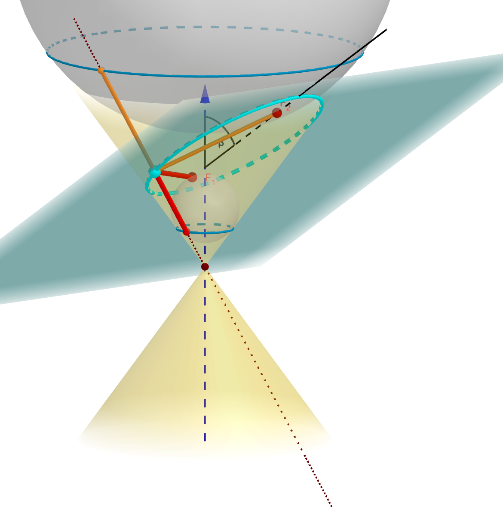
This example demonstrates the construction of intersection points between an infinite cone and a plane using Dandelin spheres. Key mathematical concepts include cone geometry, intersection of spheres and cones, and spatial geometry trajectories. Construction involves GeoGebra commands like ConeInfinite, Sphere, IntersectPath, Mirror, and Angle to build cones, spheres, and planes, and perform geometric transformations. Suitable for high school students learning solid geometry or university mathematics courses to understand spatial relationships between cones and spheres and geometric construction techniques.
GeoGebra Commands & Parameters
Intersect(xAxis, yAxis) → APoint(zAxis) → BLine(C, yAxis) → aPlane(D, a) → bMirror(C, D) → C'Ray(D, C') → cAngle(c, zAxis) → δConeInfinite(A, B, aa) → dIntersectPath(b, xz) → intIntersectPath(xz, d) → gIntersect(int, g) → V2, V1Line(A, V1) → c_1Line(A, V2) → c_2Line(A, B) → vertPoint(c_2) → KIntersectPath(b, d) → rAngularBisector(c_1, int) → f, iIntersect(vert, f) → O2Intersect(vert, i) → O1OrthogonalLine(O2, c_1, xz) → jOrthogonalLine(O1, c_1, xz) → kIntersect(c_1, j) → GIntersect(c_1, k) → HCircle(O2, G, xz) → pCircle(O1, H, xz) → qIntersect(int, q) → F_1, JIntersect(int, p) → F_2, MSphere(O1, F_1) → lSphere(O2, F_2) → mCircle(zAxis, H) → tan2Circle(zAxis, G) → tan1Point(r) → QLine(Q, A) → genIntersect(gen, tan1) → E,Intersect(gen, tan2) → F,Segment(Q, F_2) → eSegment(Q, F) → nSegment(Q, F_1) → sSegment(Q, E) → tCircle(vert, Q) → d_1Plane(tan2) → oIntersectPath(o, b) → dirOrthogonalLine(Q, dir, b) → a_1Intersect(dir, a_1) → IOrthogonalLine(Q, a_1, b) → b_1Intersect(b_1, int) → LIntersect(dir, r) → N,Intersect(int, r) → O, PIntersect(dir, int) → RSegment(Q, I) → e_1Segment(L, R) → f_1Intersect(b_1, r) → S, TPointIn(b) → WOrthogonalPlane(R, dir) → uIntersectPath(u, d) → g_1Intersect(g_1, tan2) → U, V, ,Intersect(g_1, d_1) → Z, A_1, ,Segment(Z, U) → h_1If(bb < aa, text3, If[bb > aa, text1, text2]) → angleAngle(Q, I, R, b) → αPoint(dir) → B_1Angle(F_1, R, B_1, b) → β
AI Drawing Prompt Reference
Draw a 3D solid geometry diagram: an infinite cone with apex at the origin and vertical axis. A slanted plane intersects the cone, producing an elliptical cross-section. Inside the cone, place two Dandelin spheres, each tangent to the cone's lateral surface and to the cutting plane; their tangency points with the plane are the ellipse's foci. From any point on the ellipse, draw segments to both foci and to the cone's apex, illustrating that the sum of distances to the foci is constant. Also show the circles where the spheres touch the cone, plus auxiliary lines connecting sphere centers and tangency points, to clarify the spatial relationships among cone, plane, and spheres.
The prompt above was compiled from the original drawing commands and is for reference only.