
Volume by Cylindrical Shells
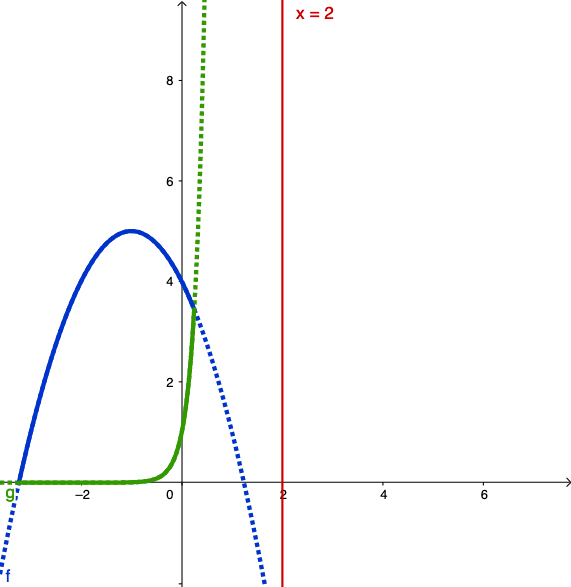
Loading the math board and drawing, please wait…
This example demonstrates how to calculate the volume of a solid of revolution around a line other than an axis using the method of cylindrical shells. Key math concepts include integral calculus, volume calculation, and solid geometry. GeoGebra commands and objects like LaTeX, Point, Segment, Mirror, and variables such as a, b, f, g are used to visualize the rotation and volume computation. Suitable for high school students and above to learn about volume calculation techniques for solids of revolution.
GeoGebra Commands & Parameters
LaTeX(("\text{step }" * steps)) → text1LaTeX("\text{The general form of the integrand is } 2\pi(radius)(height)\text{.}") → text3Point(xAxis) → ASegment((x(A), g(x(A))), (x(A), f(x(A)))) → hPoint(h) → BSegment(B, (2, y(B))) → rLaTeX("\text{In this case the radius is given by }\textcolor{#FF33CC}{r}=x-\textcolor{#CC0000}{2}\text{.}") → text4LaTeX("\text{The integration limits come from the x-coordinates of the}\cr\text{intersection points of functions }\textcolor{#000099}{f}\text{ and }\textcolor{#339900}{g}.") → text6LaTeX((((((("\text{Use cylindrical shells to calculate the volume swept out when the}\cr\text{region enclosed by the functions }\textcolor{#0033CC}{f=" * f) * "}\text{ and }\textcolor{#339900}{g=e^{") * a) * "x}}\text{ is}\cr\text{revolved around the line }\textcolor{#CC0000}{") * c) * "}.")) → text2LaTeX("\text{The height }\textcolor{#FF6600}{h}\text{ is given by }\textcolor{#0033CC}{f(x)}-\textcolor{#339900}{g(x)}.") → text5LaTeX((((((((("V=2\pi\int_{" * Lintersect) * "}^{") * Rintersect) * "}(x-2)\left[(") * f) * ")-(") * g) * ")\right]dx")) → text7Mirror(fcut, c) → fshadowMirror(gcut, c) → gshadowMirror(h, c) → h'Mirror(r, c) → r'