
Visualizing the Area of Regular Polygons
Loading the math board and drawing, please wait…
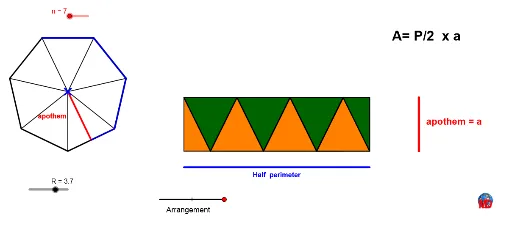
This GeoGebra example dynamically demonstrates how the area of a regular polygon changes with its number of sides and circumradius. It visualizes the decomposition of a regular n-gon into n congruent isosceles triangles, linking the polygon's area to trigonometric expressions such as A = (1/2)·n·R²·sin(2π/n). Core concepts include apothem, circumradius, central angle, and the limiting behavior as n approaches infinity (approaching the circle's area). The construction uses commands like Sequence, Rotate, Polygon, Midpoint, Distance, Segment, Arc, Sector, and CurveCartesian, with sliders for n and R, and dynamic elements via Min, Max, Mod, and Element. Suitable for middle school to high school geometry classes, math labs, or self-study, this interactive tool helps learners grasp the relationship between polygon sides, radius, and area, and introduces the idea of limits in a visual way.
GeoGebra Commands & Parameters
Sequence(Rotate[OO, i, N], i, 0, 6.28319, (2 * π / n)) → liste1Midpoint(Element[liste1, 1], Element[liste1, 2]) → F_1Distance(F_1, N) → apoSegment(E, (x(E) + 4, y(E))) → aPoint(a) → FMin((x(F) - x(E)) / (a / 2), 1) → kSequence(If[k < 1, (x(O) + ((l * sin((i * φ))) * cos((i * φ)) / sin(φ)), y(O) + ((l * sin((i * φ))) * sin((i * φ)) / sin(φ))), (x(O) + (l * i), y(O))], i, 0, (2 * n), 2) → list2Sequence(Midpoint[Element[list2, i], Element[list2, i + 1]], i, 1, Length[list2]) → liste11Sequence((x(O) + (R * sin((i * θ))), y(O) + R - (R * cos((i * θ)))), i, 0, (2 * n), 2) → list1Max((x(F) - x(E)) / (a / 2) - 1, 0) → k'Rotate((x(O) + 0, y(O) + 1), ((-k) * θ / 2), O) → ARotate(O, ((-k) * θ / 2), O) → O'Rotate(Element[list1, 1], ((-k) * θ / 2), O) → BSector(Rotate[Circle[(x(O) + 0, y(O) + 1), O], ((-k) * θ / 2), O], Rotate[O, ((-k) * θ / 2), O], Rotate[Element[list1, 1], ((-k) * θ / 2), O]) → cRotate((x(O) + 0, y(O) + 1), ((-k) * θ / 2), O) → CRotate(O, ((-k) * θ / 2), O) → O'_1Rotate(Element[list1, 1], ((-k) * θ / 2), O) → DArc(Rotate[Circle[(x(O) + 0, y(O) + 1), O], ((-k) * θ / 2), O], O'_1, D) → dCurveCartesian(t - sin(t), 1 - cos(t), t, 0, 6.28319) → bRay((0, 0), (1, 0)) → iPoint(Segment[(0, R), (6.28319, 1)]) → HSegment(H, (x(H), 0)) → jMidpoint(j) → IMidpoint(a) → JCircle(L, 1 / (1 - m)) → pCircle((0, 0), 1 / (1 - m)) → qIntersect(p, q, 1) → MCircle((0, 1), 1) → c_1Segment((0, 0), (6.283185307179586, 0)) → eSegment(G, (x(G), y(G) - 1)) → rCircleArc((0, 1 / (1 - m)), O, L) → sCircle((0, R), R) → hMod(n, 2) → nnCircle(((-R), R), R) → gSegment(N, OO) → tMidpoint(t) → QSequence(Segment[N, Element[liste1, i]], i, 1, Length[liste1]) → liste4Sequence(Rotate[Rotate[Translate[(x(O) + 0, y(O) + R), Vector[Element[list1, i], Element[list2, i]]], (((-((2 * i) - 1)) * k) * θ), Element[list2, i]], (180° * k'), (x(O) + (n * l) - (R * sin(θ / 2) / 2), y(O) + (R * cos(θ / 2) / 2))], i, n + 1, (2 * n) + 1) → liste5Sequence(If[k < 1, (x(O) + (((2 * l) * sin((i * φ))) * cos((i * φ)) / sin(φ)), y(O) - 0.5 + (((2 * l) * sin((i * φ))) * sin((i * φ)) / sin(φ))), (x(O) + ((2 * l) * i), y(O) - 0.5)], i, 0, (2 * n)) → list2bElement(list2b, Length[list2b] / 2) → SElement(list2b, 1) → TMidpoint(T, S) → UPolygon(liste1) → poly1Sequence(Circle[Element[liste11, i], apo], i, 1, Length[liste11]) → liste12Sequence(LineBisector[Element[list2, i], Element[list2, i + 1]], i, 1, Length[list2]) → liste10Sequence(Intersect[Element[liste12, i], Element[liste10, i], 2], i, 1, Length[liste10]) → liste13Sequence(Polygon[Element[list2, i], Element[list2, i + 1], Element[liste13, i]], i, 1, Length[list2]) → liste2Vector(N, F_1) → uMidpoint(Element[list2, 1], Element[list2, Length[list2]]) → G_1Polygon(Element[list2, Length[list2] / 2], G_1, G_1 + (0, apo)) → poly2, e_1, f_1, g_1Polygon(G_1, G_1 + (0, apo), Element[list2, Length[list2] / 2 + 1]) → poly3, h_1, i_1, j_1Sequence(Polygon[Element[list2, i], Element[list2, i + 1], Element[liste13, i]], i, Length[list2] / 2 + 1, Length[liste13]) → liste3Midpoint(Element[list2, Length[list2] / 2 + 1], G_1 + (0, apo)) → MMRotate(liste3, ((k' * 180))°, MM) → liste3'Rotate(poly3, ((k' * 180))°, MM) → poly3'Sequence(Polygon[Element[list2, i], Element[list2, i + 1], Element[liste13, i]], i, 1 + k', Length[liste13] / 2) → liste2bPolygon(Element[liste11, 1], Element[liste11, 1] + (0, apo), Element[list2, 2]) → poly4, k_1, l_1, m_1Segment(Element[liste11, 1] - (0, 1), Element[list2, Length[list2] / 2 + 1] - (0, 1)) → d_1Sequence(Polygon[Element[list2, i], Element[list2, i + 1], Element[liste13, i]], i, 1 + k', Length[liste13] / 2) → liste2cSequence(Polygon[Element[list2, i], Element[list2, i + 1], Element[liste13, i]], i, Length[list2] / 2 + 1, Length[liste13]) → liste3cPolygon(Element[liste11, 1], Element[liste11, 1] + (0, apo), Element[list2, 2]) → poly5, b_1, n_1, p_1Sequence(Polygon[Element[list2, i], Element[list2, i + 1], Element[liste13, i]], i, 1, Length[list2]) → liste6Sequence(Polygon[Element[list2, i], Element[list2, i + 1], Element[liste13, i]], i, 1, Length[list2]) → liste22Sequence(Polygon[Element[list2, i], Element[list2, i + 1], Element[liste13, i]], i, 1, Length[list2]) → liste22bSequence(Polygon[Element[list2, i], Element[list2, i + 1], Element[liste13, i]], i, Length[list2] / 2, Length[liste13]) → liste33Sequence(Polygon[Element[list2, i], Element[list2, i + 1], Element[liste13, i]], i, 1, Length[liste13] / 2) → liste22bbMidpoint(Element[list2, Length[list2] / 2], G_1 + (0, apo)) → NNMidpoint(NN, MM) → PPRotate(liste33, ((k' * 180))°, PP) → liste33'Segment(Element[list2, 1] - (0, 1), G_1 - (0, 1)) → q_1Rotate(liste3, ((k' * 180))°, MM) → liste3'cRotate(poly3, ((k' * 180))°, MM) → poly3'_1Sequence(Polygon[Element[list2, i], Element[list2, i + 1], Element[liste13, i]], i, 1, Length[liste13] / 2) → liste22cSegment(G_1 + (R + 1, 0), G_1 + (R + 1, apo)) → a_1Midpoint(a_1) → ZTranslate(N, Vector[(k * u)]) → N'Segment(N, N') → r_1Midpoint(d_1) → A_1Polygon(Element[list2, Length[list2] / 2], G_1, G_1 + (0, apo)) → poly6, s_1, t_1, g_2Midpoint(r_1) → B_1Midpoint(q_1) → C_1Sequence(Segment[Element[liste1, i], Element[liste1, i + 1]], i, 2, Length[liste1] / 2) → liste7Segment(N', Element[liste1, 2]) → a_2Mirror(N', N) → N''Segment(N'', Element[liste1, Length[liste1] / 2]) → b_2
AI Drawing Prompt Reference
Create a dynamic visualization of the area of a regular polygon. Show a regular polygon with adjustable number of sides and circumradius, inscribed in a circle. Decompose the polygon into congruent isosceles triangles sharing the center, with the apothem and radius clearly marked. Include a slider or axis to vary the number of sides, and illustrate how the polygon's area approaches the circle's area as sides increase. Also display a unit circle with an inscribed polygon, using arcs and sectors to highlight the central angle and trigonometric relationships. Add coordinate axes, auxiliary segments, and labels to compare areas for different side counts.
The prompt above was compiled from the original drawing commands and is for reference only.