
Cervian Triangle and Areas
Loading the math board and drawing, please wait…
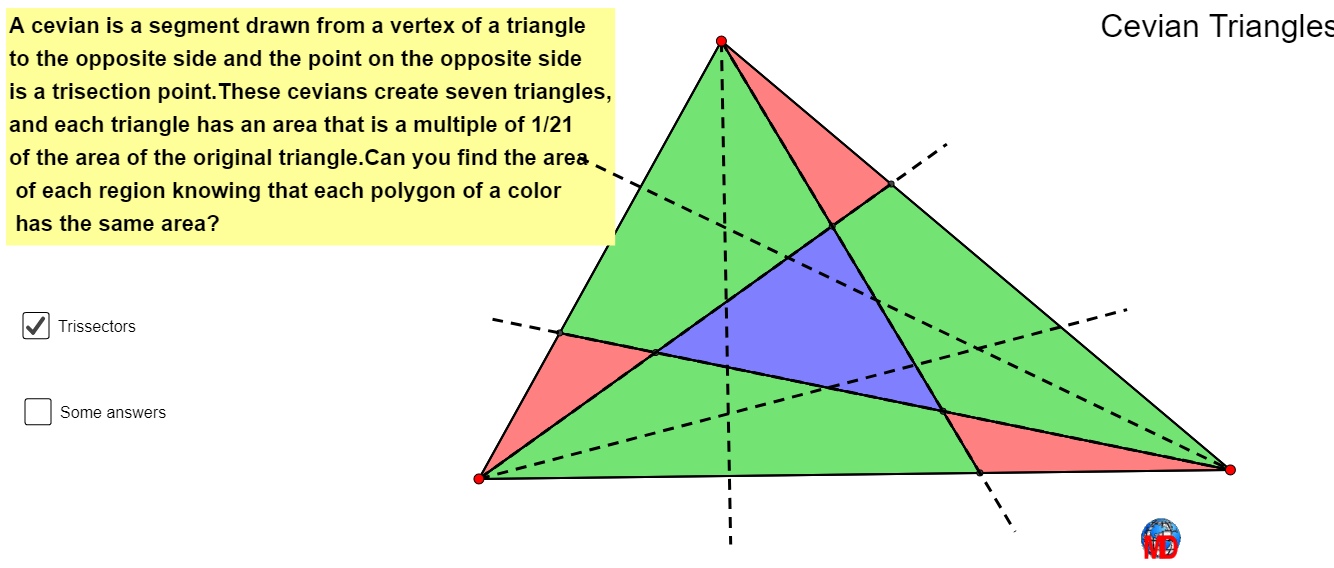
This example demonstrates the construction of the Cervian triangle and its area calculation. Key mathematical concepts include triangle geometry, area formulas, vector operations, and similarity transformations. Construction involves using GeoGebra commands like Polygon, Segment, Intersect, Midpoint, and Centroid, along with FractionText for labeling. Suitable for middle school students or above for learning geometric constructions and area calculations, useful in math teaching or self-study.
GeoGebra Commands & Parameters
Polygon(C, A, B) → poly1, b, c, aSegment(A, E) → dSegment(D, B) → eSegment(F, C) → fIntersect(d, e) → GIntersect(d, f) → HIntersect(e, f) → IPolygon(H, I, G) → poly2, g, h, iPolygon(C, E, H) → poly3, h_1, c_1, e_1Polygon(I, B, F) → poly4, f_1, i_1, b_1Polygon(G, D, A) → poly5, a_1, g_1, d_1Polygon(I, B, E, H) → poly6, i_2, b_2, e_2, h_2Polygon(G, H, C, D) → poly7, g_2, h_3, c_2, d_2Polygon(G, A, F, I) → poly8, g_3, a_2, f_2, i_3FractionText(j) → texte1FractionText(k) → texte3FractionText(l) → texte2Midpoint(C, G) → JMidpoint(C, H) → KCentroid(poly1) → LCircle(E, 0.3) → pCircle(M, 0.3) → qCircle(N, 0.3) → rCircle(D, 0.3) → sCircle(O, 0.3) → tCircle(F, 0.3) → k_1Line(A, E) → nLine(B, D) → j_1Line(B, N) → l_1Line(C, O) → m_1Line(C, F) → n_1Line(A, M) → p_1Intersect(p, n) → P, QIntersect(q, p_1) → R, SIntersect(k_1, n_1) → T, UIntersect(t, m_1) → V, WIntersect(s, j_1) → Z, A_1Intersect(r, l_1) → B_1, C_1Segment(C, U) → q_1Segment(C_1, B) → r_1Segment(A, Q) → s_1Segment(A, S) → t_1Segment(B, A_1) → j_2Segment(C, W) → k_2
AI Drawing Prompt Reference
Construct a triangle in the plane with three given vertices, then mark three points on its sides by drawing three cevians from the vertices to the chosen points. Draw the three lines/segments so that they intersect pairwise, producing several intersection points. Use these intersection points together with the side points to form a central cevian triangle and additional polygonal subregions inside the original triangle. Ensure the subregions collectively partition the interior according to the intersection structure, and include labels for the important points involved so the areas of the main and subregions can be compared.
The prompt above was compiled from the original drawing commands and is for reference only.