
Euler Line: An Important Geometric Relationship in Triangles
Loading the math board and drawing, please wait…
In collections
Besondere Punkte/Special Points
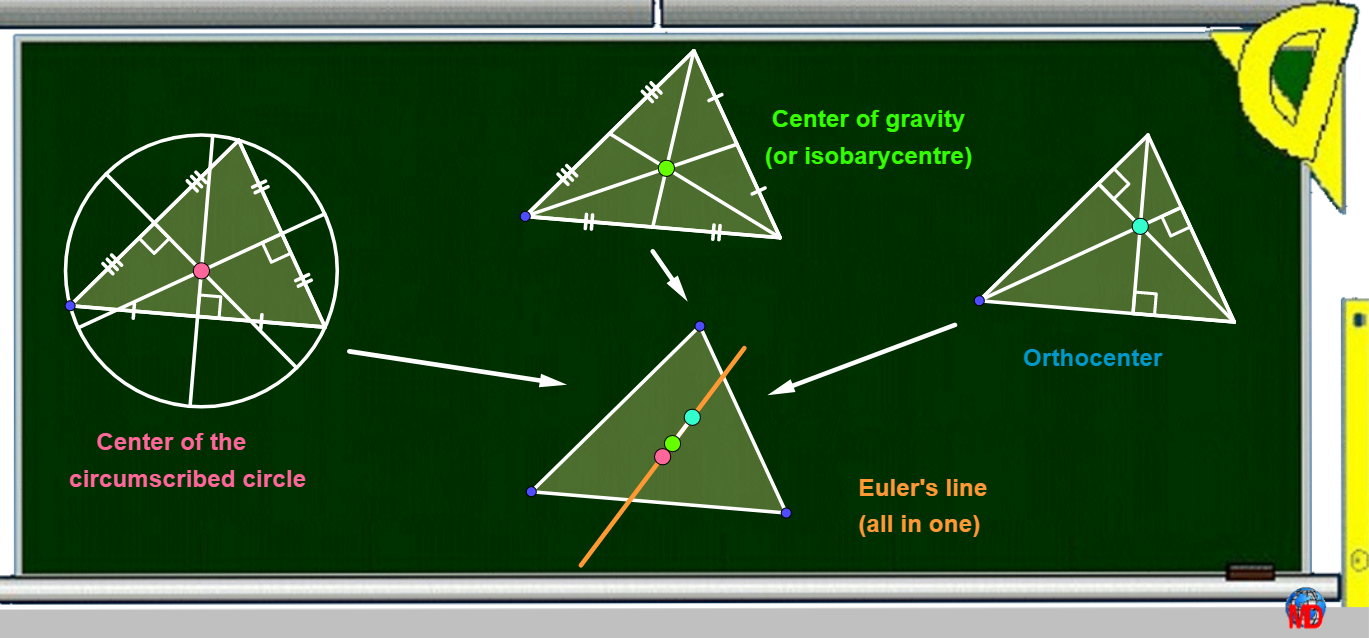
The Euler line is a line connecting the centroid, orthocenter, and circumcenter of a triangle, illustrating symmetry and transformation in triangle geometry. Key mathematical concepts include the centroid, orthocenter, circumcenter, triangle symmetry, and geometric transformations. Construction involves GeoGebra commands such as Polygon, Vector, Translate, Midpoint, Segment, Intersect, LineBisector, Circle, Angle, Line, and OrthogonalLine. Suitable for middle or high school mathematics to understand basic triangle properties and geometric construction techniques.
GeoGebra Commands & Parameters
Polygon(A, B, C) → t1, c, a, bVector(A, E) → vVector(A, F) → wTranslate(A, v) → A'_{1}Translate(B, v) → B'_{1}Translate(C, v) → C'_{1}Polygon(A'_{1}, B'_{1}, C'_{1}) → t1'_{1}, c'_{1}, a'_{1}, b'_{1}Translate(A, w) → A'_{2}Translate(B, w) → B'_{2}Translate(C, w) → C'_{2}Polygon(A'_{2}, B'_{2}, C'_{2}) → t1'_{2}, c'_{2}, a'_{2}, b'_{2}Midpoint(b'_{1}) → GMidpoint(a'_{1}) → HMidpoint(c'_{1}) → ISegment(B'_{1}, G) → iSegment(I, C'_{1}) → jSegment(H, E) → kIntersect(j, k) → JVector(A, D) → uTranslate(A, u) → A'Translate(B, u) → B'Translate(C, u) → C'Polygon(A', B', C') → t1', c', a', b'LineBisector(a') → fLineBisector(b') → gLineBisector(c') → hIntersect(f, a') → KIntersect(c', h) → LIntersect(g, b') → MIntersect(f, g) → NCircle(N, B') → dIntersect(d, h) → O, PIntersect(d, f) → Q, RIntersect(d, g) → S, TSegment(P, O) → lSegment(Q, R) → mSegment(S, T) → nAngle(Q, K, C') → αAngle(C', M, S) → βAngle(A', L, O) → γSegment(E, G) → pSegment(G, C'_{1}) → qSegment(E, I) → rSegment(I, B'_{1}) → sSegment(B'_{1}, H) → tSegment(H, C'_{1}) → eSegment(D, L) → f_1Segment(L, B') → g_1Segment(B', K) → h_1Segment(K, C') → i_1Segment(C', M) → j_1Segment(M, D) → k_1Line(F, C'_{2}) → l_1Line(B'_{2}, C'_{2}) → m_1Line(B'_{2}, F) → n_1OrthogonalLine(B'_{2}, l_1) → p_1OrthogonalLine(F, m_1) → q_1OrthogonalLine(C'_{2}, n_1) → r_1Intersect(n_1, r_1) → UIntersect(q_1, m_1) → VIntersect(p_1, l_1) → WSegment(B'_{2}, W) → s_1Segment(C'_{2}, U) → t_1Segment(F, V) → a_1Segment(C'_{2}, W) → b_1Segment(C'_{2}, V) → c_1Segment(F, U) → d_1Angle(C'_{2}, W, B'_{2}) → δAngle(C'_{2}, U, B'_{2}) → εAngle(F, V, C'_{2}) → ζIntersect(a_1, s_1) → ZIntersect(t1, t1'_{2}) → A_1LineBisector(b) → e_1LineBisector(a) → f_2Intersect(f_2, e_1) → B_1Midpoint(a) → C_1Midpoint(b) → D_1Segment(B, D_1) → g_2Segment(C_1, A) → h_2Intersect(h_2, g_2) → E_1Line(A, C) → i_2Line(B, C) → j_2OrthogonalLine(A, j_2) → k_2OrthogonalLine(B, i_2) → l_2Intersect(k_2, l_2) → F_1Circle(B_1, B) → c_2Line(B_1, F_1) → m_2Intersect(c_2, m_2) → G_1, H_1Segment(G_1, H_1) → n_2Intersect(k, i) → I_1Segment(E_1, F_1) → p_2Midpoint(c) → L_1Vector(C' + (0.5, -0.5), L_1 - (1, -0.5)) → u_1Midpoint(a) → M_1Vector(F - (0.5, 0.5), M_1 + (0.5, 0.5)) → v_1Vector(G - (0, 0.5), B + (-0.25, 0.5)) → w_1
AI Drawing Prompt Reference
Draw a triangle ABC. Then translate the triangle with A, B, C as starting points and the centroid E as the direction to get A'1, B'1, C'1, and with A, B, C as starting points and the orthocenter F as the direction to get A'2, B'2, C'2. Find the midpoints G, H, I of A'1, B'1, C'1, and connect B'1G, IC'1, HE, with their intersection J being the circumcenter of the triangle. Next, translate the triangle with A, D as starting points and the centroid E as the direction to get A', B', C', and find the angle bisectors of A', B', C', with their intersection N being the incenter of the triangle. Finally, draw a circle with N as the center and B' as the radius, and find the intersection points O, P, Q, R, S, T with the triangle's sides, and connect these points to form the incircle of the triangle.
The prompt above was compiled from the original drawing commands and is for reference only.