
Match Positive Exponents to Repeated Multiplication
Loading the math board and drawing, please wait…
In collections
Potenzen - Einführung
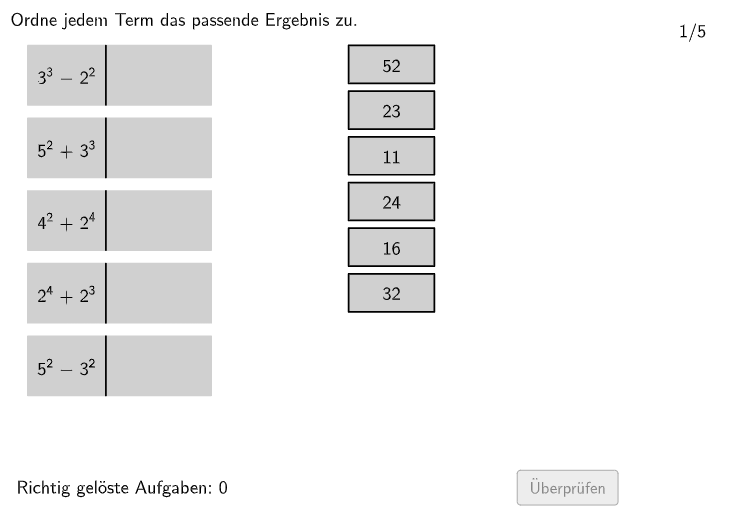
This GeoGebra example uses an interactive “match/assign” activity to help students connect positive-integer exponent notation with the meaning of repeated multiplication. It visualizes the idea that a^n represents multiplying the same number a by itself n times, and then checks student selections through immediate feedback. Key math concepts include interpreting and applying exponentiation with positive integer exponents, reading power notation as repeated multiplication, and using power expressions in simple reasoning tasks for understanding. Construction and interaction rely on GeoGebra commands and objects such as Polygon (build regions/frames for answers), Sequence (generate ordered data/positions), Shuffle (randomize option order), If (condition-based feedback), Textfield (user input/selection), Element plus Append/Remove (dynamic option management), CountIf and Length (count matches and validate sets), and PointIn (determine whether an item is placed in the correct region). It is well suited for Grades 7–8 as a conceptual exercise on exponent operations and can be used for classroom practice or online assignments.
GeoGebra Commands & Parameters
Polygon(allowedRect4, allowedRect3, allowedRect2, allowedRect1) → allowedRect, a_1, b, c, dMax(widthsOptionsR) → widthRMax(heightsOptionsR) → heightRMax(heightR, Max[heightsOptionsL]) → heightLMax(widthsOptionsL) → widthLIf(isShuffleOptionsLechts, Shuffle[1…numOptionsR], 1…numOptionsR) → indizesOptionsRechtsIf(isShuffleOptionsLinks, Shuffle[1…numOptionsL], 1…numOptionsL) → indizesOptionsLinksTextfield(input1) → InputBox1Textfield(input2) → InputBox2Polygon(PtopLeftCornerFeedback, PtopRightCornerFeedback, PbottomRightCornerFeedback, PbottomLeftCornerFeedback) → rectangleCorrect, rectangleCorrectS3, rectangleCorrectS4, rectangleCorrectS2, rectangleCorrectS1Shuffle(Sequence[Random[0, 10], i, 1, 100]) → randomNosForX, {4, 7, 8, 7, 7, 3, 9, 0, 7, 10, 7, 4, 5, 7, 10, 2, 9, 9, 3, 6, 3, 7, 4, 9, 5, 5, 9, 4, 10, 9, 0, 1, 3, 1, 7, 8, 3, 8, 2, 0, 5, 6, 1, 3, 4, 10, 3, 8, 9, 3, 0, 9, 3, 2, 0, 10, 2, 5, 10, 0, 10, 4, 2, 10, 5, 10, 7, 6, 3, 7, 7, 6, 8, 4, 1, 1, 2, 4, 8, 5, 8, 2, 5, 5, 2, 1, 5, 1, 0, 2, 10, 1, 1, 5, 7, 9, 0, 8, 6, 9}Element(randomNosForX, Mod[questionCount, 100] + 1) → numXShuffle(Sequence[Random[0, 10], i, 1, 100]) → randomNosForY, {8, 5, 3, 3, 10, 0, 3, 3, 10, 3, 4, 10, 0, 4, 1, 2, 8, 7, 4, 3, 6, 1, 8, 9, 5, 4, 0, 3, 1, 6, 1, 7, 1, 4, 6, 9, 9, 9, 0, 9, 3, 3, 7, 7, 0, 5, 7, 3, 9, 2, 3, 6, 8, 0, 1, 0, 8, 3, 7, 7, 6, 6, 7, 7, 10, 5, 9, 3, 8, 6, 2, 9, 0, 10, 10, 0, 4, 2, 5, 6, 3, 0, 6, 1, 8, 0, 10, 5, 8, 10, 0, 8, 0, 0, 3, 5, 5, 8, 8, 9}Element(randomNosForY, Mod[questionCount, 100] + 1) → numYAppend(true, Sequence[If[randomNosForX(i) ≟ randomNosForX(i - 1), false, true], i, 2, 100]) → stayXAppend(true, Sequence[If[randomNosForY(i) ≟ randomNosForY(i - 1), false, true], i, 2, 100]) → stayYRemove(Sequence[If[stayX(i), randomNosForX(i), 0], i, 1, 100], Sequence[0, i, 1, 100]) → randomNosForXwithoutRepeatRemove(Sequence[If[stayY(i), randomNosForY(i), 0], i, 1, 100], Sequence[0, i, 1, 100]) → randomNosForYwithoutRepeatElement(randomNosForXwithoutRepeat, Mod[questionCount, Length[randomNosForXwithoutRepeat]] + 1) → numXwithoutRepeatElement(randomNosForYwithoutRepeat, Mod[questionCount, Length[randomNosForYwithoutRepeat]] + 1) → numYwithoutRepeatSequence(1) → positionsOptionsRechtsSequence(Element[optionsRAll, indizesOptionsRechts(i)], i, 1, numOptionsR) → optionsRActualLength(optionsRActual) → aSequence(Element[optionsLAll, indizesOptionsLinks(i)], i, 1, numOptionsL) → optionsLActualSequence(allOptionsL(indizesOptionsLinks(i)), i, 1, numOptionsL) → optionsLSequence(allOptionsR(indizesOptionsLinks(i)), i, 1, numOptionsL) → optionsRPolygon((-10, -2), (10, -2), (10, 10), (-10, 10)) → q1, q_1, r_1, s_1, t_1Polygon(E, F, G, H) → q2, e_1, f_2, g_2, h_2Polygon(I, J, K, L) → q3, i_2, j_2, k_1, l_1Sequence(optionsLoesungAll(indizesOptionsLinks(i)), i, 1, numOptionsL) → optionsLoesungText(optionsLActual(1), CenterOptionL1, true, true, 0, 0) → opL1Text(optionsLActual(2), CenterOptionL2, true, true, 0, 0) → opL2Text(optionsLActual(3), CenterOptionL3, true, true, 0, 0) → opL3Text(optionsLActual(4), CenterOptionL4, true, true, 0, 0) → opL4Text(optionsLActual(5), CenterOptionL5, true, true, 0, 0) → opL5PointIn(allowedRect) → CenterOptionR1Text(optionsRActual(1), CenterOptionR1, true, true, 0, 0) → opR1Polygon(CenterOptionR1, CenterOptionR1 - (widthR / 2, heightR / 2), CenterOptionR1 + (widthR / 2, ((-heightR)) / 2), CenterOptionR1 + (widthR / 2, heightR / 2), CenterOptionR1 - (widthR / 2, ((-heightR)) / 2), CenterOptionR1 - (widthR / 2, heightR / 2)) → rectRMove1, centeroptionr1, f, g, h, i, jPointIn(allowedRect) → CenterOptionR2Text(optionsRActual(2), CenterOptionR2, true, true, 0, 0) → opR2Polygon(CenterOptionR2, CenterOptionR2 - (widthR / 2, heightR / 2), CenterOptionR2 + (widthR / 2, ((-heightR)) / 2), CenterOptionR2 + (widthR / 2, heightR / 2), CenterOptionR2 - (widthR / 2, ((-heightR)) / 2), CenterOptionR2 - (widthR / 2, heightR / 2)) → rectRMove2, centeroptionr2, k, l, m, n, pPointIn(allowedRect) → CenterOptionR3Text(optionsRActual(3), CenterOptionR3, true, true, 0, 0) → opR3Polygon(CenterOptionR3, CenterOptionR3 - (widthR / 2, heightR / 2), CenterOptionR3 + (widthR / 2, ((-heightR)) / 2), CenterOptionR3 + (widthR / 2, heightR / 2), CenterOptionR3 - (widthR / 2, ((-heightR)) / 2), CenterOptionR3 - (widthR / 2, heightR / 2)) → rectRMove3, centeroptionr3, q, r, s, t, ePointIn(allowedRect) → CenterOptionR4Text(optionsRActual(4), CenterOptionR4, true, true, 0, 0) → opR4Polygon(CenterOptionR4, CenterOptionR4 - (widthR / 2, heightR / 2), CenterOptionR4 + (widthR / 2, ((-heightR)) / 2), CenterOptionR4 + (widthR / 2, heightR / 2), CenterOptionR4 - (widthR / 2, ((-heightR)) / 2), CenterOptionR4 - (widthR / 2, heightR / 2)) → rectRMove4, centeroptionr4, f_1, g_1, h_1, i_1, j_1PointIn(allowedRect) → CenterOptionR5Text(optionsRActual(5), CenterOptionR5, true, true, 0, 0) → opR5Polygon(CenterOptionR5, CenterOptionR5 - (widthR / 2, heightR / 2), CenterOptionR5 + (widthR / 2, ((-heightR)) / 2), CenterOptionR5 + (widthR / 2, heightR / 2), CenterOptionR5 - (widthR / 2, ((-heightR)) / 2), CenterOptionR5 - (widthR / 2, heightR / 2)) → rectRMove5, centeroptionr5, m_1, n_1, b_1, c_1, d_1PointIn(allowedRect) → CenterOptionR6Text(optionsRActual(6), CenterOptionR6, true, true, 0, 0) → opR6Polygon(CenterOptionR6, CenterOptionR6 - (widthR / 2, heightR / 2), CenterOptionR6 + (widthR / 2, ((-heightR)) / 2), CenterOptionR6 + (widthR / 2, heightR / 2), CenterOptionR6 - (widthR / 2, ((-heightR)) / 2), CenterOptionR6 - (widthR / 2, heightR / 2)) → rectRMove6, centeroptionr6, k_2, l_2, m_2, n_2, p_2If(CountIf[P ∈ answerRectLarger1(1), P, verticesR1] ≟ 4, 1, -1, CountIf[P ∈ answerRectLarger2(1), P, verticesR1] ≟ 4, 2, CountIf[P ∈ answerRectLarger3(1), P, verticesR1] ≟ 4, 3, CountIf[P ∈ answerRectLarger4(1), P, verticesR1] ≟ 4, 4, CountIf[P ∈ answerRectLarger5(1), P, verticesR1] ≟ 4, 5) → indexAnswerR1If(CountIf[P ∈ answerRectLarger1(1), P, verticesR2] ≟ 4, 1, -1, CountIf[P ∈ answerRectLarger2(1), P, verticesR2] ≟ 4, 2, CountIf[P ∈ answerRectLarger3(1), P, verticesR2] ≟ 4, 3, CountIf[P ∈ answerRectLarger4(1), P, verticesR2] ≟ 4, 4, CountIf[P ∈ answerRectLarger5(1), P, verticesR2] ≟ 4, 5) → indexAnswerR2If(CountIf[P ∈ answerRectLarger1(1), P, verticesR3] ≟ 4, 1, -1, CountIf[P ∈ answerRectLarger2(1), P, verticesR3] ≟ 4, 2, CountIf[P ∈ answerRectLarger3(1), P, verticesR3] ≟ 4, 3, CountIf[P ∈ answerRectLarger4(1), P, verticesR3] ≟ 4, 4, CountIf[P ∈ answerRectLarger5(1), P, verticesR3] ≟ 4, 5) → indexAnswerR3If(CountIf[P ∈ answerRectLarger1(1), P, verticesR4] ≟ 4, 1, -1, CountIf[P ∈ answerRectLarger2(1), P, verticesR4] ≟ 4, 2, CountIf[P ∈ answerRectLarger3(1), P, verticesR4] ≟ 4, 3, CountIf[P ∈ answerRectLarger4(1), P, verticesR4] ≟ 4, 4, CountIf[P ∈ answerRectLarger5(1), P, verticesR4] ≟ 4, 5) → indexAnswerR4If(CountIf[P ∈ answerRectLarger1(1), P, verticesR5] ≟ 4, 1, -1, CountIf[P ∈ answerRectLarger2(1), P, verticesR5] ≟ 4, 2, CountIf[P ∈ answerRectLarger3(1), P, verticesR5] ≟ 4, 3, CountIf[P ∈ answerRectLarger4(1), P, verticesR5] ≟ 4, 4, CountIf[P ∈ answerRectLarger5(1), P, verticesR5] ≟ 4, 5) → indexAnswerR5If(CountIf[P ∈ answerRectLarger1(1), P, verticesR6] ≟ 4, 1, -1, CountIf[P ∈ answerRectLarger2(1), P, verticesR6] ≟ 4, 2, CountIf[P ∈ answerRectLarger3(1), P, verticesR6] ≟ 4, 3, CountIf[P ∈ answerRectLarger4(1), P, verticesR6] ≟ 4, 4, CountIf[P ∈ answerRectLarger5(1), P, verticesR6] ≟ 4, 5) → indexAnswerR6CountIf(ind ≠ -1, ind, indizesAnswerR) → numAnswersDraggedToLeftIf(correct, "\vphantom{✘}✓ Richtig", If[correctpartially, "\vphantom{✓}✘ Teilweise richtig", "\vphantom{✓}✘ Falsch"]) → correctTextTempText((("\textsf{" * correctTextTemp) * "}"), PStartCorrectText, true, true, 1, 0) → correctText
AI Drawing Prompt Reference
Create an interactive graphic showing the connection between positive integer exponents and repeated multiplication. Include multiple rectangular regions and options for users to drag and drop. A central large rectangle is surrounded by smaller rectangles as option areas, each labeled with an exponential expression. Users need to drag the expressions to the correct regions representing the multiplication results. The design should clearly illustrate the concept of exponentiation, suitable for middle school students.
The prompt above was compiled from the original drawing commands and is for reference only.