
Archimedes’ Approximation of Pi via Inner/Outer Polygons
Loading the math board and drawing, please wait…
In collections
Pi Approximations
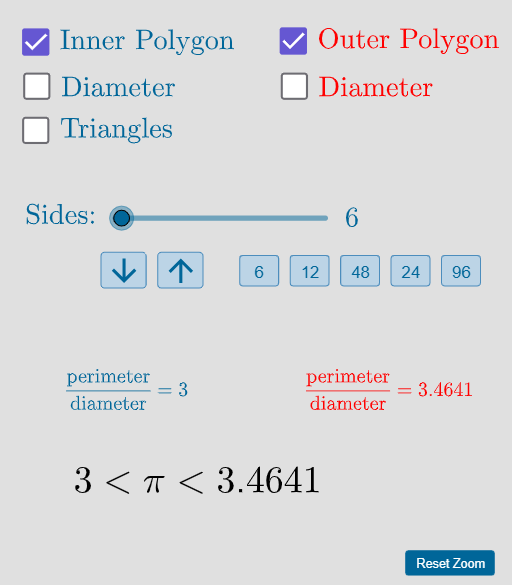
This GeoGebra example demonstrates how π can be approximated by constructing inscribed and circumscribed regular polygons in a circle and observing how the results improve as the number of sides increases. The key mathematics includes circle geometry (circumference and area), polygonal approximation to a circle, and a sequence/convergence viewpoint behind why the estimates get tighter with larger n; it also leverages angle subdivision closely tied to trigonometric notions. Construction-wise, the model uses commands such as Intersect to locate polygon vertices, Sequence to generate angle/point lists for varying n, Polygon and Circle to build the circle and regular polygons, Segment/Line to form the boundaries, and Perimeter to compute inner and outer perimeter estimates; Area is used to compare inner/outer regions, while Append/Element/Zip help manage iterative objects and display intermediate results (e.g., inside vs. outside perimeter/area). Suitable for high school advanced geometry through early university, especially for teaching π approximation and the intuition of convergence with increasing refinement.
GeoGebra Commands & Parameters
Intersect(xAxis, yAxis) → ASequence((radius; (k * anglesize)), k, 0, n - 1) → l1Polygon(l1) → polyCircle(A, radius) → cPoint(c) → BSegment(A, B) → fSequence((radius; (k * anglesize) + (0.5 * anglesize)), k, 0, n - 1) → l2Zip(Tangent[k, c], k, l2) → l3Sequence(Intersect[Element[l3, k], Element[l3, k + 1]], k, 1, Length[l3] - 1) → l4Intersect(Element[l3, 1], Element[l3, Length[l3]]) → CAppend(l4, C) → l5Polygon(l5) → poly2Perimeter(poly) → InsidePerimeterPerimeter(poly2) → OutsidePerimeterSegment(((-radius), 0), (radius, 0)) → gElement(l2, 1) → DLine(D, A) → hIntersect(c, h) → E, FSegment(E, F) → iPoint(c) → GPoint(l1) → HSegment(G, H) → jPoint(c) → IPoint(c) → JSegment(I, J) → k
AI Drawing Prompt Reference
Draw a circle with an inscribed regular polygon and a circumscribed regular polygon. The vertices of the inscribed polygon lie on the circle, while the vertices of the circumscribed polygon lie outside. Draw the boundaries of both polygons and mark their intersection points. Observe how the perimeters of the inscribed and circumscribed polygons approach the circumference of the circle as the number of sides increases.
The prompt above was compiled from the original drawing commands and is for reference only.