
Chord Polygons Preserve a Ratio: A GeoGebra Construction
Loading the math board and drawing, please wait…
In collections
geometriadinamica.es
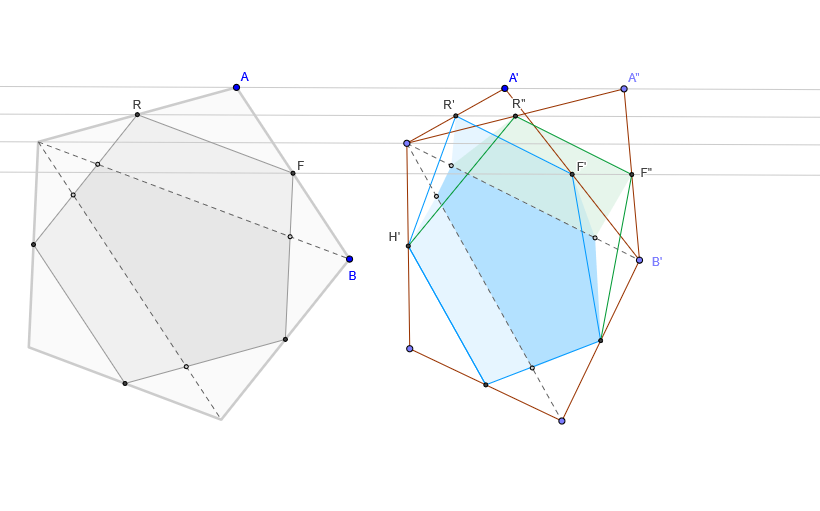
This example demonstrates how to construct a chord-based polygon (with vertices tied to a common circular configuration) and visually verify that a key ratio remains invariant across different polygon instances. The phenomenon highlights the stability of geometric relationships under construction changes. The core ideas include circle–chord geometry, polygon angle/segment relationships, measurement via lengths (distances), and the typical reasoning pathway from triangle/trigonometric structure to an invariant ratio (with an intuition connected to sequences/series behavior). Construction uses GeoGebra tools reflected in the command summary: Line, Point, Polygon, Midpoint, Segment, Intersect, and Distance. The objects poly1, poly4, and poly11 represent different polygon stages/sizes, while named points (e.g., A/A', B/B', C/C') and computed quantities (e.g., via midpoints and intersection points) define chord and partition positions, enabling the ratio to be computed and compared. Suitable for secondary-school geometry exploration, high-school geometry problem solving, and classroom demonstrations with GeoGebra for invariant-property investigations.
GeoGebra Commands & Parameters
Line(A, A') → hPoint(h) → A''Line(B, h) → iPoint(i) → B'Polygon(B, A, 5) → poly1, a, b, c, d, e, E1, D, CLine(C, h) → mPoint(m) → C_2Line(D, h) → lPoint(l) → D'Line(E1, h) → jPoint(j) → E'_1Polygon(A'', E'_1, D', C_2, B') → poly4, a', e_2, d_2, c_2, b_2Midpoint(b_2) → F''Midpoint(a') → R''Segment(E'_1, B') → f_2Midpoint(e) → JMidpoint(d) → IMidpoint(c) → HMidpoint(a) → FMidpoint(b) → RPolygon(R, F, J, I, H) → poly11, r_1, f_3, j_6, i_2, h_6Segment(E1, B) → k_2Intersect(f_3, k_2) → MIntersect(h_6, k_2) → GLine(G, i) → m_2Line(M, m_2) → p_2Intersect(p_2, f_2) → LIntersect(m_2, f_2) → KPolygon(A', B', C_2, D', E'_1) → poly2, a_1, b_1, c_1, d_1, e_1Midpoint(a_1) → F'Midpoint(e_1) → R'Midpoint(b_1) → J'Midpoint(d_1) → H'Midpoint(c_1) → I'Polygon(R', F', J', I', H') → poly3, g_1, f_1, j_1, i_1, h_1Segment(H, R) → qLine(R, h) → n_1Line(F, h) → p_1Line(H, p_1) → a_2Polygon(K, R', F', L) → poly8, s, t_{3}, k_1, l_1Line(J, p_1) → n_2Polygon(K, R'', F'', L) → poly9, m_{3}, q_1, s_1, t_1Polygon(H, I, J) → poly14, v_1, t_2, uSegment(F, J) → tDistance(R', R'') → a3Segment(R'', H') → g_2Segment(R', H') → h_2Line(D, F) → m_1Segment(E'_1, C_2) → j_2Segment(E1, C) → l_2Intersect(j_6, l_2) → NLine(N, i) → q_2Intersect(h_6, l_2) → OSegment(J', F') → nSegment(F'', J') → pLine(O, i) → rIntersect(j_2, r) → EIntersect(j_2, q_2) → PPolygon(P, J', L, K, E) → poly5, p_3, j', l_3, k_3, e_3Polygon(E, H', I', P) → poly6, e_4, h', i', p_4Polygon(O, G, M, J, N) → poly7, o, g_3, m_3, j_3, n_3
AI Drawing Prompt Reference
Draw a circle and construct multiple polygons by connecting vertices on the circle. Show the relationships formed by lines connecting the vertices to the circle's center. Verify that a key ratio of lengths remains invariant across different polygons by measuring distances. Illustrate the construction using midpoints, intersection points, and lines formed by these points to create new polygons, ultimately displaying a collection of multiple polygons and auxiliary shapes.
The prompt above was compiled from the original drawing commands and is for reference only.