
Circumference and Diameter: Polygon Approximation of Pi
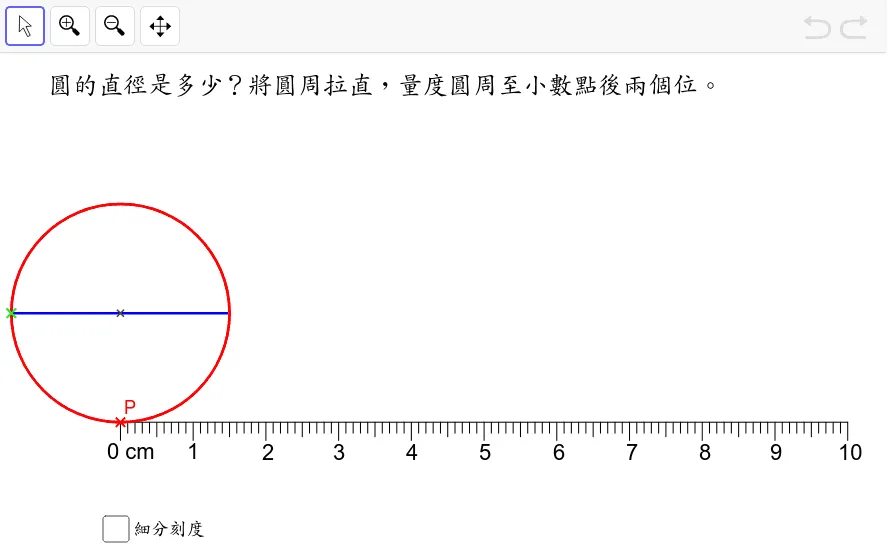
This GeoGebra applet demonstrates the relationship between a circle's circumference and its diameter, providing a visual and interactive derivation of pi (π). The construction uses circles, inscribed or circumscribed polygons, vectors, and trigonometric functions such as the tangent function, combined with the Sequence command for progressive subdivision. By systematically increasing the number of sides of the polygon, the model approximates the circumference through polygon perimeters.
Through parameterized curves (CurveCartesian), circular arcs (CircleArc), and conditional logic (If), the applet builds a fully dynamic interactive model. Students can manipulate parameters and observe in real time how the ratio of the polygon perimeter to the circle's diameter converges toward π as the number of polygon sides increases. This convergence illustrates the core mathematical principle that a circle can be approached arbitrarily closely by regular polygons, embodying the concept of a limit in a tangible, visual form.
The applet is designed for secondary school and early university mathematics instruction. It supports lessons on circle geometry, the definition of π, limits, and numerical approximation methods. By allowing learners to actively explore how finer polygonal subdivisions yield increasingly accurate estimates of π, the tool transforms an abstract concept into an intuitive, hands-on experience. Teachers can use it to introduce or reinforce the idea that π is not merely a memorized constant but a value derived from geometric reasoning and limiting processes.
Overall, the applet serves as an effective educational resource for demonstrating how classical geometric methods can approximate irrational numbers, bridging the gap between Euclidean geometry and calculus-level thinking about limits and convergence.
Loading the math board and drawing, please wait…