
Peg Solitaire Diamond Board Demonstration
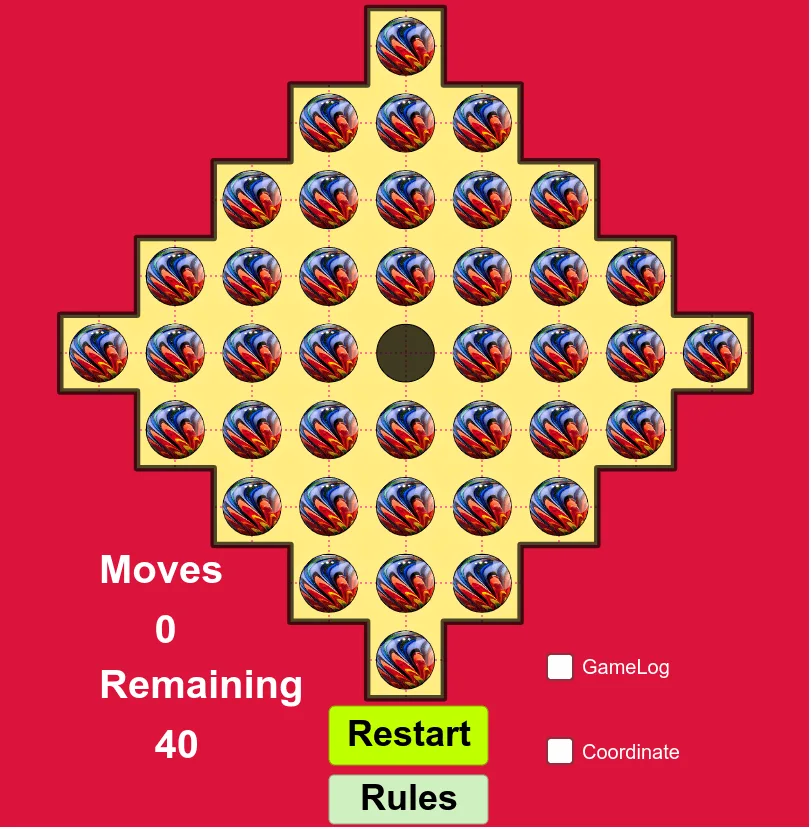
This GeoGebra applet demonstrates the classic Peg Solitaire puzzle on a diamond-shaped board containing 41 holes. The diamond board is a well-known variant of the traditional English-style Peg Solitaire, and this applet provides an interactive environment for students and enthusiasts to explore its geometry, combinatorics, and logical structure.
The applet was constructed using GeoGebra commands such as Polygon, Circle, and Sequence to accurately render the grid and precisely position each hole. The diamond layout consists of rows with varying numbers of holes: 1, 3, 5, 7, 9, 7, 5, 3, 1, forming a symmetric rhombus pattern. This geometric arrangement allows the applet to showcase both mathematical construction techniques and spatial reasoning in an integrated way.
Users can interact with the board by clicking on individual pegs to select them and then clicking on an adjacent empty hole to perform a valid jump move. When a peg jumps over an neighboring peg, the jumped peg is removed from the board, replicating the standard rules of Peg Solitaire. The applet includes interactive logic that validates each move, ensuring only legal jumps are executed. An automated log records every move made during gameplay, providing a full trace of the game state progression that students can review and analyze.
The center starting hole is initially empty, and the objective of the game is to reduce the number of remaining pegs to exactly one through a sequence of valid jumps. The applet supports undo functionality and resets, allowing learners to experiment with different strategies and compare solutions.
This model highlights the intersection of geometric construction, algorithmic thinking, and combinatorial reasoning. By visualizing the board dynamically, students gain intuitive insight into the constraints and branching possibilities inherent in the puzzle. The interactive nature of the applet makes abstract concepts in discrete mathematics tangible, helping learners develop logical deduction skills and strategic planning abilities. It serves as both an engaging recreational tool and a rigorous educational platform for studying graph traversal, state-space search, and the underlying mathematical structure of constraint-based games.
In collections
Math Games with GeoGebra
Loading the math board and drawing, please wait…