
Ultimate Tic-Tac-Toe
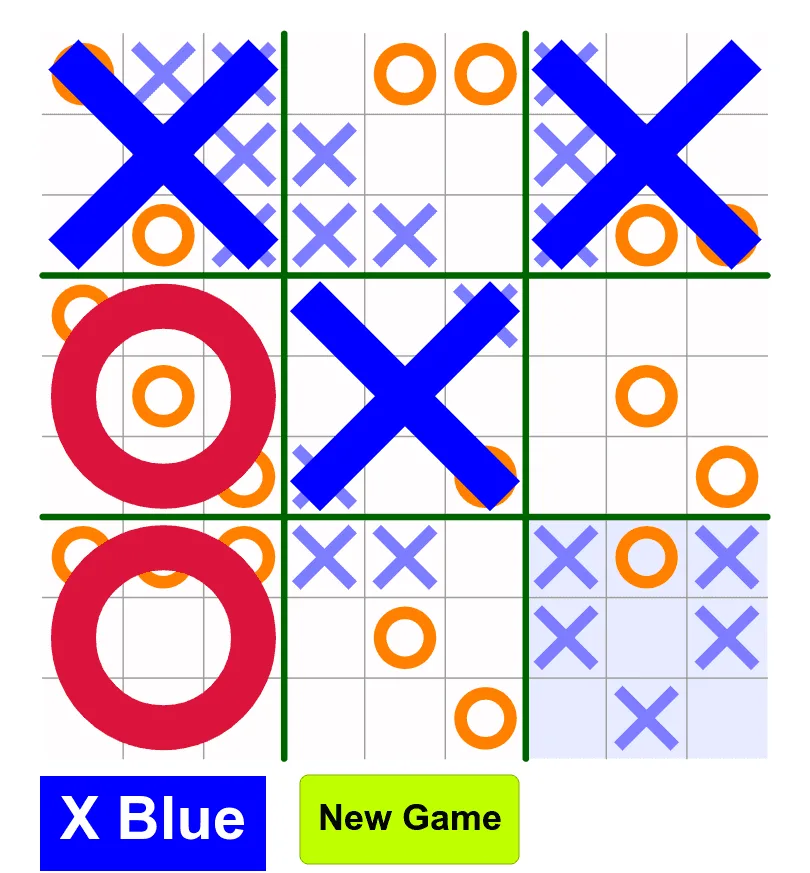
This interactive GeoGebra applet presents a comprehensive digital construction of the Ultimate Tic-Tac-Toe board, elevating the classic childhood game into a profound exercise in combinatorial game theory and discrete mathematics. Visually, the applet utilizes precise polygon commands to render a large 3x3 macro grid composed of nine smaller, individual tic-tac-toe micro grids. This nested geometric layout results in a total of 81 playable squares, providing a striking visual representation of recursive structures and fractal-like grid modeling within a two-dimensional plane.
The core interaction of the applet revolves around the unique ruleset of Ultimate Tic-Tac-Toe, which transforms a trivial, solved game into one of deep strategic complexity. When a player places their mark in a specific square of a micro grid, their opponent is forced to play their next move in the corresponding micro grid of the macro board. The applet dynamically highlights the active sub-grid, guiding users through the constrained movement mechanics and visually tracking the state of both the local micro battles and the global macro war. Winning a local 3x3 grid claims that section of the larger board, and the ultimate goal is to win three macro sections in a row.
From a mathematical perspective, this applet serves as an exceptional tool for exploring combinatorial explosion and state-space complexity. While standard tic-tac-toe possesses a relatively small game tree that can be easily solved, Ultimate Tic-Tac-Toe introduces a massive branching factor and intricate heuristic dependencies. Students can observe how local tactical decisions directly dictate global strategic options, illustrating the concept of constrained optimization. The geometric construction of the board itself offers a practical application of coordinate geometry and spatial partitioning, demonstrating how complex discrete structures can be mapped and modeled using fundamental geometric primitives.
For students and educators, the applet provides immense educational value. It acts as an engaging bridge between recreational mathematics and formal logical strategy analysis. By interacting with the board, learners naturally develop advanced forward-planning skills, spatial reasoning, and the ability to evaluate multi-layered decision trees. Teachers can utilize this visualization in discrete mathematics or computer science courses to introduce topics such as algorithmic game theory, minimax algorithms, and the computational complexity of combinatorial games. Ultimately, the applet transforms an abstract mathematical concept into a tangible, highly interactive puzzle that challenges the mind and deepens the understanding of nested geometric and logical systems.
In collections
Math Games with GeoGebra
Loading the math board and drawing, please wait…