
Vector Representation in 3D Space
Loading the math board and drawing, please wait…
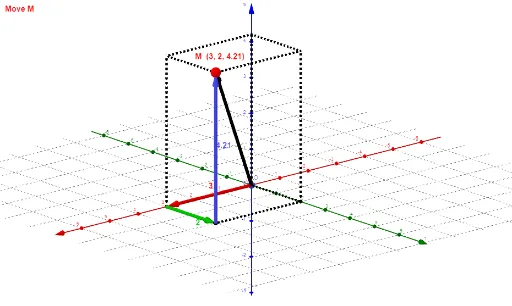
This GeoGebra example demonstrates how to express and decompose a vector in three-dimensional space using given directions (e.g., reference directions or vectors determined by constructed segments). It builds geometric relationships that reflect vector equality via parallelism and translation, emphasizing how endpoints and direction lines determine the same vector in space. Key concepts include 3D vector representation, vector translation/stacking, constructing vectors from segments, and using midpoint/intersection to obtain structured intermediate points that support the decomposition. The construction is driven by commands such as Line (create direction lines), Intersect (compute intersection points), Translate (apply translations to form parallel relationships), Vector (create vector objects), Segment (create connecting segments), and Midpoint (find midpoints for scaffolded geometry). Typical point objects (e.g., M, B, C, D and their translated counterparts) plus derived vectors are used to make the representation visually precise. Suitable for secondary school advanced/vector topics and early undergraduate vector geometry, especially for lessons on spatial intuition and vector decomposition.
GeoGebra Commands & Parameters
Line(C, xAxis) → fLine(B, yAxis) → gIntersect(f, g) → ALine(A, zAxis) → hLine(C, zAxis) → iLine(B, zAxis) → jLine(M, xAxis) → kLine(M, yAxis) → lLine(D, xAxis) → mLine(D, yAxis) → nIntersect(k, n) → EIntersect(l, m) → FTranslate(O, Vector[(If[b < 5, b / 5, 1] * Vector[O, C])]) → O'Vector(O, O') → uTranslate(C, Vector[(If[b ≤ 5, 0, If[5 ≤ b < 10, (b - 5) / 5, 1]] * Vector[C, A])]) → C'Vector(O', C') → vTranslate(A, Vector[(If[b ≤ 10, 0, If[10 < b < 15, (b - 10) / 5, 1]] * Vector[A, M])]) → A'Vector(A, A') → wSegment(D, E) → pSegment(E, M) → qSegment(M, F) → rSegment(D, F) → sSegment(M, A) → tSegment(F, B) → eSegment(O, D) → g_1Segment(A, B) → dSegment(E, C) → b_{1}Segment(C, A) → c_{1}Segment(C, O) → f_1Translate(O, Vector[(If[a < 5, a / 5, 1] * Vector[O, B])]) → O'_{1}Vector(O, O'_{1}) → u_1Translate(A, Vector[(If[a ≤ 10, 0, If[10 < a < 15, (a - 10) / 5, 1]] * Vector[A, M])]) → A'_{1}Translate(B, Vector[(If[a ≤ 5, 0, If[5 ≤ a < 10, (a - 5) / 5, 1]] * Vector[B, A])]) → B'Vector(B, B') → v_1Vector(A, A'_{1}) → w_1Translate(O, Vector[(If[c < 5, c / 5, 1] * Vector[O, D])]) → O'_{2}Vector(O, O'_{2}) → d_1Translate(D, Vector[(If[c ≤ 5, 0, If[5 ≤ c < 10, (c - 5) / 5, 1]] * Vector[D, F])]) → D'Vector(D, D') → e_1Translate(F, Vector[(If[c ≤ 10, 0, If[10 < c < 15, (c - 10) / 5, 1]] * Vector[F, M])]) → F'Vector(F, F') → h_1Vector(O, M) → i_1Midpoint(O, O'_{1}) → IMidpoint(B, B') → JMidpoint(A, A'_{1}) → K
AI Drawing Prompt Reference
In 3D space, construct a reference framework with segments and planes along coordinate axes from the origin. From given points, draw lines parallel to each axis, find intersection points, and connect them to form parallelograms or rectangles. Use sliders to control proportions, translate points along specific directions to generate vectors placed head-to-tail, representing vector decomposition in three directions. Additionally, construct midpoints and connect them to relevant vertices to form auxiliary segments, clearly showing parallel and equal vector relationships. The overall figure emphasizes geometric representation and decomposition of vectors in space.
The prompt above was compiled from the original drawing commands and is for reference only.