
Various Methods to Construct a Cardioid
Loading the math board and drawing, please wait…
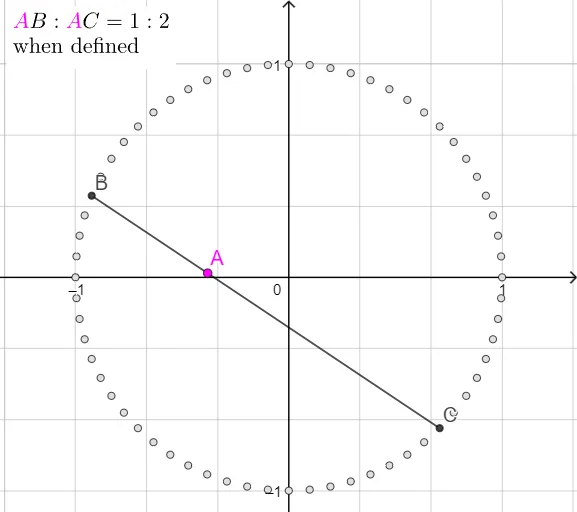
This example demonstrates various methods to construct a cardioid, a special curve resembling a heart. Using geometric concepts such as rotation, tangent, and angle, we can construct a cardioid. The example uses GeoGebra commands like Intersect, CurveCartesian, Segment, Sequence, Circle, Tangent, Angle, Rotate, etc., suitable for high school mathematics education and learning.
GeoGebra Commands & Parameters
Intersect(xAxis, yAxis) → OCurveCartesian((R / 3 * cos(t)), (R / 3 * sin(t)), t, 0, (2 * pi)) → cCurveCartesian(X(t), Y(t), t, 0, (2 * pi)) → aCurveCartesian((R * cos(t)), (R * sin(t)), t, 0, (2 * pi)) → bSegment(B, C) → fCurveCartesian((((2 * R)) / 3 * cos(t)), (((2 * R)) / 3 * sin(t)), t, 0, (2 * pi)) → dSequence(b(((2 * pi) * t / N)), t, 0, N - 1) → l1Sequence(c(((2 * pi) * t / N)), t, 0, N - 1) → l2Circle(c(T), a(pi)) → kSegment(c(T), A) → jCircle(d(T), R / 3) → eCurveCartesian(R / 3 + (((2 * R)) / 3 * cos(t)), (((2 * R)) / 3 * sin(t)), t, 0, (2 * pi)) → mSegment(I, J) → nTangent(J, m) → pSegment(H, G) → hAngle(J, G, A) → angle2Angle(O, H, G) → angle1Segment(G, J) → iAngle((1, 0), O, D) → angle3Angle(J, D, A) → angle4Segment(D, A) → gSegment(O, D) → lSegment(D, J) → rCorner(1, 5) → Dims1Segment(H, A) → qRotate(D, pi / 2, A) → B2_{image}Corner(2, 5) → Dims2PolyLine((xminideal, yminideal), (xmaxideal, yminideal), (xmaxideal, ymaxideal), (xminideal, ymaxideal), (xminideal, yminideal)) → Window