
Unwrapping a Cylinder: Geometric Construction and Transformations
Loading the math board and drawing, please wait…
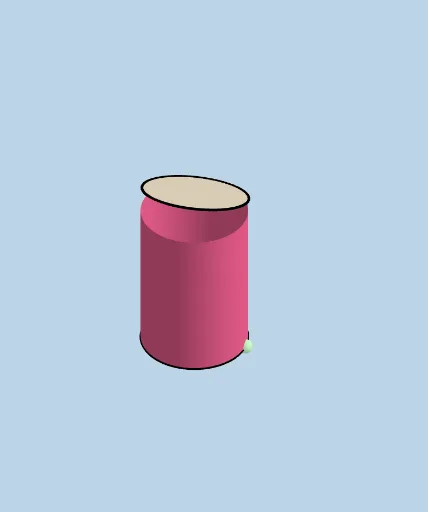
This example demonstrates how to unwrap the lateral surface of a cylinder onto a plane along a chosen generatrix, producing a planar net that corresponds to the original 3D geometry. It highlights the geometric phenomenon that lengths around the circular cross-section become distances along an arc/line segment in the unfolded layout, preserving the underlying angle and similarity relationships. Key concepts include cylinder surface unwrapping, solid-to-plane geometric mapping, similarity of triangles for angle/ratio justification, and coordinate/vector-driven construction supported by geometric transformations. The construction uses GeoGebra commands such as Cylinder to build the solid, Line/Plane/Intersect (and supporting Sphere objects) to determine intersection curves and auxiliary sections, and Rotate, Dilate, Vector, Translate to carry points from the cylinder surface into the unfolding plane. Finally, Polygon, Segment, and CircleArc are used to draw the resulting boundary and arc elements of the net. Suitable for advanced middle school through early university students, especially in solid geometry and transformation-based visualization learning.
GeoGebra Commands & Parameters
Cylinder(A, C, r) → a, c, d, bLine(D, E) → fIntersect(f, d, 1) → FSphere(F, r) → eIntersect(f, e) → G, HPlane(G, F, C) → gRotate(C, If[0 < i ≤ 1, (i * π / 2), π / 2], D, g) → C'Rotate(d, If[0 < i ≤ 1, (i * π / 2), π / 2], D, g) → d'Rotate(dd, If[0 < i ≤ 1, (i * π / 2), π / 2], D, g) → dd'Dilate(C, If[1 < i ≤ 2, 2 - i, 0], I) → C'_1Dilate(C, If[1 < i ≤ 2, 2 - i, 0], J) → C'_2Vector(C, C'_1) → uVector(C, C'_2) → vTranslate(dd, u) → dd'_1Translate(dd, v) → dd'_2Translate(K, u) → K'Translate(K, v) → K'_1Rotate(K', If[1 < i ≤ 2, ((i - 1) * π), π], C'_1) → K''Rotate(K'_1, If[1 < i ≤ 2, ((-(i - 1)) * π), (-π)], C'_2) → LTranslate(D, u) → D'Translate(D, v) → D'_1Polygon(D', D'_1, N, M) → poly1, d'_1, d'_2, n, mSegment(K'', Q) → jCircleArc(P, Q, M) → kSegment(L, S) → lCircleArc(R, N, S) → pCircleArc(C'_2, D'_1, L) → qCircleArc(C'_1, K'', D') → sPlane(T, A, B) → oRotate(C', If[2 < i ≤ 3, ((i - 2) * π / 2), π / 2], E, g) → C''Rotate(poly1, If[2 < i ≤ 3, ((i - 2) * π / 2), π / 2], E, g) → poly1'Rotate(d', If[2 < i ≤ 3, ((i - 2) * π / 2), π / 2], E, g) → d'_3Rotate(dd', If[2 < i ≤ 3, ((i - 2) * π / 2), π / 2], E, g) → dd'_3Rotate(K'', If[2 < i ≤ 3, ((i - 2) * π / 2), π / 2], E, g) → K'''Rotate(Q, If[2 < i ≤ 3, ((i - 2) * π / 2), π / 2], E, g) → Q'Segment(K''', Q') → j'Rotate(L, If[2 < i ≤ 3, ((i - 2) * π / 2), π / 2], E, g) → L'Rotate(S, If[2 < i ≤ 3, ((i - 2) * π / 2), π / 2], E, g) → S'Segment(L', S') → l'Dilate(C'', If[3 < i ≤ 4, 4 - i, 0], U) → C'''Vector(C'', C''') → wDilate(C'', If[3 < i ≤ 4, 4 - i, 0], V) → C'''_1Vector(C'', C'''_1) → tTranslate(Z, w) → Z'Translate(Z, t) → Z'_1Translate(W, w) → W'Translate(W, t) → W'_1Rotate(W', If[3 < i ≤ 4, ((-(i - 3)) * π), (-π)], C''') → W''CircleArc(C''', Z', W'') → c_1Segment(Z, Z') → f_1Rotate(W'_1, If[3 < i ≤ 4, ((i - 3) * π), π], C'''_1) → A_1CircleArc(C'''_1, Z'_1, A_1) → d_1Segment(Z, Z'_1) → g_1
AI Drawing Prompt Reference
Draw a cylinder and illustrate the process of unwrapping its lateral surface along a generatrix into a flat net. The cylinder has a circular base, and the unwrapped surface forms a rectangle whose one side equals the cylinder's height and the other side equals the circumference of the base circle. During unwrapping, points on the cylinder surface are mapped to the plane via rotations and translations, creating corresponding segments and circular arcs. The final figure includes the 3D cylinder outline, the flattened boundary, and auxiliary segments and arcs connecting corresponding points, demonstrating the 3D-to-2D geometric transformation.
The prompt above was compiled from the original drawing commands and is for reference only.