
Isometries Case 4: Independent R & T (Reflection + Translation)
Loading the math board and drawing, please wait…
In collections
Congruence Transformations
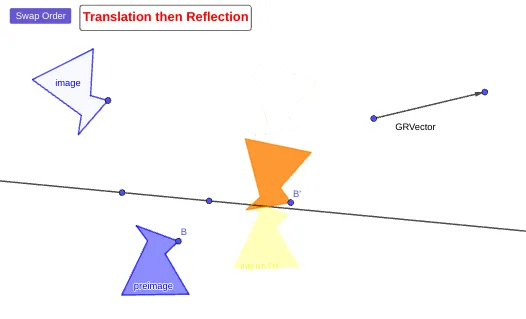
This example demonstrates how to obtain congruent (isometric) correspondences between geometric figures by applying an independent sequence of transformations—translation and reflection—while preserving key invariants such as distances and perimeter-related relations. The core ideas are isometries (distance-preserving mappings), vector-based translation, reflection across a line, and the use of preimage/image points to track how each vertex moves under the transformation. Construction-wise, the GeoGebra setup uses commands If, Vector, Translate, Line, Mirror, Point, and Polygon. A reflection axis is defined via Line (lineOfReflection), a vector (GRVector) drives the Translate step to produce image points (e.g., A′, B′, C′, …), and Mirror is then applied to the translated configuration to produce the next set of images (e.g., A″, B″, C″, …). Animators (anim1/anim2, animator) together with intermediate variables (like interimRT and indexed points such as a′3, b′3, …) support step-by-step visualization, while Polygon connects transformed vertices to form the resulting figure whose perimeter/ratio behavior can be compared. Suitable for secondary-school advanced geometry, contest preparation, and lessons on transformation geometry and invariants.
GeoGebra Commands & Parameters
If(animator > 1, animator - 1, 0) → anim2Vector(K, L) → GRVectorTranslate(A, GRVector) → A'Line(I, J) → lineOfReflectionMirror(A', lineOfReflection) → A''If(animator > 1, 1, animator) → anim1Point(Circle[A, 1.2851459061133876]) → BPolygon(A, B, C, D, E, F) → preimage, a, b, c, d, e, fMirror(A, lineOfReflection) → A'_{1}Mirror(B, lineOfReflection) → B'_{1}Mirror(C, lineOfReflection) → C'_{1}Mirror(D, lineOfReflection) → D'_{1}Mirror(E, lineOfReflection) → E'_{1}Mirror(F, lineOfReflection) → F'_{1}Mirror(A, lineOfReflection) → A'_{3}Mirror(B, lineOfReflection) → B'_{3}Mirror(C, lineOfReflection) → C'_{3}Mirror(D, lineOfReflection) → D'_{3}Mirror(E, lineOfReflection) → E'_{3}Mirror(F, lineOfReflection) → F'_{3}Polygon(A'_{3}, B'_{3}, C'_{3}, D'_{3}, E'_{3}, F'_{3}) → interimRT, a'_{3}, b'_{3}, c'_{3}, d'_{3}, e'_{3}, f'_{3}Point(Circle[U, 1.2935928228236204]) → B_2Polygon(U, B_2, W, Z, G_1, H_1) → image, u, v, w, z_1, g_1, h_1Translate(A'_{3}, GRVector) → MTranslate(B'_{3}, GRVector) → B'Translate(C'_{3}, GRVector) → OTranslate(D'_{3}, GRVector) → PTranslate(E'_{3}, GRVector) → QTranslate(F'_{3}, GRVector) → RPolygon(M, B', O, P, Q, R) → finalRT, m, n, o, p, q, rTranslate(B, GRVector) → B'_{2}Translate(C, GRVector) → C'Translate(D, GRVector) → D'Translate(E, GRVector) → E'Translate(F, GRVector) → F'Polygon(A', B'_{2}, C', D', E', F') → intermTR, a', b'_{2}, c', d', e', f'Mirror(B'_{2}, lineOfReflection) → B''Mirror(C', lineOfReflection) → C''Mirror(D', lineOfReflection) → D''Mirror(E', lineOfReflection) → E''Mirror(F', lineOfReflection) → F''Polygon(A'', B'', C'', D'', E'', F'') → finalTR, a'', g, c'', d'', e'', f''Translate(B, Vector[(anim1 * GRVector)]) → B'_{4}Translate(C, Vector[(anim1 * GRVector)]) → C'_{2}Translate(D, Vector[(anim1 * GRVector)]) → D'_{2}Translate(E, Vector[(anim1 * GRVector)]) → E'_{2}Translate(F, Vector[(anim1 * GRVector)]) → F'_{2}Translate(A, Vector[(anim1 * GRVector)]) → A'_{2}Polygon(A'_{2}, B'_{4}, C'_{2}, D'_{2}, E'_{2}, F'_{2}) → interimTRsliding, a'_{2}, b'_{4}, c'_{2}, d'_{2}, e'_{2}, f'_{2}Polygon(A''_{moving}, B''_{moving}, C''_{moving}, D''_{moving}, E''_{moving}, F''_{moving}) → intermTRflipping, a''_{moving}, b''_{moving}, c''_{moving}, d''_{moving}, e''_{moving}, f''_{moving}Polygon(A'_{1moving}, B'_{1moving}, C'_{1moving}, D'_{1moving}, E'_{1moving}, F'_{1moving}) → interimRTflipping, a'_{1moving}, b'_{1moving}, c'_{1moving}, d'_{1moving}, e'_{1moving}, f'_{1moving}Translate(A'_{3}, Vector[(anim2 * GRVector)]) → GTranslate(B'_{3}, Vector[(anim2 * GRVector)]) → HTranslate(C'_{3}, Vector[(anim2 * GRVector)]) → NTranslate(D'_{3}, Vector[(anim2 * GRVector)]) → STranslate(E'_{3}, Vector[(anim2 * GRVector)]) → TTranslate(F'_{3}, Vector[(anim2 * GRVector)]) → VTranslate(A'_{3}, Vector[(anim2 * GRVector)]) → A_1Translate(B'_{3}, Vector[(anim2 * GRVector)]) → B_1Translate(C'_{3}, Vector[(anim2 * GRVector)]) → C_1Translate(D'_{3}, Vector[(anim2 * GRVector)]) → D_1Translate(E'_{3}, Vector[(anim2 * GRVector)]) → E_1Translate(F'_{3}, Vector[(anim2 * GRVector)]) → F_1Polygon(A_1, B_1, C_1, D_1, E_1, F_1) → interimRTsliding, a_1, b_1, c_1, d_1, e_1, f_1
AI Drawing Prompt Reference
Draw a closed polygon made of multiple corresponding vertices to illustrate an isometry using an independent sequence of transformations. Start with a set of original polygon vertices, and define a straight line to serve as a reflection axis. Construct a translation vector from given defining points, apply this vector to each original vertex to obtain translated images, and connect those translated points to form the translated polygon. Then reflect the translated polygon across the same reflection axis to produce the final reflected polygon. Keep the original polygon, the translated image, and the reflected image visible to emphasize vertex correspondences and how the perimeter/outline changes under these transformations.
The prompt above was compiled from the original drawing commands and is for reference only.