
Sierpinski Pyramid in a 4D Frame: Geometric Construction
Loading the math board and drawing, please wait…
In collections
GeoGebra and 4D Frame: ideas collection
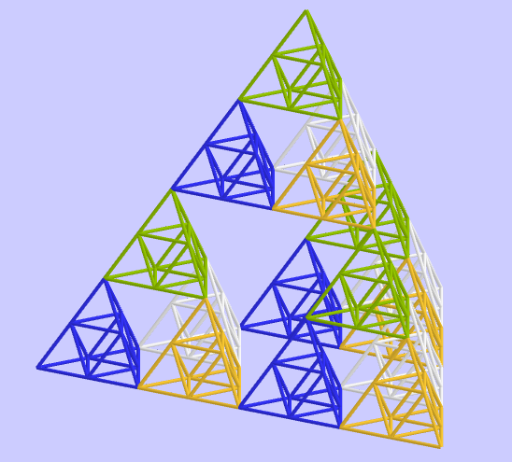
This example visualizes a Sierpinski-type pyramid (fractal tetrahedral structure) using a “4D frame” construction idea projected into a drawable 3D geometric configuration. By composing vector-based transformations and plane/line-guided constraints, the model repeatedly subdivides and symmetrically replicates tetrahedral faces and edges, producing self-similar voids and layered structure. Key concepts include tetrahedra and their edge relationships, midpoints, orthogonal planes, and transformation-based symmetry: Vector for direction building, OrthogonalPlane and Line for geometric constraints, Rotate and Translate for replication, Point for defining transformed vertices, and Tetrahedron to establish the initial 3D solid. The construction then derives multiple face/edge objects (e.g., various faceAA'B / faceA'BC / faceABC and corresponding edges) to assemble the fractal-like frame. Suitable for high school through early undergraduate learners, especially for lessons on solid geometry, geometric constructions, and transformation-driven fractal visualization.
GeoGebra Commands & Parameters
Vector(O, (x(O), y(O), z(O) - (a * sqrt(6) / 3))) → u_{2}Translate(O, u_{2}) → F'OrthogonalPlane(F', zAxis) → pLine(O, F') → fRotate(A, ((2 * π)) / 3, Line[O, F']) → CPoint(Circle[Midpoint[C, A], (Distance[C, A] * sqrt(3) / 2), Segment[C, A]]) → BTetrahedron(C, A, B) → T_O, tet_{strange}, edgeBC, edgeAC, faceAA'B, faceA'BC, faceAA'C, faceABC, edgeA'B, edgeAA'_{1}, edgeAB, edgeA'CMidpoint(edgeA'B) → DMidpoint(edgeA'C) → EMidpoint(edgeAC) → GMidpoint(edgeBC) → HMidpoint(edgeAB) → IMidpoint(edgeAA'_{1}) → JSegment(H, D) → gSegment(D, E) → hSegment(E, H) → iSegment(H, G) → jSegment(G, E) → kSegment(E, J) → lSegment(J, G) → mSegment(G, I) → nSegment(I, H) → qSegment(I, D) → rSegment(I, J) → sSegment(J, D) → tSegment(D, E) → dSegment(G, H) → eVector(O, B) → vTranslate(l1, v) → T_BVector(O, A) → uVector(O, C) → wTranslate(A, u) → A_{1}Translate(C, w) → C_1Translate(B, v) → B_1Translate(l1, u) → T_{A}Translate(l1, w) → T_{C}Translate(l1, Vector[(2 * u)]) → T_A_1Translate(l1, Vector[(2 * w)]) → T_{C1}Translate(l1, Vector[(2 * v)]) → T_{B1}Translate(A_{1}, u) → A_{2}Translate(B_1, v) → B_{2}Translate(C_1, w) → C_{2}Translate(l1, Vector[(3 * u)]) → T_{A2}Translate(l1, Vector[(3 * v)]) → T_{B2}Translate(l1, Vector[(3 * w)]) → T_{C2}Translate(T_{C}, Vector[(2 * v)]) → T_{B'2}Translate(T_{C}, Vector[(2 * u)]) → T_{A''2}Translate(T_B, Vector[(2 * w)]) → T_{C''_2}Translate(T_B, Vector[(2 * u)]) → T_{A'2}Translate(T_{A}, Vector[(2 * v)]) → T_{B''2}Translate(l2, Vector[(4 * u)]) → l3Translate(T_{A}, Vector[(2 * w)]) → T_{C'2}
AI Drawing Prompt Reference
Draw a 3D Sierpinski pyramid framework. Start with a regular tetrahedron defined by three vertices, where one vertex is obtained by rotating another 120 degrees around the vertical axis through the apex, and the third lies on the perpendicular bisector plane of the base edge. Mark midpoints of all edges and connect them to form inner tetrahedral voids. Then translate the entire framework along the three vertex directions by one, two, and three unit lengths, creating nested symmetric layers that reveal a self-similar fractal hollow pyramid.
The prompt above was compiled from the original drawing commands and is for reference only.