
Aperiodic Tiling
Loading the math board and drawing, please wait…
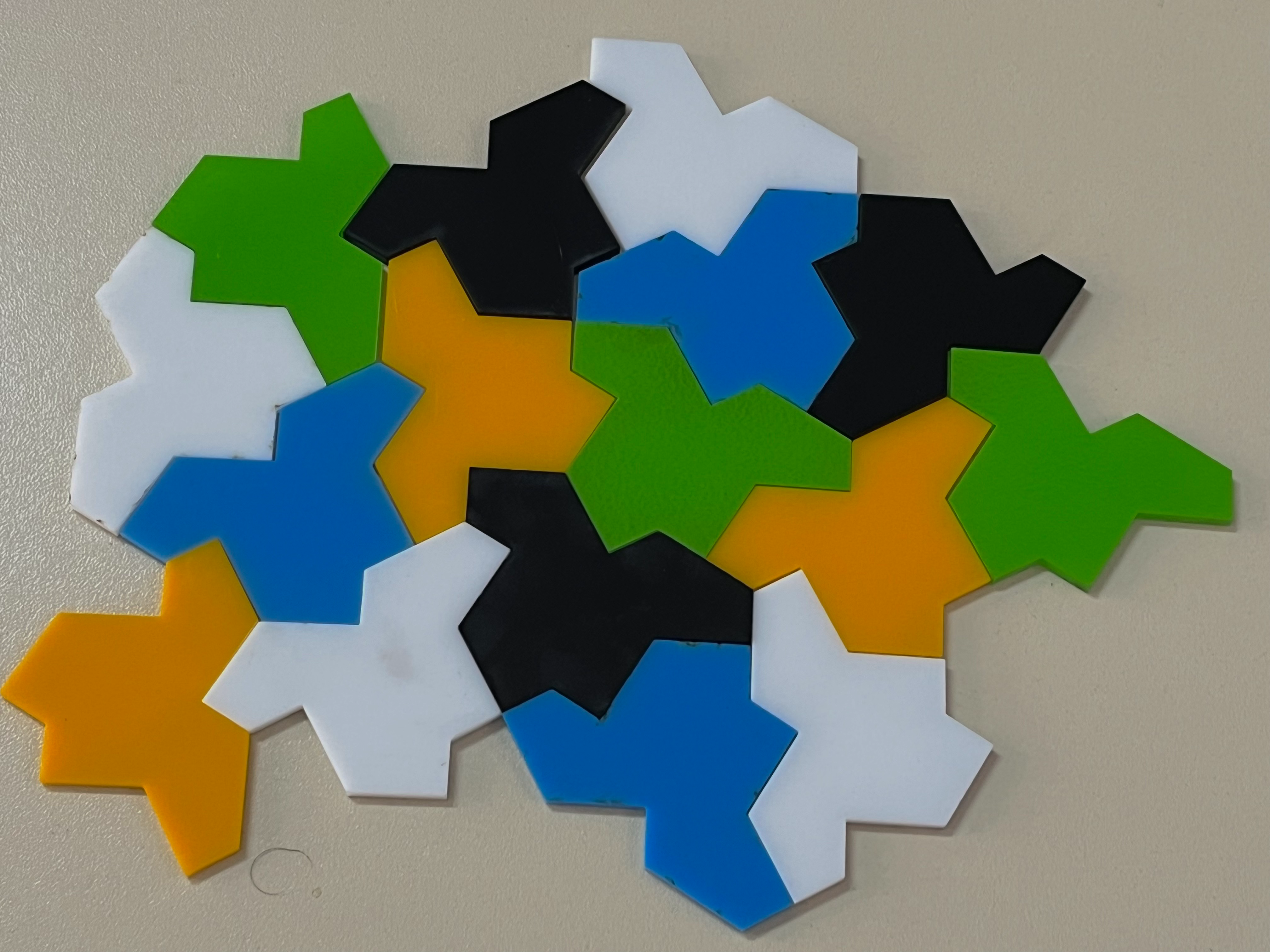
This example demonstrates the geometric construction and properties of aperiodic tiling. Key math concepts include geometric construction, symmetry, and fractal geometry. It utilizes commands like Polygon, Midpoint, Segment, Intersect, and Mirror in GeoGebra. Suitable for high school students and math enthusiasts exploring the construction methods and mathematical aesthetics of aperiodic patterns.
GeoGebra Commands & Parameters
Polygon(A, B, 3) → poly1, f, g, h, CMidpoint(f) → DMidpoint(h) → EMidpoint(g) → FSegment(E, B) → iSegment(F, A) → jIntersect(i, j) → GSegment(G, D) → kSegment(E, G) → lSegment(G, F) → mPolygon(E, C, F, G) → q1, e, c, f_1, g_1Mirror(G, g) → G'Mirror(E, g) → E'Segment(G', E') → nMirror(E, g) → E'_{1}Mirror(C, g) → C'Mirror(F, g) → F'Mirror(G, g) → G'_{1}Polygon(E'_{1}, C', F', G'_{1}) → q1', e'_{1}, c', f', g'_{1}Mirror(E'_{1}, f') → HMirror(C', f') → C''Mirror(F', f') → F''Mirror(G'_{1}, f') → IPolygon(H, C'', F'', I) → q1'', h_1, c'', f'', i_1Mirror(E, h) → E'_{2}Mirror(C, h) → C'_{1}Mirror(F, h) → F'_{1}Mirror(G, h) → G'_{2}Polygon(E'_{2}, C'_{1}, F'_{1}, G'_{2}) → q1'_{1}, e'_{2}, c'_{1}, f'_{1}, g'_{2}Mirror(E'_{2}, c'_{1}) → JMirror(C'_{1}, c'_{1}) → KMirror(F'_{1}, c'_{1}) → LMirror(G'_{2}, c'_{1}) → MPolygon(J, K, L, M) → q2, j_1, k_1, l_1, m_1Polygon(E, G, D, A) → q3, e_1, g_2, d, aMirror(E, f) → E'_{3}Mirror(G, f) → G'_{3}Mirror(D, f) → D'Mirror(A, f) → A'Polygon(E'_{3}, G'_{3}, D', A') → q3', e'_{3}, g'_{3}, d', a'Polygon(G'_{3}, E'_{3}, H, B, D, A, E, G'_{2}, M, J, C, E', G') → poly2, p, g', h_2, b, d_1, q, a_1, e_2, r, m_2, j_2, c_1, e'
AI Drawing Prompt Reference
Start with an equilateral triangle. Mark the midpoints of its three sides. Connect two midpoints to their opposite vertices to find an interior intersection point. Using this point, the triangle's vertices, and the midpoints, construct several quadrilaterals. Reflect these quadrilaterals across the triangle's sides, then continue reflecting across the edges of the newly formed quadrilaterals to expand outward. The result is a tiling pattern of interconnected mirrored quadrilaterals, demonstrating aperiodic symmetry and geometric complexity.
The prompt above was compiled from the original drawing commands and is for reference only.