
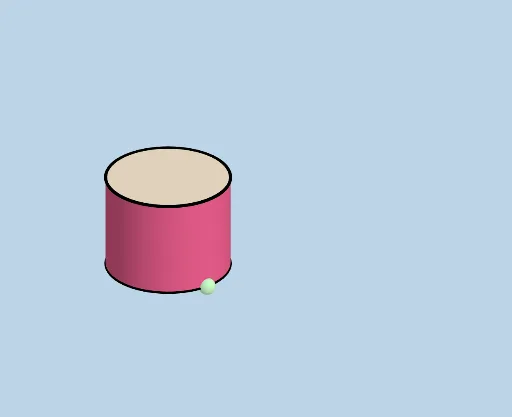
Unwrapping a Cylinder: Dynamic and Modifiable Illustration
Loading the math board and drawing, please wait…
In collections
GeoGebra 3D & AR: Geometry Resources & Challenges
This example demonstrates how to unfold a cylinder into a flat shape, helping students understand how to calculate lateral and total surface areas. Key math concepts include cylinder, 2D vectors, mode, trapezoid, cuboid, and tangent function. Construction highlights the use of GeoGebra commands like Cylinder, Line, Intersect, Sphere, Plane, Rotate, Dilate, Vector, Translate, Polygon, Segment, CircleArc, Angle, CurveCartesian, Surface, Midpoint, Mirror. Suitable for high school students learning solid geometry and area calculations.
GeoGebra Commands & Parameters
Cylinder(A, C, r) → a, c, d, bLine(D, E) → fIntersect(f, d, 1) → FSphere(F, r) → eIntersect(f, e) → G, HPlane(G, F, C) → gRotate(C, If[0 < i ≤ 1, (i * π / 2), π / 2], D, g) → C'Rotate(d, If[0 < i ≤ 1, (i * π / 2), π / 2], D, g) → d'Rotate(dd, If[0 < i ≤ 1, (i * π / 2), π / 2], D, g) → dd'Dilate(C, If[1 < i ≤ 2, 2 - i, 0], I) → C'_1Dilate(C, If[1 < i ≤ 2, 2 - i, 0], J) → C'_2Vector(C, C'_1) → uVector(C, C'_2) → vTranslate(dd, u) → dd'_1Translate(dd, v) → dd'_2Translate(K, u) → K'Translate(K, v) → K'_1Rotate(K', If[1 < i ≤ 2, ((i - 1) * π), π], C'_1) → K''Rotate(K'_1, If[1 < i ≤ 2, ((-(i - 1)) * π), (-π)], C'_2) → LTranslate(D, u) → D'Translate(D, v) → D'_1Polygon(D', D'_1, N, M) → poly1, d'_1, d'_2, n, mSegment(K'', Q) → jCircleArc(P, Q, M) → kSegment(L, S) → lCircleArc(R, N, S) → pCircleArc(C'_2, D'_1, L) → qCircleArc(C'_1, K'', D') → sPlane(T, A, B) → oRotate(C', If[2 < i ≤ 3, ((i - 2) * π / 2), π / 2], E, g) → C''Rotate(poly1, If[2 < i ≤ 3, ((i - 2) * π / 2), π / 2], E, g) → poly1'Rotate(d', If[2 < i ≤ 3, ((i - 2) * π / 2), π / 2], E, g) → d'_3Rotate(dd', If[2 < i ≤ 3, ((i - 2) * π / 2), π / 2], E, g) → dd'_3Rotate(K'', If[2 < i ≤ 3, ((i - 2) * π / 2), π / 2], E, g) → K'''Rotate(Q, If[2 < i ≤ 3, ((i - 2) * π / 2), π / 2], E, g) → Q'Segment(K''', Q') → j'Rotate(L, If[2 < i ≤ 3, ((i - 2) * π / 2), π / 2], E, g) → L'Rotate(S, If[2 < i ≤ 3, ((i - 2) * π / 2), π / 2], E, g) → S'Segment(L', S') → l'Dilate(C'', If[3 < i ≤ 4, 4 - i, 0], U) → C'''Vector(C'', C''') → wDilate(C'', If[3 < i ≤ 4, 4 - i, 0], V) → C'''_1Vector(C'', C'''_1) → tTranslate(Z, w) → Z'Translate(Z, t) → Z'_1Translate(W, w) → W'Translate(W, t) → W'_1Rotate(W', If[3 < i ≤ 4, ((-(i - 3)) * π), (-π)], C''') → W''CircleArc(C''', Z', W'') → c_1Segment(Z, Z') → f_1Rotate(W'_1, If[3 < i ≤ 4, ((i - 3) * π), π], C'''_1) → A_1CircleArc(C'''_1, Z'_1, A_1) → d_1Segment(Z, Z'_1) → g_1Segment(R, N) → h_1Angle(N, R, S) → αCurveCartesian(x(C'_2) + (r * cos(t)), y(C'_2) + (r * sin(t)), z(C'_2), t, π / 2, π / 2 + α) → a_1Vector(A, C) → ttSurface(x(C'_2) + (r * cos(t)) - (u * x(tt)), y(C'_2) + (r * sin(t)) - (u * y(tt)), z(C'_2) - (u * z(tt)), u, 0, 1, t, π / 2, π / 2 + α) → b_1Surface((-x(C'_2)) - (r * cos(t)) - (u * x(tt)), y(C'_2) + (r * sin(t)) - (u * y(tt)), z(C'_2) - (u * z(tt)), u, 0, 1, t, π / 2, π / 2 + α) → e_1Midpoint(L', S') → B_1Midpoint(K''', Q') → C_1Line(B_1, C_1) → i_1Mirror(d_1, i_1) → k_1Mirror(c_1, i_1) → p_1Mirror(Z, i_1) → Z'_2Mirror(Z', i_1) → Z''Segment(Z'_2, Z'') → j_1Mirror(Z, i_1) → Z'_3Mirror(Z'_1, i_1) → D_1Segment(Z'_3, D_1) → l_1
AI Drawing Prompt Reference
Draw an unfolded cylinder, starting by creating a cylinder and then unfolding it into a flat shape. Use rotation, translation, and dilation to generate the various parts of the unfolded shape, such as rectangles, trapezoids, and triangles. Finally, use mirroring and translation to complete the unfolded shape.
The prompt above was compiled from the original drawing commands and is for reference only.