
Similarity in Solid Figures
Loading the math board and drawing, please wait…
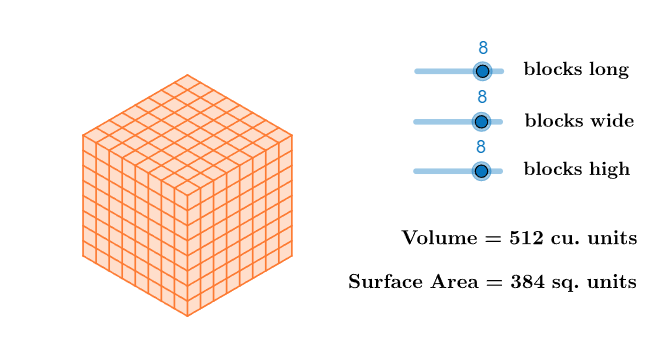
This example demonstrates similarity transformations in solid figures like cubes and prisms. It involves core math concepts such as area and volume calculations, along with transformations like dilation and translation. GeoGebra commands used include Dilate, Polygon, Vector, Translate, Intersect, Circle, Point, Line, OrthogonalLine, and Angle. Suitable for high school geometry and transformation learning.
GeoGebra Commands & Parameters
Dilate(E, a, A) → E'_1Dilate(F, a, D) → F'_1Dilate(G, a, C) → G'_1Dilate(A, b, D) → A'_1Dilate(E'_1, b, F'_1) → E''_1Dilate(B, b, C) → B'_1Dilate(F'_1, c, G'_1) → F''_1Dilate(D, a, B) → D'_1Dilate(E'_1, c, D'_1) → E''Dilate(E'', b, F''_1) → E'''Dilate(A'_1, c, B'_1) → A''_1Dilate(D, c, C) → D'_2Polygon(C, G'_1, F''_1, D'_2) → poly1, ur, vr, uc, vc2Polygon(C, D'_2, A''_1, B'_1) → poly2, vc, wc2, vl, wlPolygon(A''_1, D'_2, F''_1, E''') → poly3, wc, uc2, wr, ul2Polygon(B, A, D, C) → poly4, b_1, a_1, d_3, c_3Polygon(C, D, F, G) → poly5, c_4, d_1, f_2, g_1Polygon(D, F, E, A) → poly6, d_2, f_1, e_1, a_2Vector(C, D) → uSequence(Segment[Translate[C, Vector[(j * u)]], Translate[G'_1, Vector[(j * u)]]], j, 1, c - 1) → list1Sequence(Segment[Translate[B'_1, Vector[(j * u)]], Translate[C, Vector[(j * u)]]], j, 1, c - 1) → list2Vector(C, G) → vVector(C, B) → wSequence(Segment[Translate[C, Vector[(j * v)]], Translate[D'_2, Vector[(j * v)]]], j, 1, a - 1) → list3Sequence(Segment[Translate[C, Vector[(j * w)]], Translate[D'_2, Vector[(j * w)]]], j, 1, b - 1) → list4Sequence(Segment[Translate[F''_1, Vector[(j * w)]], Translate[D'_2, Vector[(j * w)]]], j, 1, b - 1) → list5Sequence(Segment[Translate[D'_2, Vector[(j * v)]], Translate[A''_1, Vector[(j * v)]]], j, 1, a - 1) → list6Dilate(G, (a * d), C) → G'Dilate(F, (a * d), D) → F'Dilate(F', (c * f), G') → F''Dilate(D, (c * f), C) → D'Dilate(B, (b * e), C) → B'Dilate(A, (b * e), D) → A'Dilate(A', (c * f), B') → A''Vector(D', F'') → zTranslate(A'', z) → A'''Polygon(D', C, G', F'') → poly7, d'_3, ur2, vr2, f_4Polygon(D', C, B', A'') → poly8, d_6, wl2, vl2, a_4Polygon(A'', D', F'', A''') → poly9, a''_3, d'_5, wr2, ulSequence(Segment[Translate[C, Vector[((j * c) * u)]], Translate[G', Vector[((j * c) * u)]]], j, 1, f) → list7Sequence(Segment[Translate[C, Vector[((j * c) * u)]], Translate[B', Vector[((j * c) * u)]]], j, 1, f) → list8Sequence(Segment[Translate[D', Vector[((j * a) * v)]], Translate[C, Vector[((j * a) * v)]]], j, 1, d) → list9Sequence(Segment[Translate[D', Vector[((j * b) * w)]], Translate[C, Vector[((j * b) * w)]]], j, 1, e) → list10Sequence(Segment[Translate[A'', Vector[((j * a) * v)]], Translate[D', Vector[((j * a) * v)]]], j, 1, d) → list11Sequence(Segment[Translate[F'', Vector[((j * b) * w)]], Translate[D', Vector[((j * b) * w)]]], j, 1, e) → list12Intersect(xAxis, yAxis) → HCircle(H, base) → kPoint(k) → ILine(H, I) → jOrthogonalLine(H, j) → lCircle(H, height) → pIntersect(p, l, 2) → JOrthogonalLine(J, l) → mOrthogonalLine(I, j) → nIntersect(m, n) → KPolygon(H, I, K, J) → q1, h_1, i_1, k_1, j_1Angle(H, J, K) → αAngle(J, K, I) → βAngle(K, I, H) → γAngle(I, H, J) → δAngle(H, J, K) → εAngle(J, K, I) → ζAngle(K, I, H) → ηAngle(I, H, J) → θ
AI Drawing Prompt Reference
Draw a cube and its similar transformed figure. Start by drawing a cube, then apply similarity transformations to its vertices, including dilation, translation, and rotation. Finally, connect the transformed vertices to form new polygons, demonstrating the effect of similarity transformations.
The prompt above was compiled from the original drawing commands and is for reference only.