
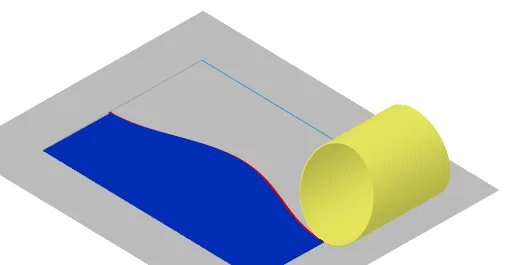
Unfolding of the oblique section of a cylinder
Loading the math board and drawing, please wait…
This example demonstrates the unfolding process of an oblique section of a cylinder, visually showing how the oblique section unfolds into a planar shape. Key mathematical concepts involved include cylinder, polygons, area calculation, rational numbers, straight lines, and incircle. The construction utilizes GeoGebra commands such as Line, OrthogonalPlane, Segment, Rotate, Sequence, Cylinder, Conic, If, Translate, Polygon, and Vector. It is suitable for high school solid geometry teaching, helping students understand the unfolding and reconstruction of spatial geometric bodies and enhancing geometric intuition.
GeoGebra Commands & Parameters
Line(E_1, yAxis) → g_1OrthogonalPlane(E_1, xAxis) → eSegment((0, 0, 0), (h, 0, 0)) → fRotate(e, α, g_1) → e_1Sequence((0, ((i * π) * r / 180), 0), i, 0, 359) → L9Sequence(Rotate[f, i°, Line[M_1, M_2]], i, 0, 359) → LSequence(Intersect[e_1, Element[L, i]], i, 1, 360) → L1Cylinder((0, 0, r), (h, 0, r), r) → b, b_2, b_3, b_4Conic(Element[L1, 1], Element[L1, 91], Element[L1, 181], Element[L1, 271], Element[L1, 330]) → dSequence(Rotate[(0, 0, 0), i°, Line[M_1, M_2]], i, 1, 359) → L2If(Defined[d], Sequence[Segment[Element[L1, i], Element[L2, i]], i, 1, 359]) → L3Sequence(Rotate[(h, 0, 0), i°, Line[M_1, M_2]], i, 1, 359) → L4If(Defined[d], Sequence[Segment[Element[L1, i], Element[L4, i]], i, 1, 359]) → L5Translate(b_3, Vector[(0, abw, 0)]) → gTranslate(Line[M_1, M_2], Vector[(0, abw, 0)]) → jRotate(A, ((((-abw)) / π * 180 / r))°, j) → A'Cylinder(g, (-h)) → i, k, lSegment(A', B) → mSequence(Element[L9, i] + (x(Element[L1, i]), 0, 0), i, 1, 360) → L14Sequence(Element[L14, i], i, 1, o) → L17Sequence(Rotate[E, i°, j], i, 0, 359) → L7Sequence(Translate[Element[L3, i], Vector[Element[L2, i], Element[L7, i]]], i, 1, 360) → L8Sequence(Translate[Element[L3, i], Vector[Element[L2, i], Element[L9, i]]], i, 1, 360) → L10Sequence(Element[L7, i] + (x(Element[L1, i]), 0, 0), i, 1, 360) → L15Sequence(Element[L15, i], i, o + 1, 360) → L16Sequence(Element[L8, i], i, o + 1, 359) → L13If(Defined[d], 1, 0) → defPolygon((-4, -4, 0), (h + 4, -4, 0), (h + 4, ((2 * π) * r) + 4, 0), (-4, ((2 * π) * r) + 4, 0)) → v2, p, q, s, tTranslate(L7, Vector[E, A']) → L7'Sequence(Element[L7', i], i, o + 1, 359) → L6Vector((0, 0, (2 * r) + 1), (a, 0, (2 * r) + 1)) → uVector((a, 0, (2 * r) + 1), (0, 0, (2 * r) + 1)) → vSegment((0, 0, 0), (0, 0, (2 * r) + 1.5)) → cSegment((a, 0, 0), (a, 0, (2 * r) + 1.5)) → f_1Sequence(Element[L10, i], i, 1, o - 1) → L12Segment(D, A) → nSegment((0, 0, 0), D) → h_1Sequence(Translate[Element[L3, i], Vector[Element[L2, i], Element[L9, i]]], i, 1, 360) → l1