
Typical Textbook Applications of Triangle Congruence: Symmetry and Mirror Constr
Loading the math board and drawing, please wait…
In collections
Triangle Congruence
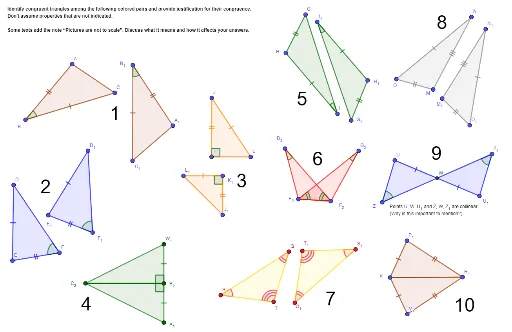
① This GeoGebra example demonstrates typical textbook applications of triangle congruence by using mirror transformations to visually show corresponding relationships between congruent triangles. ② The core mathematical concepts are triangle congruence criteria (SSS, SAS, etc.) and axial symmetry, emphasizing that congruent figures preserve properties under reflection. ③ Construction highlights: Based on the construction summary, the example uses commands such as Polygon, Angle, Mirror, Segment, Midpoint, and Point, creating multiple triangles (e.g., ABC, DEF, GHI) and their mirrored copies (e.g., A_1B_1C_1), with corresponding angles (α, γ) and sides labeled, and text objects (text1) for explanation. ④ It is suitable for middle school geometry teaching or self-study, helping learners understand congruence criteria and the role of symmetry in geometric proofs.
GeoGebra Commands & Parameters
Polygon(A, B, C) → t1, c, a, bAngle(C, B, A) → αPolygon(A_1, B_1, C_1) → t1_1, c_1, a_1, b_1Angle(C_1, B_1, A_1) → α_1Polygon(D, E, F) → t2, f, d, eAngle(D, F, E) → γPolygon(D_1, E_1, F_1) → t2_1, f_1, d_1, e_1Angle(D_1, F_1, E_1) → γ_1Polygon(G, H, I) → t3, i, g, hAngle(G, I, H) → βPolygon(G_1, H_1, I_1) → t3_1, i_1, g_1, h_1Angle(G_1, I_1, H_1) → β_1Polygon(J, K, L) → t4, l, j, kAngle(L, K, J) → δPolygon(J_1, K_1, L_1) → t4_1, l_1, j_1, k_1Angle(L_1, K_1, J_1) → δ_1Polygon(M, N, O) → t5, o, m, nPolygon(M_1, N_2, O_1) → t5_1, o_1, m_1, n_1Mirror(M_1, n_1) → PMirror(N_2, n_1) → N_1Mirror(O_1, n_1) → RPolygon(P, N_1, R) → t6, r, p, qPolygon(Q, S, T) → t7, t, q_1, sAngle(Q, T, S) → εAngle(S, Q, T) → ζAngle(T, S, Q) → ηPolygon(Q_1, S_1, T_1) → t7_1, t_1, q_2, s_1Angle(Q_1, T_1, S_1) → ε_1Angle(S_1, Q_1, T_1) → ζ_1Angle(T_1, S_1, Q_1) → η_1Segment(U, U_1) → p_1Midpoint(p_1) → WPolygon(U, Z, W) → t8, w, u, z_1Mirror(U, W) → U'Mirror(Z, W) → Z_1Mirror(W, W) → W'Polygon(U', Z_1, W') → t8', w', u', z'Angle(W, Z, U) → θAngle(W, Z_1, U_1) → ιPolygon(V, P_1, R_1) → t9, r_1, v, f_2Mirror(P_1, f_2) → V_1Polygon(V, V_1, R_1) → t10, g_2, v_1, h_2Segment(W_1, A_2) → i_2Point(i_2) → B_2Segment(B_2, C_2) → j_2Polygon(C_2, B_2, W_1) → t11, w_1, c_2, b_2Polygon(C_2, A_2, B_2) → t12, k_2, l_2, a_2Angle(C_2, B_2, A_2) → λAngle(W_1, B_2, C_2) → κPolygon(D_2, E_2, F_2) → t13, m_2, d_2, e_2Polygon(E_2, F_2, G_2) → t14, n_2, p_2, r_2Angle(F_2, E_2, G_2) → μAngle(D_2, F_2, E_2) → νAngle(E_2, D_2, F_2) → ξAngle(E_2, G_2, F_2) → ο
AI Drawing Prompt Reference
Draw a set of geometric figures demonstrating triangle congruence and axial symmetry. First, create several triangles, each with a line of symmetry, and reflect each across that line to form mirror images, ensuring corresponding angles and sides are equal. Then, construct a triangle using a segment's midpoint and endpoints, and mirror it across the midpoint line to create a symmetric pair. Next, draw a triangle and reflect one vertex across one of its sides to form a new triangle. Finally, on a segment, choose a point and connect it to the segment's endpoints to form two triangles, labeling one angle. Clearly mark all corresponding angles and sides to show congruence.
The prompt above was compiled from the original drawing commands and is for reference only.