
Triple Cylinder Screw
Loading the math board and drawing, please wait…
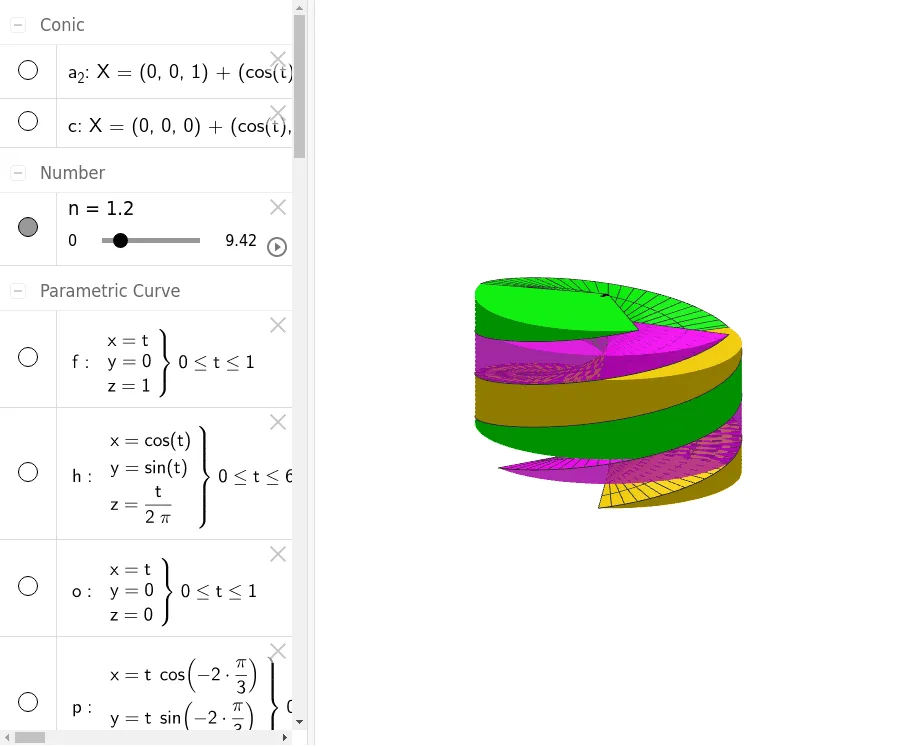
This example demonstrates the construction of a triple cylinder screw. Key mathematical concepts include cylinders, vectors, and 3D geometry. Using GeoGebra commands such as Intersect, Circle, Surface, and Rotate, the triple cylinder screw can be constructed. Suitable for high school mathematics education and learning 3D geometry.
GeoGebra Commands & Parameters
Intersect(yAxis, zAxis) → ACircle(A, 1, zAxis) → cCylinder(c, 1) → a, a_2, a_3Surface((u * cos(t)), (u * sin(t)), t / ((2 * π)), t, 0, (2 * π), u, 0, 1) → bRotate(b, (2 * π / 3)) → dRotate(b, (4 * π / 3)) → eCurveCartesian(t, 0, 1, t, 0, 1) → fSurface(f, (2 * π / 3), zAxis) → gCurveCartesian(cos(t), sin(t), t / ((2 * π)), t, 0, (2 * π)) → hSurface(h, (2 * π / 3), zAxis) → iRotate(i, (2 * π / 3)) → i'Rotate(i, (4 * π / 3)) → i'_1Translate(Rotate[g, n, zAxis], Vector[(0, 0, n / ((2 * π)))]) → jTranslate(Rotate[i, n, zAxis], Vector[(0, 0, n / ((2 * π)))]) → kTranslate(Rotate[d, n, zAxis], Vector[(0, 0, n / ((2 * π)))]) → lTranslate(Rotate[Rotate[d, (4 * π / 3), zAxis], n, zAxis], Vector[(0, 0, n / ((2 * π)))]) → mCurveCartesian(t, 0, 0, t, 0, 1) → oCurveCartesian((t * cos((-2 * π / 3))), (t * sin((-2 * π / 3))), 0, t, 0, 1) → pSurface(p, (2 * π / 3), zAxis) → qTranslate(Rotate[q, (-n), zAxis], Vector[(0, 0, ((-n)) / ((2 * π)))]) → rTranslate(Rotate[i'_1, (-n), zAxis], Vector[(0, 0, ((-n)) / ((2 * π)))]) → sTranslate(Rotate[Rotate[d, (4 * π / 3), zAxis], (-n), zAxis], Vector[(0, 0, ((-n)) / ((2 * π)))]) → tTranslate(Rotate[Rotate[d, (2 * π / 3), zAxis], (-n), zAxis], Vector[(0, 0, ((-n)) / ((2 * π)))]) → uTranslate(r, Vector[(0, 0, 1)]) → r'Translate(j, Vector[(0, 0, -1)]) → j'Surface(CurveCartesian[(t * cos((2 * π / 3))), (t * sin((2 * π / 3))), 1, t, 0, 1], (2 * π / 3), zAxis) → vTranslate(v, Vector[(0, 0, -1)]) → v'