
Tube Surface at a Fixed Distance from a 3D Curve
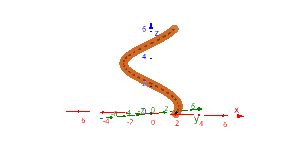
Loading the math board and drawing, please wait…
This example demonstrates how to construct a tube (a 3D surface) at a fixed distance from a given space curve, showing the resulting offset geometry around the curve (outer/inner sides depending on the chosen direction). The key math concepts are 3D vector geometry, parametric representation of curves, derivatives for extracting geometric direction information (tangent/normal-related vectors), and generating offset surfaces via a prescribed distance. Construction highlights in GeoGebra: Derivative is used to compute derivatives of the curve’s Cartesian components (fx, fy, fz → dfx, dfy, dfz), which then feed into direction/offset computations involving vector quantities (e.g., vx, vy, vz and related intermediate objects such as dvy, dvz, dvx, ldv/ldf, ux/uy/uz, and wx/wy/wz). The space curve itself is created with CurveCartesian, and the resulting tube surface is built with Surface. Parameters such as the distance (dis), the parameter interval (from/to), and user inputs (InputBox1–InputBox6, a/b/c/d) control the extent and radius of the tube. Suitable for advanced high school/early university learners studying 3D analytic geometry, vector calculus intuition, and geometric modeling.
GeoGebra Commands & Parameters
Derivative(fx) → dfxDerivative(fy) → dfyDerivative(fz) → dfzTextfield(fx) → InputBox1Textfield(fy) → InputBox2Textfield(fz) → InputBox3Textfield(dis) → InputBox4Textfield(from) → InputBox5Textfield(to) → InputBox6Surface(fx(t) + (dis * ((cos(an) * vx(t)) + (sin(an) * wx(t)))), fy(t) + (dis * ((cos(an) * vy(t)) + (sin(an) * wy(t)))), fz(t) + (dis * ((cos(an) * vz(t)) + (sin(an) * wz(t)))), t, from, to, an, 0, (2 * pi)) → aCurveCartesian(fx(t), fy(t), fz(t), t, from, to) → b
AI Drawing Prompt Reference
Draw a space curve and then create a tube surface at a fixed distance around it. First, input the parametric equation of the curve, then input the distance, parameter interval, and direction angle. Use the curve's derivative to compute direction vectors and construct the tube surface based on these vectors and the given distance.
The prompt above was compiled from the original drawing commands and is for reference only.