
Geometric Meaning of the Derivative via Tangent Slope
Loading the math board and drawing, please wait…
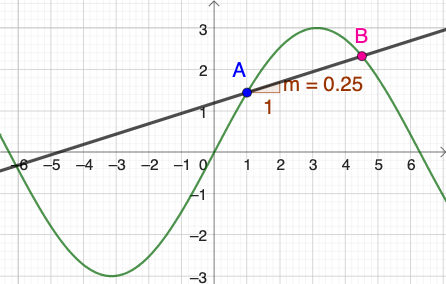
This example demonstrates the geometric idea that the derivative is the slope of the tangent line at a given point on a function’s graph, turning the notion of instantaneous rate of change into an interpretable geometry problem. It centers on concepts such as derivative, tangent line slope, and the relationship between a function and a line determined by selected points or parameters. The construction (from the provided GeoGebra summary) uses Point to define key points (including those associated with f, A, and B), Line to create relevant straight lines (such as g and h), If to apply conditional logic for choosing or updating constructions depending on the configuration, and Slope to compute the slope values (m and m_1) of the lines. This makes it suitable for students learning calculus and function graph analysis in high school through the first year of college, especially for visual, interactive understanding of tangent lines and derivatives.
GeoGebra Commands & Parameters
Point(f) → APoint(f) → BLine(A, B) → gIf(A ≟ B, Tangent[A, f]) → hSlope(g) → mSlope(h) → m_1
AI Drawing Prompt Reference
Draw a function graph and mark two key points A and B. Connect A and B to form line g, and draw the tangent line h at point A. Calculate the slopes m and m_1 of lines g and h to illustrate the geometric meaning of the derivative.
The prompt above was compiled from the original drawing commands and is for reference only.