
Transformations: Mapping Rectangles onto Rectangles
Loading the math board and drawing, please wait…
In collections
Congruence (CO) Cluster
Congruence (Vol 1)
Congruence (Vol 1) Over 80 Resources
CCSS High School: Geometry (Congruence) Volume 1 S N ATTAR
Geometry (Congruence) Volume 1
CCSS High School: Geometry (Congruence) Volume 1
CCSS High School: Geometry (Congruence) Volume 1
CCSS High School: Geometry (Congruence) Volume 1
CCSS High School: Geometry (Congruence) Volume 1
CCSS High School: Geometry (Congruence) Volume 1
CCSS High School: Geometry (Congruence) Volume 1
CCSS High School: Geometry (Congruence) Volume 1
CCSS High School: Geometry (Congruence) Volume 1
CCSS High School: Geometry (Congruence) Volume 1
CCSS High School: Geometry (Congruence) Volume 1
CCSS High School: Geometry (Congruence) Volume 1
GCSE Higher Ch8 Transformations & Constructions
CCSS High School: Geometry (Congruence) Volume 1
Transformations! (Geometry)
Transformations/Symmetry
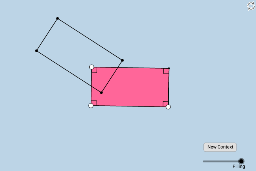
This example demonstrates how to map one rectangle onto another using geometric transformations. Key mathematical concepts include geometric transformations, linear equations, and vectors. Using GeoGebra commands such as Random, Line, Rotate, and Translate, the transformation process can be constructed. Suitable for students at the junior high school level and above to learn about geometric transformations and related concepts.
GeoGebra Commands & Parameters
Random(1, 359) → pLine(A, B) → fOrthogonalLine(A, f) → gPoint(g) → CRay(A, C) → iPoint(i) → DOrthogonalLine(D, i) → jOrthogonalLine(B, f) → hIntersect(h, j) → ESegment(E, D) → mMidpoint(m) → HSegment(A, B) → kMidpoint(k) → IMidpoint(H, I) → JRandom(-3, 3) → cRandom(-4, 4) → oPolygon(A, B, E, D) → poly1, a, b, e, dSegment(B, E) → lSegment(D, A) → nAngle(poly1) → α, β, γ, δRotate(A, (p * π / 180), J) → A'Rotate(B, (p * π / 180), J) → B'Rotate(E, (p * π / 180), J) → E'Rotate(D, (p * π / 180), J) → D'Polygon(A', B', E', D') → poly1', a', b', e', d'Vector(J, (x(J) + (sqrt(c^(2) + o^(2)) * cos((p * π / 180))), y(J) + (sqrt(c^(2) + o^(2)) * sin((p * π / 180))))) → uTranslate(A', u) → A''Translate(B', u) → B''Translate(E', u) → E''Translate(D', u) → D''Polygon(A'', B'', E'', D'') → poly1'', a'', b'', e'', d''Segment(D'', E'') → qSegment(E'', B'') → rSegment(B'', A'') → sSegment(A'', D'') → t