
Torus–Sphere Relation Theorem: Parameterized 3D Surfaces and Symmetry
Loading the math board and drawing, please wait…
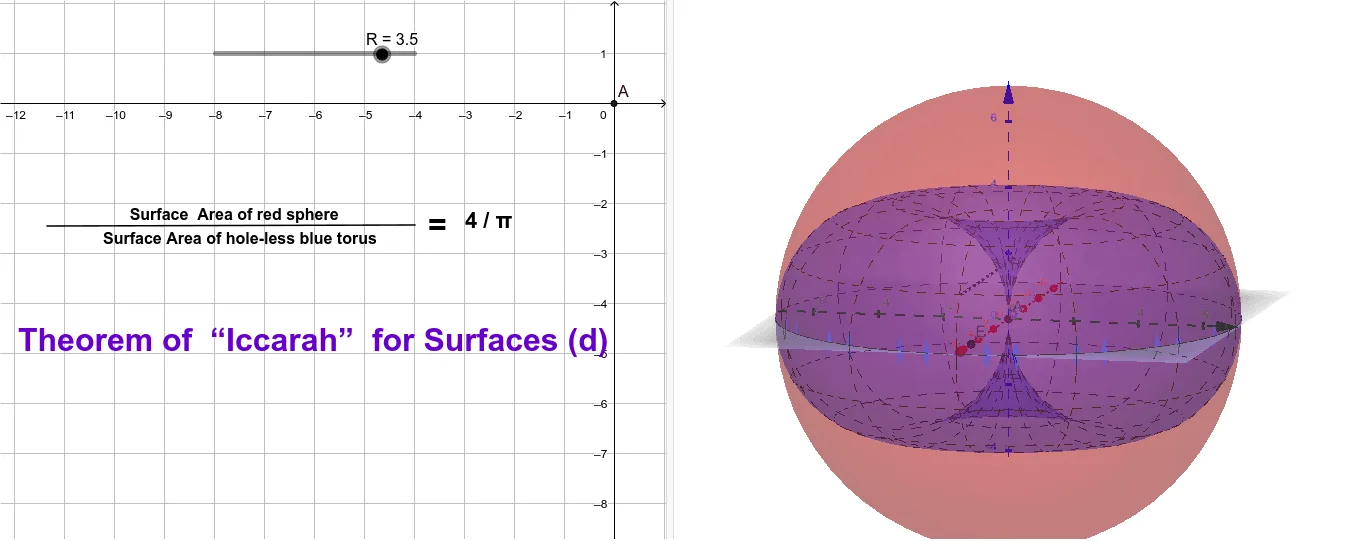
This example demonstrates a geometric theorem linking a torus-related surface to a sphere by visually verifying their spatial correspondence through intersection conditions. Key mathematical ideas include 3D surfaces (Surface), spheres (Sphere), intersection computation (Intersect), parameterized angles (e.g., theta and phi), and the role of symmetry and geometric transformation in establishing a consistent relationship. Construction focuses on creating the relevant surface(s) and the sphere in 3D, then using Intersect to compute intersection points/curves. Point objects are used to mark critical locations, while Segment supports connecting constructed geometric elements. Parameter and intermediate quantities such as A, E, F, G, b, heta, phi, a, D, H, and f organize the theorem’s relationship, and text objects (text1–text4) clarify the displayed mathematical meaning. Suitable for advanced high school and early university students studying solid geometry, parametric surfaces, and intersection geometry with visualization in GeoGebra.
GeoGebra Commands & Parameters
Intersect(zAxis, yAxis) → APoint(xAxis) → ESurface((sin(theta) * (R + (R * cos(phi)))), (cos(theta) * (R + (R * cos(phi)))), (R * sin(phi)), theta, 0, theta1, phi, 0, phi1) → bSphere(A, (2 * R)) → aSegment(D, H) → f
AI Drawing Prompt Reference
Draw a sphere and a torus in 3D space. Define the sphere by a point and the torus by parameters theta and phi. Connect the two surfaces, mark key points, and show their symmetry.
The prompt above was compiled from the original drawing commands and is for reference only.