
Toblerone Modeling Question for Algebra, Geometry, and Calculus
Loading the math board and drawing, please wait…
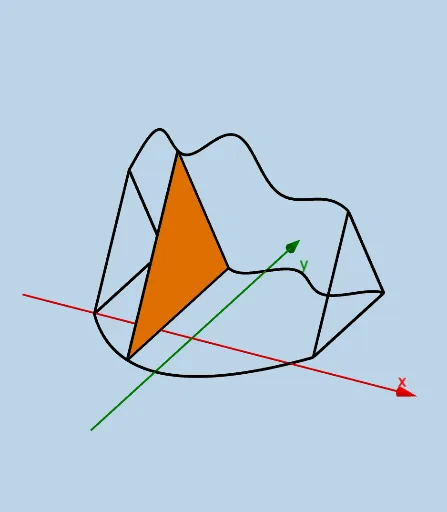
This example uses Toblerone chocolate bars to model geometric concepts, covering algebra, geometry, and calculus. It involves equilateral triangles, prisms, volume, tangent functions, and natural numbers. Using GeoGebra commands such as Segment, Intersect, and Polygon, students can explore these concepts. Suitable for high school and above students for geometric modeling and mathematical exploration.
GeoGebra Commands & Parameters
Segment(H, I) → s_1Midpoint(s_1) → ESegment(J, K) → q_1Midpoint(q_1) → FIntersect(upper, h, (-2.3, 9.25429478782328)) → BIntersect(lower, h, (-2.3, -4.471)) → CSegment(C, B) → qIntersect(upper, q, (-2.2999999999999994, 9.25429478782328)) → GMidpoint(C, G) → TLine(B, D) → iSphere(B, d) → eSegment(C, B) → pPolygon(C, G, U) → q1, f_1, g_1, n_1Polygon(K, J, W) → q2, l, m, nPolygon(Q, P, V) → q3, r, s, tTextfield(upper) → InputBox1Textfield(lower) → InputBox2Textfield(a) → InputBox3Textfield(b) → InputBox4Segment(K, W) → fSegment(W, J) → gSegment(Q, V) → jSegment(V, P) → kCurveCartesian(t, (0.5 * (upper(t) + lower(t))), ((sqrt(3) * 1 / 2) * (upper(t) - lower(t))), t, a, b) → cSurface(u, ((1 - v) * lower(u)) + ((0.5 * v) * (lower(u) + upper(u))), (sqrt(3) / 2 * (v * (upper(u) - lower(u)))), u, a, b, v, 0, 1) → oSurface(u, (v * upper(u)) + (((1 - v) * 0.5) * (lower(u) + upper(u))), (((sqrt(3) * 0.5) * (1 - v)) * (upper(u) - lower(u))), u, a, b, v, 0, 1) → uSegment(C, U) → i_1Segment(U, G) → j_1Segment(C, G) → k_1
AI Drawing Prompt Reference
Create a geometric model using various shapes including equilateral triangles, prisms, and surfaces. Start by drawing two line segments and finding their midpoints, then use these points and intersections of two curves to construct new line segments. Next, form multiple polygons using these segments and points, and add text fields to display relevant data. Finally, draw curves and surfaces defined by parametric equations to illustrate geometric and calculus concepts.
The prompt above was compiled from the original drawing commands and is for reference only.