
Third Egg: Surface Construction with Geometric Mean and Poisson Distribution
Loading the math board and drawing, please wait…
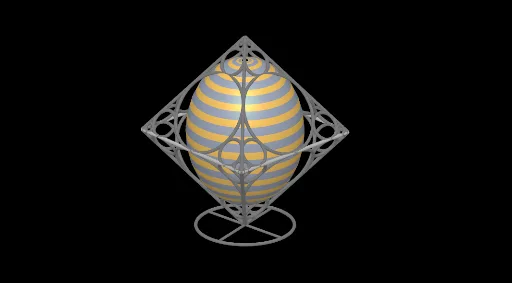
① This GeoGebra example constructs a 3D surface named 'Third egg', demonstrating how to create an egg-like solid using geometric mean, multiplication, and Poisson distribution-related mathematical relationships. ② Core mathematical concepts include geometric mean, multiplication, Poisson distribution, parametric surfaces, equations, and means. ③ Construction highlights: from the summary, commands such as Sequence, Circle, Distance, Surface, Line, Mirror, Segment, and Point are used, with many objects (A, C, B, D, E, F, liste, G, I, c, A1, B1, C1, etc.) defined to generate point sequences and build the surface, possibly using mirror and segment for symmetry. ④ Suitable for advanced high school to university courses on 3D geometry, parametric surfaces, probability distributions combined with geometric means, and mathematical visualization or modeling.
GeoGebra Commands & Parameters
Sequence(Segment[Element[liste, k], Element[liste, k + 1]], k, 1, 6) → liste11Sequence(Segment[E, Element[liste, k]], k, 1, 4) → liste12Sequence(Segment[F, Element[liste, k]], k, 1, 4) → liste13Circle(G, 0.8164965809277259, Vector[(0, 0), G]) → cSequence(Translate[Dilate[c, (1 / 3)^(k), G], Vector[(Sum[Sequence[(2 / 3 * (1 / 3)^(i - 1)), i, 1, k]] * Vector[G, A])]], k, 1, 3) → liste1Sequence(Translate[Dilate[c, (1 / 3)^(k), G], Vector[(Sum[Sequence[(2 / 3 * (1 / 3)^(i - 1)), i, 1, k]] * Vector[G, E])]], k, 1, 3) → liste2Sequence(Translate[Dilate[c, (1 / 3)^(k), G], Vector[(Sum[Sequence[(2 / 3 * (1 / 3)^(i - 1)), i, 1, k]] * Vector[G, B])]], k, 1, 3) → liste3Sequence(ApplyMatrix[Z^(k), {c, liste1, liste2, liste3}], k, 1, 3) → liste4Sequence(ApplyMatrix[Z^(k), ApplyMatrix[O, {c, liste1, liste2, liste3}]], k, 1, 4) → liste5Distance(G, (0, 0, 0)) → rSequence(CurveCartesian[f(α, β), g(α, β), h(α, β), α, -3.14159, 3.141592653589793], β, 0, 3.141592653589793, 0.15707963267948966) → liste7Sequence(CurveCartesian[f(α, β), g(α, β), h(α, β), β, -3.14159, 3.141592653589793], α, 0, 3.141592653589793, 0.15707963267948966) → liste6Surface(f(α, β), g(α, β), (1.3 * h(α, β)), α, 0, 6.28319, β, 0, 3.141592653589793) → aSurface(f(α, β), g(α, β), (1.3 * h(α, β)), α, 0, 6.28319, β, 0, 3.041592653589793) → bLine(E, F) → dCircle(d, F) → eCircle(d, H) → kMirror(H, F) → H'Segment(H', H) → iPoint(k) → KSegment(F, K) → jMirror(K, F) → K'Point(liste13) → LSegment(F, K') → l
AI Drawing Prompt Reference
Create a 3D surface named 'Third Egg' demonstrating how to construct an egg-like solid using geometric mean, multiplication, and Poisson distribution-related mathematical relationships. Focus on core concepts like geometric mean, multiplication, Poisson distribution, parametric surfaces, equations, and means. Start by constructing segments and circles, then build symmetric structures using mirrors and segments, generate point sequences with geometric mean and multiplication, and finally transform these sequences into a parametric surface to form the egg shape.
The prompt above was compiled from the original drawing commands and is for reference only.