
The Relationship of a Cylinder's Volume and Height
Loading the math board and drawing, please wait…
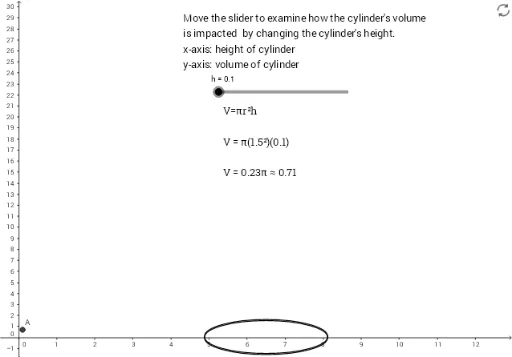
This example demonstrates the relationship between a cylinder's volume and its height. Key mathematical concepts include the volume formula of a cylinder and geometric construction. Using GeoGebra commands such as Ellipse, Line, Intersect, Point, Segment, Circle, OrthogonalLine, Vector, and Translate, the example dynamically shows how the volume of a cylinder changes with its height. Suitable for students at the middle school level and above, particularly for geometry and calculus studies.
GeoGebra Commands & Parameters
Ellipse(G, H, I) → dLine(G, H) → lIntersect(d, l, 2) → JIntersect(d, l, 1) → KPoint(Circle[J, h]) → LSegment(J, L) → mCircle(J, L) → eOrthogonalLine(J, m) → nIntersect(e, n) → M, NVector(J, N) → uVector(J, N) → vTranslate(d, v) → d'Translate(K, v) → K'Segment(N, J) → fSegment(K', K) → g
AI Drawing Prompt Reference
Draw an ellipse as the base of a cylinder, and draw its major axis line. This line intersects the ellipse at two points; choose one as a base vertex. With this vertex as center, draw a circle with radius equal to the cylinder's height. Pick a point on the circle, connect it to the center to form a segment, and draw a perpendicular line through the center to this segment. The perpendicular intersects the circle at two points; choose one, create a vector from the center to this point, and translate the entire ellipse and the other base intersection point by this vector. Finally, connect the center to the perpendicular intersection point, and connect the translated point to the original base vertex, forming the cylinder's lateral edges.
The prompt above was compiled from the original drawing commands and is for reference only.