
Exploring Similar Volumes
Loading the math board and drawing, please wait…
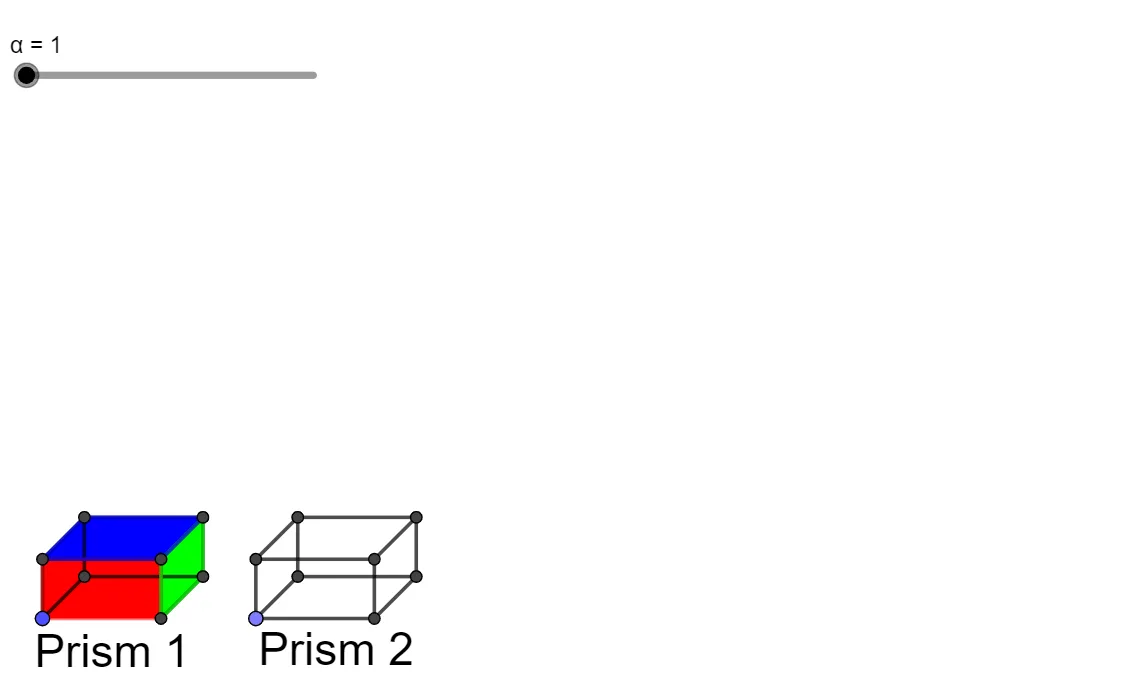
This example demonstrates the relationship between volumes of similar figures. It involves key mathematical concepts such as similarity transformation and volume calculation. Using GeoGebra commands like Circle, Intersect, Segment, and OrthogonalLine, similar prisms and cylinders are constructed and their volume changes are observed. Suitable for middle and high school students learning geometry and volume calculations.
GeoGebra Commands & Parameters
Circle(A, 2) → cIntersect(c, f, 2) → BSegment(A, B) → gCircle(B, 1) → dOrthogonalLine(B, g) → hOrthogonalLine(A, f) → iIntersect(d, h, 2) → CRotate(C, (-(45°)), B) → C'OrthogonalLine(C, h) → jSegment(B, C') → kLine(C, k) → lLine(A, k) → mIntersect(i, j) → DLine(D, m) → nLine(C', h) → pLine(C', f) → qIntersect(m, q) → ESegment(E, A) → rSegment(E, C') → sIntersect(l, p) → FLine(F, q) → tIntersect(n, t) → GLine(G, i) → bSegment(F, C') → eSegment(F, C) → f_1Segment(C, B) → g_1Segment(C, D) → h_1Segment(D, A) → i_1Segment(G, E) → j_1Segment(G, D) → k_1Segment(G, F) → l_1Point(f) → HCircle(H, (g * a)) → c_1Intersect(c_1, f, 2) → ISegment(H, I) → m_1Circle(I, (k * a)) → d_1OrthogonalLine(I, f) → n_1OrthogonalLine(H, f) → p_1Intersect(d_1, n_1, 2) → JOrthogonalLine(J, n_1) → q_1Intersect(p_1, q_1) → KSegment(H, K) → r_1Segment(K, J) → s_1Segment(I, J) → t_1Rotate(J, (-(45°)), I) → J'Segment(I, J') → a_1Line(J', t_1) → b_1Line(J, a_1) → e_1Line(K, e_1) → f_2Line(H, e_1) → g_2Line(J', m_1) → h_2Intersect(b_1, e_1) → LLine(L, h_2) → i_2Intersect(g_2, h_2) → MIntersect(f_2, i_2) → NSegment(M, N) → j_2Segment(N, L) → k_2Segment(J, L) → l_2Segment(L, J') → m_2Segment(K, N) → n_2Segment(H, M) → p_2Segment(M, J') → q_2Polygon(D, C, B, A) → q1, d_2, c_2, b_2, a_2Polygon(C, F, C', B) → q2, c_3, f_3, c', b_3Polygon(C, F, G, D) → q3, c_4, f_4, g_3, d_3
AI Drawing Prompt Reference
To draw a geometric figure demonstrating the relationship between similar volumes. The figure includes two similar prisms and cylinders, connected through similarity transformations. Key objects are these prisms and cylinders, along with their volume change relationships. The construction order starts with circles, then intersecting line segments, followed by vertical lines, and finally through rotation and intersections to obtain similar shapes. The overall aim is to help students understand geometry and volume calculations.
The prompt above was compiled from the original drawing commands and is for reference only.