
Area of a Circle by Anthony Dove
Loading the math board and drawing, please wait…
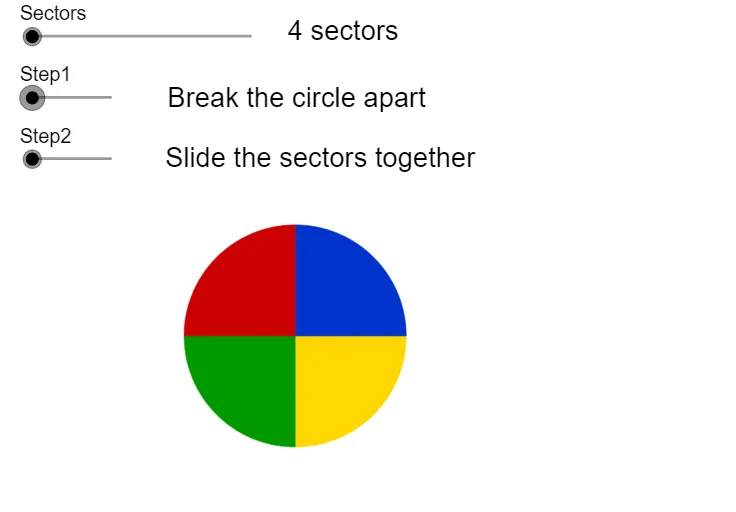
This example demonstrates how to calculate the area of a circle using geometric construction. Key mathematical concepts include the properties of circles and the area formula. It utilizes commands such as Sequence, Point, OrthogonalLine, Mirror, Intersect, Vector, If, Segment, Line, and Polygon in GeoGebra. Suitable for middle school and above students learning geometry and area calculation.
GeoGebra Commands & Parameters
Sequence((((2 * i) - 1) * a), i, 1, n) → anglesSequence(Vector[(d * Vector[(cos((-Element[angles, i])), sin((-Element[angles, i])))])], i, 1, n) → vectorsSequence(Midpoint[Cell[2, i], Cell[2, 1 + i]], i, 1, n) → midpointsSequence(Intersect[Circle[Cell[2, i], 1], OrthogonalLine[Element[midpoints, i], Line[Cell[2, i], Cell[2, 1 + i]]]], i, 1, n) → lowpointsSequence(Mirror[Element[lowpoints, i], yAxis], i, 1, n) → lowpoints2Sequence(Midpoint[Cell[3, i], Cell[3, 1 + i]], i, 1, n) → midpointsDownSequence(Intersect[Circle[Cell[3, i], 1], OrthogonalLine[Element[midpointsDown, i], Line[Cell[3, i], Cell[3, 1 + i]]]], i, 1, n) → uppointsSequence(Mirror[Element[uppoints, i], yAxis], i, 1, n) → uppoints2Point(yAxis) → BOrthogonalLine(B, yAxis) → gPoint(g) → CMirror(C, yAxis) → C'Point(h) → DMirror(D, (-2, -0.5)) → D'Intersect(b, xAxis) → EIntersect(c, h) → FIntersect(e, g) → GIntersect(g, f) → HVector(D', I) → uVector(D, F) → vSequence(CircleSector[Element[uppoints, i], Cell[3, 1 + i], Cell[3, i]], i, 1, n, 2) → sectorsDown1Sequence(CircleSector[Element[uppoints2, i], Mirror[Cell[3, i], yAxis], Mirror[Cell[3, 1 + i], yAxis]], i, 1, n, 2) → sectorsDown3Sequence(CircleSector[Element[lowpoints, i], Cell[2, 1 + i], Cell[2, i]], i, 1, n, 2) → sectors1Sequence(CircleSector[Element[lowpoints2, i] + ((2 * x(A)), 0), Mirror[Cell[2, i], yAxis] + ((2 * x(A)), 0), Mirror[Cell[2, 1 + i], yAxis] + ((2 * x(A)), 0)], i, 1, n, 2) → sectors3Sequence(CircleSector[Element[lowpoints, i], Cell[2, 1 + i], Cell[2, i]], i, 2, n, 2) → sectors2Sequence(CircleSector[Element[lowpoints2, i] + ((2 * x(A)), 0), Mirror[Cell[2, i], yAxis] + ((2 * x(A)), 0), Mirror[Cell[2, 1 + i], yAxis] + ((2 * x(A)), 0)], i, 2, n, 2) → sectors4Sequence(CircleSector[Element[uppoints, i], Cell[3, 1 + i], Cell[3, i]], i, 2, n, 2) → sectorsDown2Sequence(CircleSector[Element[uppoints2, i], Mirror[Cell[3, i], yAxis], Mirror[Cell[3, 1 + i], yAxis]], i, 2, n, 2) → sectorsDown4If(n ≟ 1, (-0.518, -0.123), If[n ≟ 2, (-1.14, -0.087), If[n ≟ 3, (-1.289, -0.0015), If[n ≟ 4, (-1.38, 0), If[n ≟ 5, (-1.41, 0), If[n ≟ 6, (-1.44, 0), If[n ≟ 7, (-1.46, 0), If[n ≟ 8, (-1.48, 0), If[n ≟ 9, (-1.495, 0), If[n ≟ 10, (-1.505, 0), If[n ≟ 11, (-1.51, 0), If[n ≟ 12, (-1.52, 0), If[n ≟ 13, (-1.523, 0), If[n ≟ 14, (-1.527, 0), If[n ≟ 15, (-1.531, 0), If[n ≟ 16, (-1.535, 0), If[n ≟ 17, (-1.54, 0), If[n ≟ 18, (-1.543, 0), If[n ≟ 19, (-1.546, 0), (-1.55, 0)]]]]]]]]]]]]]]]]]]) → KIf(n ≟ 1, (-1.423, -1), If[n ≟ 2, (-1.539, -1), If[n ≟ 3, (-1.56, -1), (-1.575, -1)]]) → LSegment(K, L) → lLine(L, q) → kIf(n ≟ 1, (1.407, -1), If[n ≟ 2, (1.52, -1), If[n ≟ 3, (1.56, -1), (1.571, -1)]]) → JLine(J, l) → mIntersect(q, m) → MVector(O, P) → pVector(Q, R) → wPolygon(K, M, J, L) → q1, k_1, m_1, j_1, l_1
AI Drawing Prompt Reference
Draw a geometric construction diagram containing circles, points, line segments, and sectors. The diagram includes circles that intersect to form points, which are mirrored to the y-axis, and then connected to line segments and sectors. The construction order is: first draw circles, then intersect to get points, mirror points, and finally draw line segments and sectors. The diagram illustrates the method of calculating the area of a circle.
The prompt above was compiled from the original drawing commands and is for reference only.