
Thales and the Pyramids
Loading the math board and drawing, please wait…
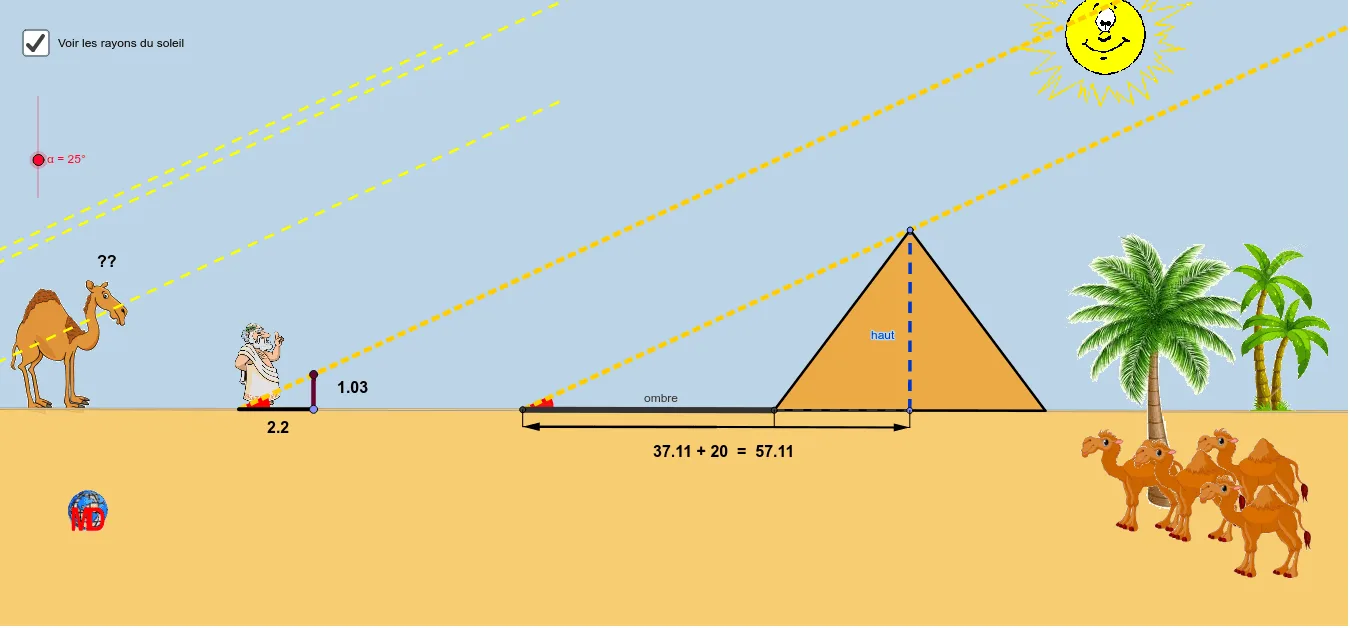
This example demonstrates how Thales measured the height of the pyramids using geometric methods. It involves core math concepts like geometric construction, similar triangles, vectors, and coordinate geometry. Construction highlights include commands/objects like Line, Point, Segment, Vector, OrthogonalLine, Rotate, Angle, Intersect, Ray, Translate, Midpoint, Polygon, Circle from GeoGebra. Suitable for high school and above learning geometric proofs and real-world applications.
GeoGebra Commands & Parameters
Line(A, B) → aPoint(a) → CPoint(a) → DSegment(C, D) → bPoint(b) → FVector(F1, I1) → vPoint(b) → EOrthogonalLine(E, a) → cPoint(c) → GOrthogonalLine(F, a) → dSegment(E, G) → hautPoint(d) → HSegment(F, H) → personaLine(H, a) → eLine(G, a) → fPoint(e) → IPoint(f) → JRotate(I, α, H) → KAngle(I, H, K) → βRotate(J, α, G) → LAngle(J, G, L) → γLine(G, L) → gLine(H, K) → hPoint(haut) → MPoint(haut) → NPoint(haut) → OPoint(haut) → PLine(M, g) → iLine(N, i) → jLine(O, j) → kLine(P, k) → lLine(B, haut) → mIntersect(g, a) → UIntersect(h, a) → VRay(V, H) → sRay(U, G) → tSegment(E, U) → a1Segment(F, V) → b1Vector(F1, C1) → uTranslate(E, u) → E1Translate(G, u) → D1Translate(H, v) → H1Translate(F, v) → G1Angle(F, V, H) → δAngle(E, U, G) → εMidpoint(b1) → J1Midpoint(a1) → K1Midpoint(persona) → L1Midpoint(haut) → M1Line(R, s) → pLine(Q, s) → qIntersect(a, p) → SIntersect(q, a) → TLine(N1, t) → rIntersect(r, a) → O1Segment(Q, T) → c1Segment(R, S) → d1Segment(N1, O1) → e1Intersect(a, xAxis) → P1Line(G, a) → f1Point(f1) → Q1Point(a) → A1Point(a) → B1Polygon(A1, B1, S1, T1) → poly1, a1_1, b1_1, s1, t1Circle(D, 4) → k1Intersect(k1, a1_1) → W1, Z1Polygon(G, Z1, W1) → poly2, w1, g_1, z1Segment(W1, U) → h1Polygon(G, W1, Z1) → poly3, z1_1, g_2, w1_1Point(t) → U1Segment(W1, D) → g1Point(a1_1) → A_1Midpoint(D_1, C_1) → E_1Vector(E_1, C_1) → zVector(E_1, D_1) → u_1Segment(D_1, C_1) → a_1Segment(U, D_1) → b_1Segment(W1, F_1) → c_1Segment(D, C_1) → d_1