
Surfaces of Revolution: Helical Cross Section
Loading the math board and drawing, please wait…
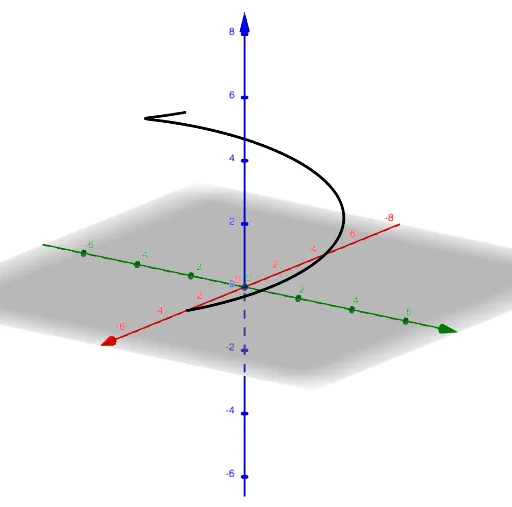
This example demonstrates how to generate a surface of revolution by rotating a helical curve. Key math concepts include surfaces of revolution, parametric equations, 3D geometry, and calculus. The construction uses GeoGebra's Curve (Cartesian), Surface, and Rotate commands, with sliders a and n controlling the helix shape and rotation angle, and slider b controlling the rotation radius. Suitable for high school and above students to understand the formation process and mathematical principles of surfaces of revolution.
GeoGebra Commands & Parameters
CurveCartesian((3 * cos(t)), (3 * sin(t)), t, t, 0, (2 * π)) → aSurface(a, n, zAxis) → bRotate(a, n, zAxis) → a'
AI Drawing Prompt Reference
Create a surface of revolution generated by rotating a helical curve with parametric equations x=3cos(t), y=3sin(t), z=t for t ranging from 0 to 2π. Use sliders to control the shape of the helix, the rotation angle, and the radius of rotation. The final image should display the solid formed by rotating the helix, illustrating the process and mathematical principles of surface of revolution.
The prompt above was compiled from the original drawing commands and is for reference only.